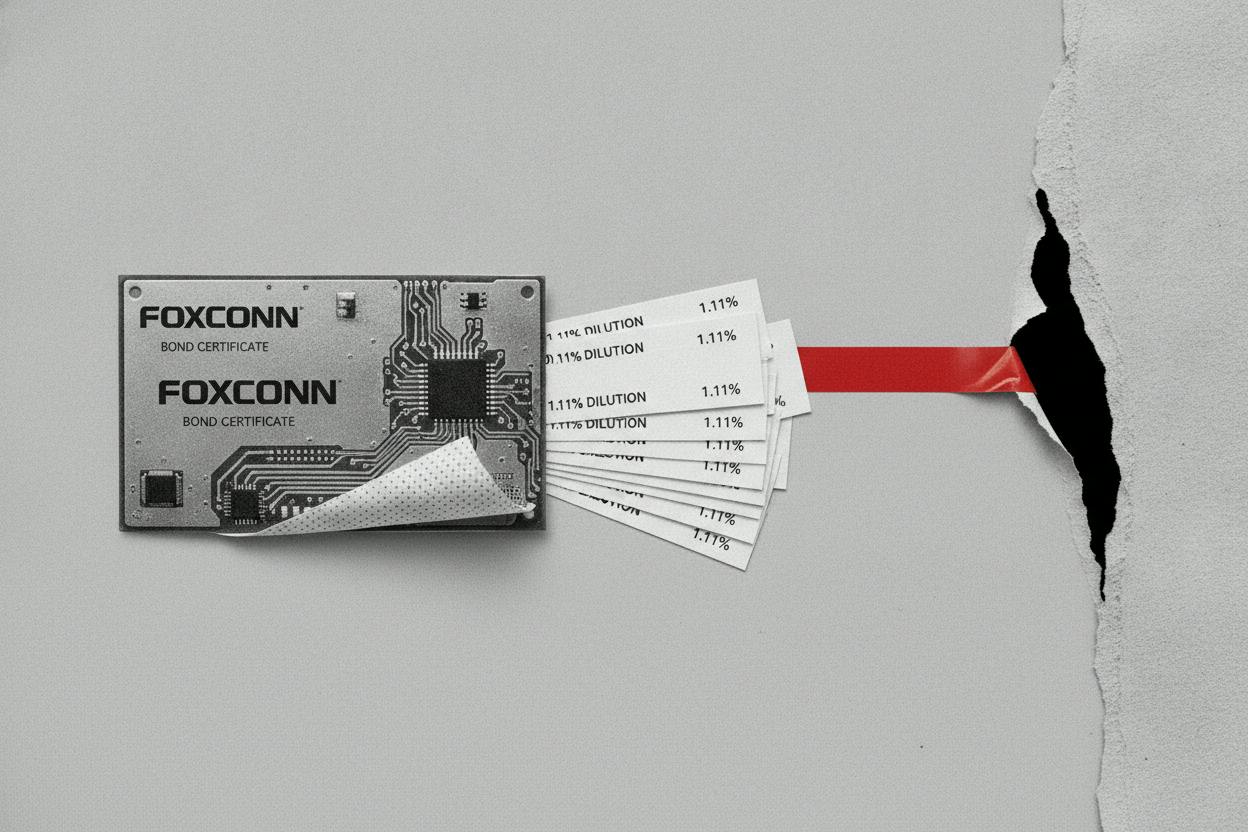
Foxconn, the Taiwanese electronics giant formally known as Hon Hai Precision Industry, has raised $1.25 billion through a zero-coupon convertible bond sale. The move, disclosed in a filing to the Taiwan Stock Exchange, sent its shares tumbling nearly 10% in Wednesday morning trading.
The bonds are unsecured and will list in Singapore, with issuance scheduled for December 1st. Because they are zero-coupon, investors receive no regular interest payments. Instead, they get the right to convert the bonds into Foxconn shares at a preset price of NT$260.48. If the bonds are not converted, repurchased, or redeemed, Foxconn has said holders would be repaid the principal plus a return calculated at 1.95% per year, compounded semiannually.
Why the stock is falling
The sharp drop in Foxconn's share price may seem disproportionate to the relatively modest dilution the company has projected. Foxconn estimates that if all the bonds are converted by 2026, the increase in share count would dilute existing shareholders by about 1.11%. That is a small number, but the market reaction is often driven by mechanics rather than just the long-term impact.
Many buyers of convertible bonds run what is known as convertible arbitrage. They purchase the bond for its downside protection—since it still pays back principal plus a small return if not converted—and then short the underlying stock to hedge the equity option embedded in the bond. This hedging activity can create immediate selling pressure around the pricing and into the issuance date, even if the eventual dilution is small.
That dynamic appears to be at play here. The NT$260.48 conversion price also becomes a key reference point for investors. If Foxconn's share price rises above that level, conversion becomes more likely, and the market may start to focus on when the theoretical dilution becomes real. Conversely, if the stock stays below the conversion price, the bonds are less likely to be converted, and the dilution may never materialize.
What Foxconn plans to do with the cash
Foxconn said it intends to use the proceeds to buy raw materials overseas. The company is one of the world's largest contract electronics manufacturers, best known for assembling Apple's iPhones, but it also makes servers, networking equipment, and other components. Its supply chain is global, and securing raw materials is a constant priority, especially as it expands into areas like electric vehicles and AI servers.
The company has been investing heavily in new production capacity, including in India, where it has faced some challenges. Earlier reports noted that a Foxconn India unit faced an insolvency petition over unpaid vendor rent, highlighting the operational risks of rapid expansion. Despite such hiccups, Foxconn continues to diversify its manufacturing footprint beyond China.
What it means for investors
For everyday investors, the key takeaway is that convertible bonds can move a stock in ways that go beyond the simple math of dilution. The immediate selling pressure from arbitrageurs is a temporary, deal-related phenomenon. Once the bonds are issued and the hedging is complete, that pressure typically subsides.
The more lasting question is whether Foxconn's share price will stay above the conversion price. If it does, the company will likely see the bonds converted into new shares, which would increase the total share count and slightly reduce the value of each existing share. If the stock stays below NT$260.48, the bonds may simply be held to maturity, and the dilution may never happen.
Investors should also consider the broader context. Foxconn's move comes at a time when global markets are watching interest rates and corporate financing costs. Zero-coupon convertibles are attractive to issuers because they avoid immediate cash interest payments, but they come with the potential cost of future dilution. For a company like Foxconn, which is investing heavily in growth areas, this trade-off can be worthwhile.
In the near term, the market's focus will likely remain on the mechanics of the bond issuance and the stock's reaction to the conversion price. As the December 1st listing date approaches, expect continued volatility. For long-term investors, the 1.11% dilution is modest, but the signal it sends about Foxconn's financing strategy is worth watching.