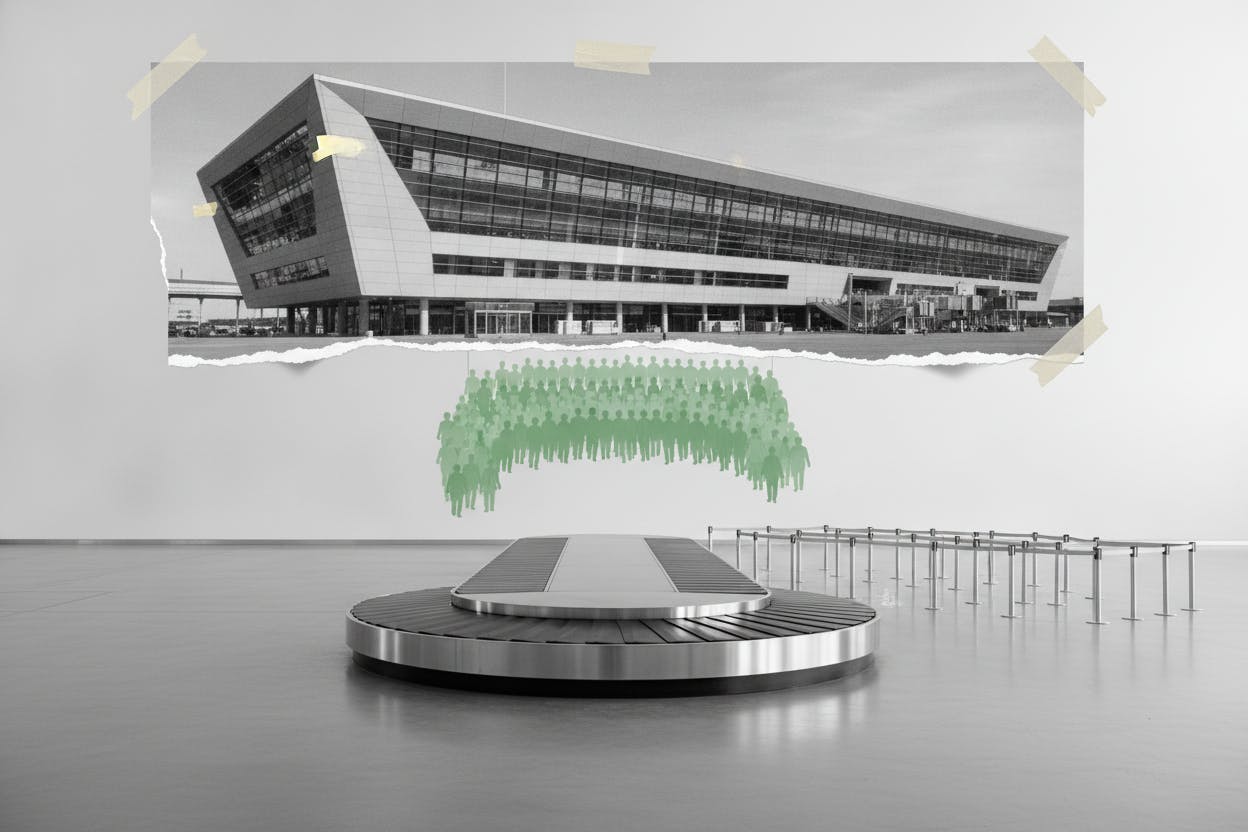
Fraport, the operator of Frankfurt Airport, has opened its €4 billion Terminal 3, a massive expansion that adds capacity for 19 million passengers a year. But the timing could hardly be more challenging: passenger demand at Frankfurt is softening, and analyst firm mwb Research warns that the combination of new fixed costs and slower traffic puts Fraport's full-year 2026 financial targets at risk.
What's happening with Frankfurt traffic?
Frankfurt Airport saw passenger numbers fall 1.7% year-on-year in June and 0.8% in the first half of the year, according to mwb. The analyst firm points to several headwinds: strikes at Lufthansa, higher jet fuel costs, and geopolitical tensions around Iran, which can reduce flight schedules and dampen traveler confidence.
Fraport's wider group, which includes airports in other countries, still saw overall passenger numbers rise 1.0% in the first half, helped by international routes. But the mix was uneven, with domestic and short-haul traffic lagging.
CEO Stefan Schulte has already lowered his 2026 passenger forecast for Frankfurt to flat versus 2025, down from a previous target of 65-66 million. Management continues to describe the company's 2026 financial targets as “achievable,” but has also warned that weaker German traffic could weigh on results.
Why Terminal 3 changes the math
Airports have a cost structure that is largely fixed. Once a terminal is built and opened, expenses like depreciation, staffing, and ongoing maintenance don't drop much when fewer passengers show up. That means the new capacity from Terminal 3 comes with a higher fixed-cost base.
This is the operating leverage effect: when traffic grows, those fixed costs are spread over more passengers, boosting margins. But when traffic stalls or falls, the opposite happens. Each missing passenger not only means lost revenue from landing fees, retail, and parking, but also means those fixed costs are spread over fewer travelers, squeezing profitability.
mwb Research cut its 2026 sales, EBIT (earnings before interest and taxes), and earnings per share forecasts for Fraport, questioning how comfortable the company's full-year 2026 targets really are. The analyst firm noted that the soft patch in Frankfurt traffic is hitting just as the new terminal's costs kick in.
What it means for investors
For investors, the key takeaway is that Fraport's earnings are now more sensitive to passenger volumes than before. A small miss on traffic can translate into a bigger hit to operating profit and earnings per share.
The situation also highlights a broader risk for airport operators: large capital projects can create a mismatch between capacity and demand. When demand is strong, new terminals are a growth engine. When demand softens, they become a drag on margins.
Investors will be watching closely for any further guidance changes from Fraport, especially as the summer travel season unfolds. The company's ability to manage costs and potentially attract new airlines to fill the extra capacity will be key.
For context, the broader aviation industry has been navigating a patchy recovery. While international travel has rebounded strongly in many regions, domestic and short-haul markets in Europe have faced headwinds from strikes, higher fuel costs, and geopolitical uncertainty. These factors are not unique to Fraport, but the company's exposure to Frankfurt makes it particularly vulnerable to the current soft patch.
Meanwhile, other sectors are seeing different dynamics. For example, TSMC's record quarter shows AI demand is still driving growth, highlighting how technology-driven demand can outpace broader economic trends. And in the chip industry, SK Hynix's $26.5 billion Nasdaq debut drew massive investor demand, underscoring the appetite for AI-related investments.
For Fraport, the next few quarters will be critical. If Frankfurt traffic picks up, the new terminal could become a valuable asset. If it stays flat, the company's 2026 targets may need to be revised.



