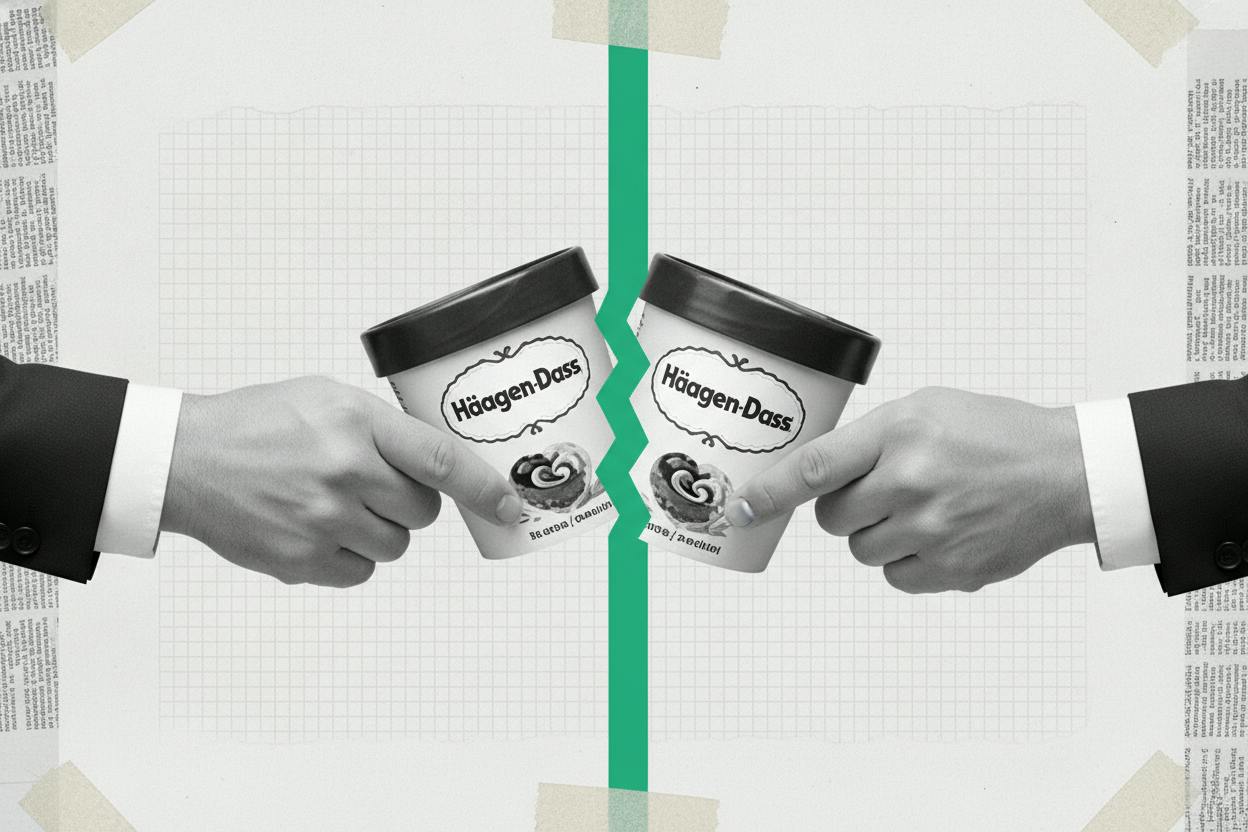
General Mills is exploring a separation of its Häagen-Dazs ice-cream business outside North America, a move that could ultimately lead to a sale, according to a report from The Wall Street Journal. The report names Froneri, the joint venture that already runs the brand in the US, as a potential buyer.
The company declined to comment on the report, but the news underscores a broader shift among packaged-food giants toward streamlining their portfolios. With ingredient and shipping costs pressuring margins and consumer tastes evolving, many food companies are shedding non-core brands to focus on their strongest lines.
How Häagen-Dazs is already split
Häagen-Dazs operates as two distinct businesses. General Mills controls the brand outside North America, while Froneri manages it in the US. That geographic division makes a carve-out more straightforward than it might be for a brand run under a single global structure.
Froneri is a global ice-cream joint venture owned equally by PAI Partners, a private-equity firm, and Nestlé, the consumer-goods giant. A buyer of that scale typically looks for operational efficiencies: owning more of the brand could allow it to consolidate manufacturing, logistics, and marketing under one plan, and negotiate better terms with suppliers.
General Mills has already been trimming Häagen-Dazs-related assets. In June, it agreed to sell its Häagen-Dazs shops in mainland China to a group led by tea-chain operator Ningji. That earlier divestiture suggests the company is comfortable reshaping its ice-cream footprint when it makes strategic sense.
Why a sale could be valued on savings
When a brand is split by region, it often carries duplicated overhead. Two management teams, separate supply chains, and less bargaining power on ingredients, packaging, and freight can weigh on profitability. If Froneri were to reunite more of Häagen-Dazs under one roof, the price it could pay might hinge on how much it expects to save by running a single production-and-distribution network and a more consistent marketing approach.
For General Mills, any sale would also change the story investors are valuing. Removing an international ice-cream unit could simplify results and shift the group's overall margin profile. That is why portfolio reviews can move expectations even before a deal is signed.
What it means for investors
For everyday investors, the key takeaway is that this is part of a larger pattern in the packaged-food sector. Companies are increasingly willing to prune brands that no longer fit their core strategy, especially when those brands face regional complexities or margin pressure. The potential sale of Häagen-Dazs outside North America would be another example of that trend.
Investors should watch for further details on the review, including any formal sale process and the price Froneri might be willing to pay. A deal that captures cost savings could be more valuable than one based purely on ice-cream sales, which could be good news for General Mills shareholders if the price reflects those synergies.
At the same time, the broader market context matters. Packaged-food stocks have been under pressure as input costs rise and consumers trade down to cheaper alternatives. A successful divestiture could help General Mills refocus on higher-growth areas, but it also signals that the company sees limited upside in an international ice-cream business that may be harder to scale efficiently.
For now, the review is still at an early stage, and there is no guarantee a sale will happen. But the fact that General Mills is even considering it tells investors that the company is actively managing its portfolio, which can be a positive sign in an industry where agility is increasingly valued.