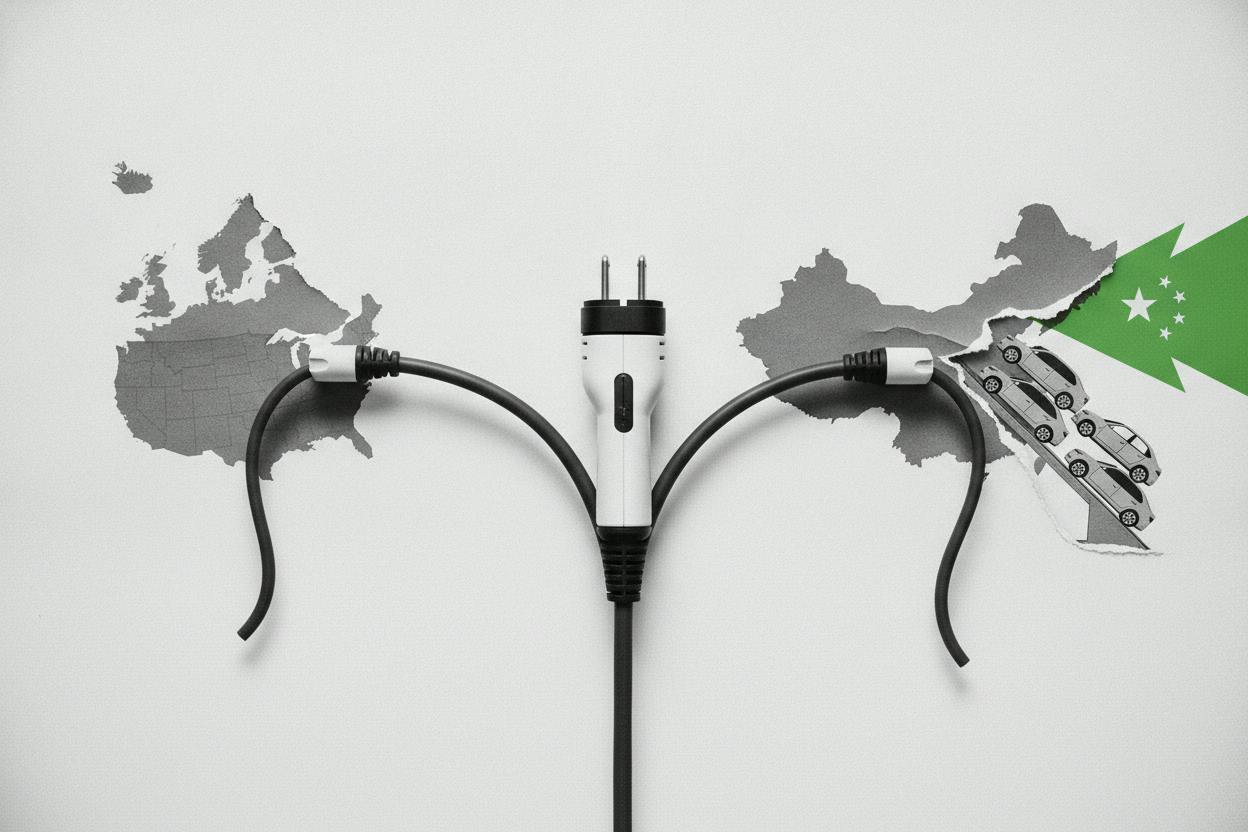
Global electric vehicle sales slipped 2% in September to 2.15 million units, according to data from Benchmark Mineral Intelligence cited by Reuters. The headline number masks a sharply divided market: Europe set a fresh record, while North America and China both pulled the total lower.
Europe recorded almost 600,000 EV sales in September, roughly 10% above its previous high set in June. That strength stood in contrast to China, where sales fell 18% to 1.11 million, and North America, which dropped 44% — the steepest monthly decline among the three regions.
Why the regions are moving in opposite directions
The divergence reflects different stages of policy and consumer adoption. In Europe, a combination of consumer demand and government support is still pushing sales higher. Many European countries have maintained purchase incentives, and stricter emissions rules have encouraged automakers to steer buyers toward electric models. That has helped the region post record volumes even as the global total shrinks.
China, by contrast, is seeing a softer domestic market. The world's largest EV market has been the engine of global growth for years, but its slowdown is notable. After a long run of rapid expansion, demand appears to be normalising, and the comparison base from a year earlier is high. A decline of this size in China matters because the country typically accounts for more than half of global EV sales.
North America's 44% drop is the most dramatic. US federal EV tax credits ended in September 2025, removing a key incentive that had supported buyers. When subsidies expire, sales often fall sharply in the following months as consumers who had planned purchases pull forward their buying to capture the credit, then demand cools. That pattern appears to be playing out now.
What this means for investors
For everyday investors, the key takeaway is that the EV story is no longer a single global trend. It is now a patchwork of regional markets driven by local policy, incentives and consumer confidence. A headline like "global EV sales fell 2%" can be misleading if it hides a record in Europe and a collapse in North America.
Companies across the EV supply chain — automakers, battery makers, lithium and mineral producers, and charging infrastructure firms — will feel these regional shifts differently. A manufacturer with heavy exposure to the US market may face a tougher stretch after the tax credit expiry, while one with a strong European presence could benefit from that region's momentum. Investors who hold EV-related stocks or funds should look beyond the global aggregate and check where a company actually sells its vehicles.
Battery and raw materials producers are also sensitive to these trends. Benchmark Mineral Intelligence, the firm behind the data, is widely followed for its tracking of lithium, graphite and other battery minerals. A slowdown in EV sales can feed through to weaker demand for those materials, pressuring prices and the miners that supply them. That said, Europe's record month offers some offset.
It is also worth remembering that monthly sales data can be volatile. A single month does not make a trend, and the end of a subsidy program can distort figures for several months as the market adjusts. Investors should watch the next few months of data to see whether North America stabilises and whether China's decline is a blip or the start of a longer slowdown.
What to watch next
Several factors will shape the EV market in the coming months. In the US, the question is how quickly demand recovers without federal tax credits, and whether automakers respond with price cuts or new incentives of their own. In China, investors will look for signs that the domestic market is finding a floor, especially as competition among local brands remains intense. In Europe, the sustainability of record sales will depend on whether policy support continues and whether consumers keep embracing electric models.
For those tracking the broader market, EV sales are also a window into commodity demand, battery technology and the global energy transition. The sector remains a long-term growth story for many investors, but the path is unlikely to be smooth. September's split picture is a reminder that regional policy can change the trajectory quickly — and that a global headline can conceal very different realities on the ground.