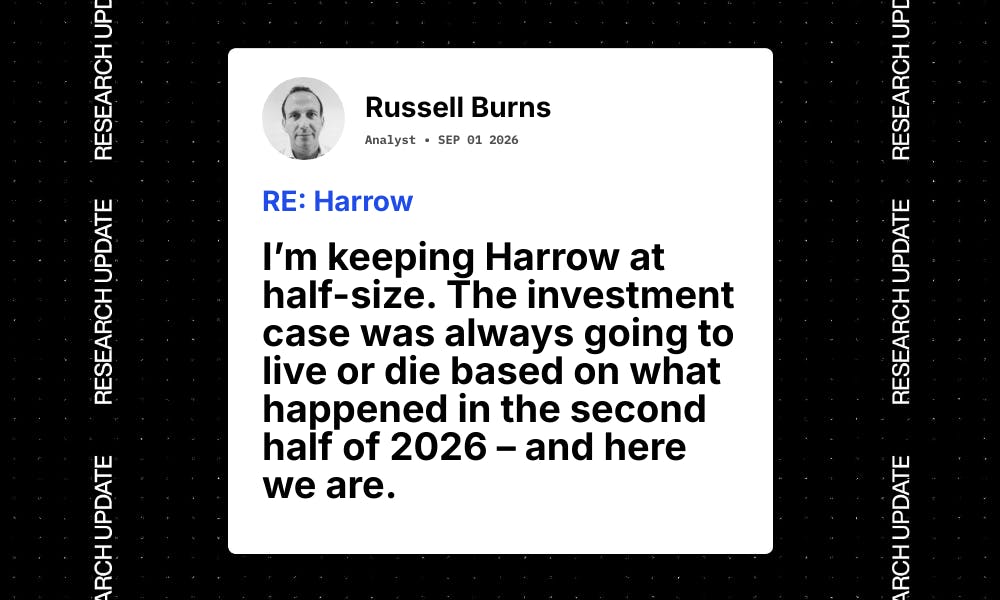
Harrow, the eye-care pharmaceutical specialist, has been in a spending-and-waiting phase for months. That phase is now coming to a head: the company's investment case was always going to live or die on what happens in the second half of 2026, and that moment has arrived.
The stock slipped 5% in August, and the latest quarterly numbers didn't offer much comfort. Harrow reported $70.7 million in sales for the quarter, which came in toward the lower end of what analysts had expected. Still, that was 11% higher than the same period a year earlier. For the first half of the year, sales reached $114.9 million.
The more worrying figure was on the bottom line. Adjusted earnings before interest, taxes, depreciation, and amortization (EBITDA) showed a $13.9 million loss, a direct result of the company's heavy investment in building out its sales team earlier in the year. In plain terms, Harrow spent a lot of money to set up the infrastructure it hopes will drive future growth, and that spending is currently eating into profitability.
Why the spending spree matters
Harrow is not a household name, but it occupies a specific niche: prescription eye-care products. The company has been developing and commercializing drugs for conditions like dry eye and other ophthalmology issues. The strategy has been to invest heavily in a dedicated sales force to push these products to eye-care specialists, betting that a focused approach will win market share from larger competitors.
That kind of strategy is common in specialty pharma. Companies often accept short-term losses to build a commercial engine, hoping that the scale will eventually produce strong returns. The risk is that the spending doesn't translate into the expected sales growth, leaving the company with a bloated cost base and no payoff.
For Harrow, the second half of 2026 is the window in which that bet will be judged. The company has essentially told investors: give us time to ramp up, and the results will show. Now, the market is watching to see if the sales team's efforts are converting into prescriptions and revenue.
What the numbers say
The 11% year-over-year sales growth is positive, but it's not the kind of acceleration that would justify the heavy spending. The fact that sales came in at the lower end of expectations suggests that the ramp-up is taking longer than hoped, or that competition is stiffer than anticipated.
The adjusted EBITDA loss of $13.9 million is a clear sign of the cost of that investment. Adjusted EBITDA is a measure that strips out certain one-off or non-cash items, so it gives a cleaner view of ongoing operations. A loss here means the company is not yet generating enough profit from its sales to cover its operating costs, let alone the extra spending on the sales force.
Investors who hold Harrow, like those in the Finimize Portfolio (where the position is kept at half-size), are essentially waiting for the inflection point. If the second half of 2026 shows a meaningful jump in sales and a path to profitability, the stock could re-rate. If not, the losses could continue and the stock could face further pressure.
What it means for investors
For everyday investors, Harrow is a classic example of a high-risk, high-reward growth story. The company is betting that its eye-care drugs will become blockbusters, but that bet is far from guaranteed. The recent 5% drop and the weak headline numbers are reminders that such bets can go either way.
It's also a reminder that investing in early-stage or turnaround pharma companies is not for the faint of heart. These stocks can be volatile, and the financial statements can look ugly for long stretches before (or if) the payoff arrives.
What should investors watch next? The key is the second-half sales trajectory. If Harrow can show accelerating growth and narrowing losses, the thesis holds. If sales stagnate or the losses widen, the market may lose patience.
For context, broader market conditions also matter. The recent mixed US economic data and cooling factory growth suggest a slowing economy, which could affect healthcare spending, though eye-care is generally considered a stable category. Meanwhile, Microsoft's AI spending shows that heavy investment can pay off, but that's a very different business with a much larger scale.
In the end, Harrow's story is a test of execution. The company has made its move, and now it has to deliver. The next few quarters will tell whether the eye-care bet was a smart one or a costly mistake.