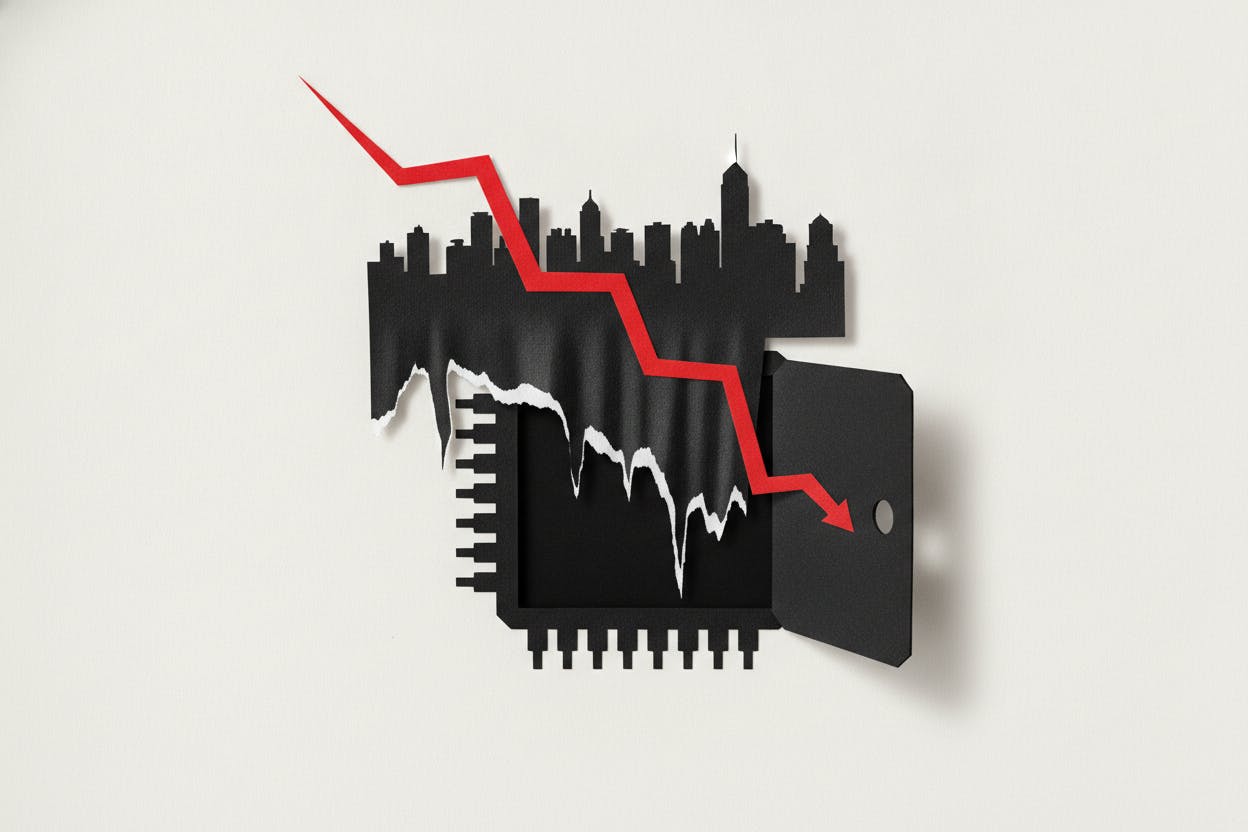
Hong Kong stocks fell sharply on Friday, with the Hang Seng Index sliding 1.8% to 24,562.24, as a broad sell-off in technology shares hit artificial intelligence and semiconductor stocks particularly hard. The decline accelerated throughout the session as investors reduced exposure to AI-linked names, according to MT Newswires, while a regionwide chip rout spread even after some upbeat earnings earlier in the week.
The Hang Seng China Enterprises Index, which tracks mainland Chinese companies listed in Hong Kong, dropped 2.2% to 8,136.73. The move reflected a broader pattern: when a popular investment theme becomes crowded, investors often reduce risk all at once, and that can overwhelm company-specific news. Even solid earnings reports from some tech firms were drowned out by the selling pressure.
Why AI and Chip Stocks Are Under Pressure
The sell-off in AI and semiconductor shares wasn't limited to Hong Kong. Similar moves were seen across Asian markets, with Taiwan's chip stocks also tumbling despite record profits from industry giant TSMC. That story, covered in our earlier report Taiwan Chip Stocks Tumble 6% Despite TSMC's Record Profit as AI Optimism Fades, highlights how investor enthusiasm for AI has cooled after a long rally.
When investors “unwind” an AI-and-semiconductor basket, the selling is often driven by market plumbing as much as by fundamentals. Margin rules force some traders to trim positions, funds that target a set level of volatility cut exposure when markets get choppier, and ETF outflows can trigger automatic selling of the same group of stocks. That flow-driven loop makes many names move together, so even solid earnings can get drowned out.
The broader tech rout also echoed declines in Japan, where the Nikkei 225 plunged 3.6% amid a chip rout and Middle East tensions, as we reported in Nikkei 225 Plunges 3.6% as Chip Rout and Middle East Tensions Spook Investors.
Macro Headlines Add to the Gloom
Fresh macro headlines didn't help investor sentiment. Oil prices stayed elevated after Iran launched new attacks on US facilities in the Gulf, following another round of US strikes on Iranian military sites. That kept investors alert to energy-driven inflation and growth risks, as higher oil prices can feed into broader costs and slow economic activity.
Meanwhile, the US imposed a 25% tariff on some Brazilian imports, another reminder that policy shifts can spill into global supply chains and sentiment well beyond the countries directly involved. Trade tensions remain a recurring concern for markets, particularly for export-oriented economies like Hong Kong and China.
For a look at how similar tensions have affected other markets, see our coverage of New Zealand Stocks Rise as Markets Weigh US-Iran Tensions and Sticky Inflation.
Single Stocks Still Made Moves
Some individual stocks moved on their own news. Jiangxi Copper fell more than 5% after approving a proposed spin-off and Hong Kong listing of its controlled subsidiary, Jiangxi JCC Copper Foil Technology. The move reflects a broader trend of Chinese companies spinning off units to unlock value, but investors often react negatively to the complexity and potential dilution.
Other sectors also felt the pressure. Mining stocks were weak, mirroring declines in Australia where the ASX 200 dropped as miners slumped on weaker iron ore and copper prices, as detailed in ASX 200 Drops as Miners Slump on Weaker Iron Ore and Copper; Energy Stocks Rise.
What It Means for Investors
The Hang Seng's 1.8% drop showed how fast crowded tech trades can unwind. For everyday investors, the key takeaway is that when a popular sector like AI and chips sells off, the move can be sharper and quicker than in more diversified indexes. That's because many of the same investors hold similar positions, and when they all try to exit at once, prices can fall faster than fundamentals would suggest.
The upshot is that Hong Kong benchmarks can see sharper, quicker drawdowns when tech is the marginal seller, and rebounds tend to wait for those forced flows to settle rather than for the next round of headlines. Investors should be prepared for continued volatility in tech-heavy indexes, especially if oil prices stay high or trade tensions escalate further.
For now, the focus remains on whether the selling is a temporary pullback or the start of a deeper correction. With earnings season still underway and central bank decisions on the horizon, markets are likely to remain sensitive to any new developments.



