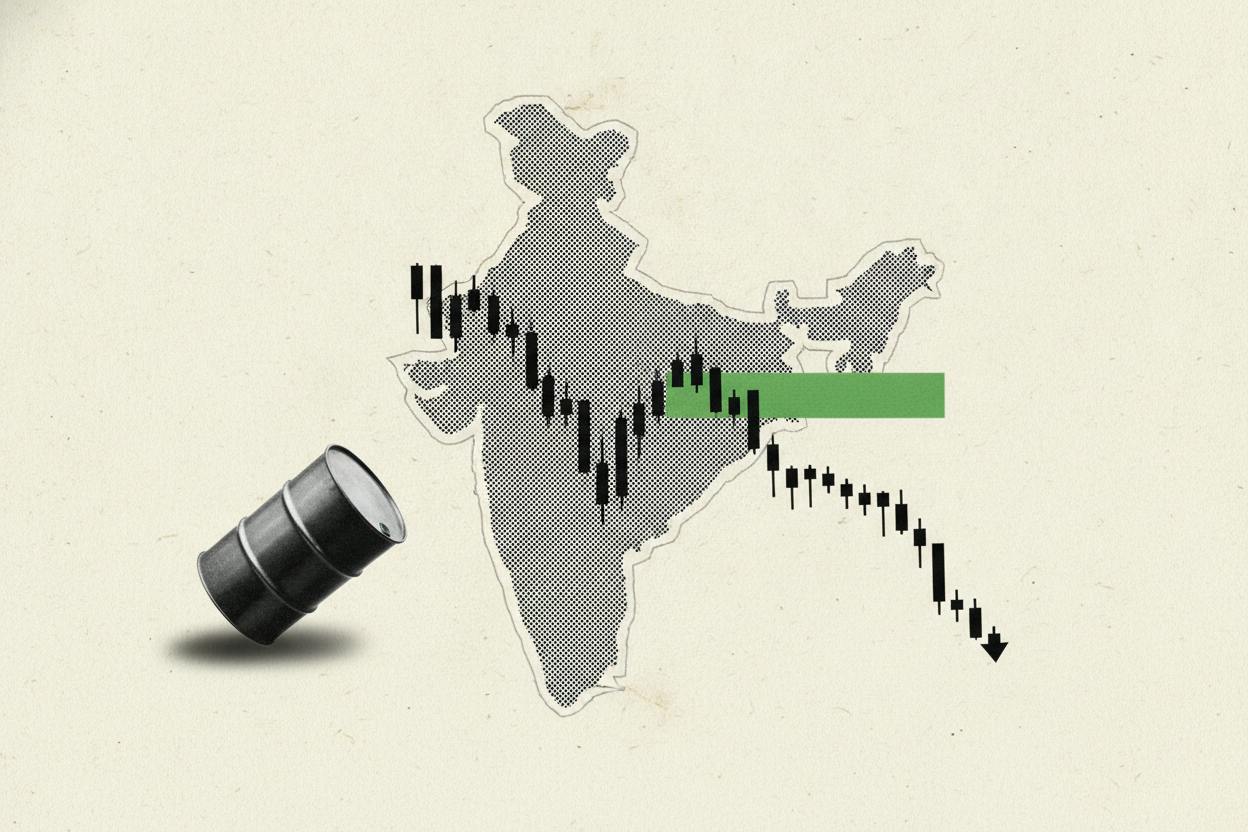
Indian stocks looked set to open higher on Monday, snapping an eight-week losing streak that was the longest in a quarter-century. Early signals pointed to gains, with GIFT Nifty futures trading around 22,639, above the Nifty 50's close of 22,421.95 on Thursday. Indian markets were shut Friday for a public holiday.
The bounce comes after a brutal stretch for equities, driven by a toxic mix of heavy foreign selling, stubbornly high oil prices, and rising global bond yields that made safer assets more attractive. But two factors helped stabilize sentiment over the weekend: a softer-than-expected US jobs report and a dip in Brent crude to $101.6 a barrel.
What's behind the slide?
The eight-week decline was the longest for the Nifty 50 and Sensex in 25 years. The main culprit was relentless selling by foreign portfolio investors (FPIs), who have been net sellers for six straight sessions. On Thursday alone, they dumped 94.84 billion rupees worth of Indian stocks.
That selling pressure was partly offset by domestic institutional investors (DIIs), who bought 100.42 billion rupees on the same day. But sustained rallies in benchmarks like the Nifty 50 tend to look healthier when foreign selling slows or flips to buying.
Rising global bond yields have been a key driver of foreign outflows. When yields on US Treasuries climb, they offer investors a safer, higher-return alternative to emerging market stocks. That makes India—and other developing markets—less attractive to overseas money.
Why the mood is improving
The US jobs report released Friday came in weaker than expected, cooling expectations for further rate hikes by the Federal Reserve. According to two traders cited by Reuters, the implied odds of an October Fed hike fell below 25%. That's a relief for global markets, as higher US rates tend to suck capital out of emerging markets.
Oil is the other big swing factor for India. Brent crude dipping to $101.6 a barrel is a pressure valve for foreign outflows. Cheaper oil can ease inflation and reduce strain on the current account—the gap between what a country earns from abroad and what it spends—which tends to support the rupee. That, in turn, lowers the cost of currency hedges for foreign investors, making Indian assets more appealing.
The softer jobs data also lifted hopes that the Fed might pause its rate-hike cycle, a scenario that has historically been positive for risk assets. As recent US jobs data showed, weaker hiring can boost stock markets by fueling expectations of easier monetary policy.
Company news at the margin
On the corporate front, HDFC Bank named Anup Bagchi as its next CEO for a three-year term. The appointment, while not a market-moving event, is significant for India's largest private sector bank and could influence investor sentiment in the banking sector.
What it means for investors
For everyday investors, the key takeaway is that the worst of the selling pressure may be easing, but the road ahead is still uncertain. The combination of softer US rate expectations and lower crude prices could help stabilize foreign flows, which have been the steady headwind for Indian markets.
However, oil prices remain elevated, and any spike could reignite inflation fears and put pressure on the rupee. As Brent has held above $100 recently, supply concerns persist. Investors should watch both oil and US rate signals closely.
Domestic institutional investors have been a stabilizing force, buying when foreigners sell. But their buying power is not unlimited. If foreign selling continues, DIIs may not be able to cushion the fall indefinitely.
For those with long-term horizons, the current pullback could offer entry points, but it's important to remember that markets can remain volatile. As always, diversification and a focus on fundamentals remain key.
In the near term, all eyes will be on whether the bounce can sustain. If foreign selling slows and oil stays below $102, the Nifty 50 could find its footing. But if either factor worsens, the slide could resume.