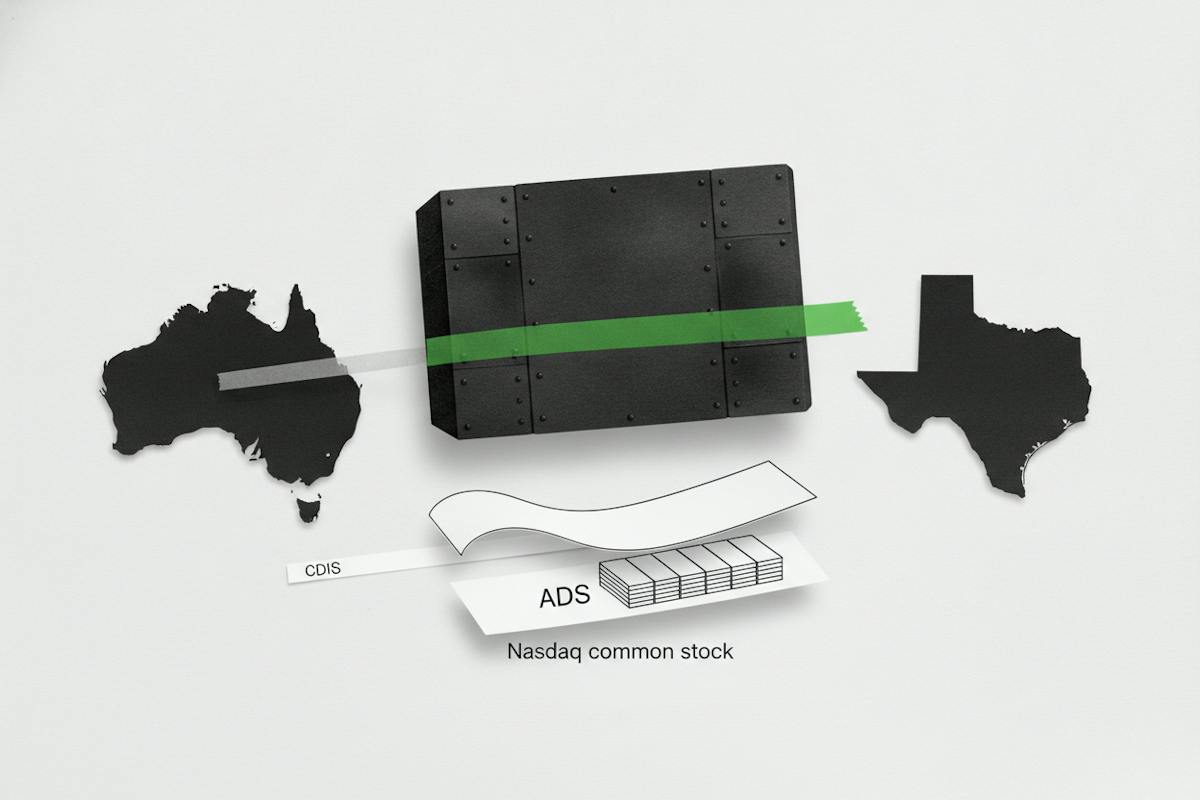
IperionX, a critical minerals and materials company, has announced plans to move its corporate base to Texas and change how its shares trade on U.S. markets. The company expects shareholders to vote on the proposal in January 2027.
Under the plan, IperionX would replace its American depositary shares (ADSs) on the Nasdaq with common shares of a newly incorporated Texas parent company. At the same time, it would keep its presence on the Australian Stock Exchange (ASX) by quoting CHESS depositary interests (CDIs) instead of its current ordinary shares.
For everyday investors, the key takeaway is that the move is largely structural. It does not change the underlying business or its fundamentals, but it could affect how you hold and trade the stock.
What's behind the move?
IperionX is a critical minerals company focused on titanium and rare earth elements, which are essential for defense, aerospace, and clean energy technologies. The company has operations and projects in the United States, including a planned titanium production facility in Virginia.
By redomiciling to Texas, IperionX would become a U.S.-incorporated company, which could make it more attractive to U.S. investors and index funds. Many U.S. institutional investors prefer to hold common stock in domestic companies rather than ADSs, which are foreign securities traded on U.S. exchanges.
The company has signed a scheme implementation deed, a legal document that outlines the steps for the reorganization. If shareholders and regulators approve, the new Texas parent would list common shares on Nasdaq, and the CDIs would be quoted on the ASX.
The exchange ratios are designed to keep the economic value of each holding broadly the same, so existing shareholders should not see a change in the value of their investment as a result of the swap.
What does this mean for investors?
For U.S. investors, the switch from ADSs to common shares could simplify things. ADSs often come with extra fees and administrative complexity, so holding common stock directly could reduce those costs. It might also make the stock eligible for inclusion in U.S. indices, which could increase demand from passive funds.
For Australian investors, the change to CDIs is also mostly administrative. CDIs are the standard way foreign companies list on the ASX, and they function similarly to ordinary shares for trading and dividend purposes.
The vote is still more than a year away, so nothing changes immediately. Investors should watch for further announcements about the scheme, including the official meeting date and any regulatory approvals.
This move is part of a broader trend of companies shifting their primary listings to the U.S. For example, Compass Group plans to move its primary listing to New York, and Goldman Sachs has moved some ETFs to the Texas Stock Exchange. These shifts reflect the deep liquidity and investor appetite in U.S. markets.
For IperionX, the move to Texas also aligns with its U.S.-focused growth strategy, which includes other companies expanding in Texas to take advantage of the state's business-friendly environment.
What to watch next
Investors should keep an eye on the scheme implementation process. The company will need to hold a shareholder meeting, likely in late 2026, to vote on the plan. Regulatory approvals from the Australian courts and U.S. authorities will also be required.
If approved, the new structure would take effect sometime after the vote. Until then, the current ADSs and ordinary shares will continue to trade as they do now.
For those holding IperionX shares, the main thing to remember is that this is a corporate housekeeping move, not a change in the company's prospects. The underlying business—producing critical minerals for the energy transition—remains the same.
As with any corporate action, there is some risk that the deal could be delayed or fall through. But if it proceeds as planned, it could make IperionX more accessible to a wider range of investors.