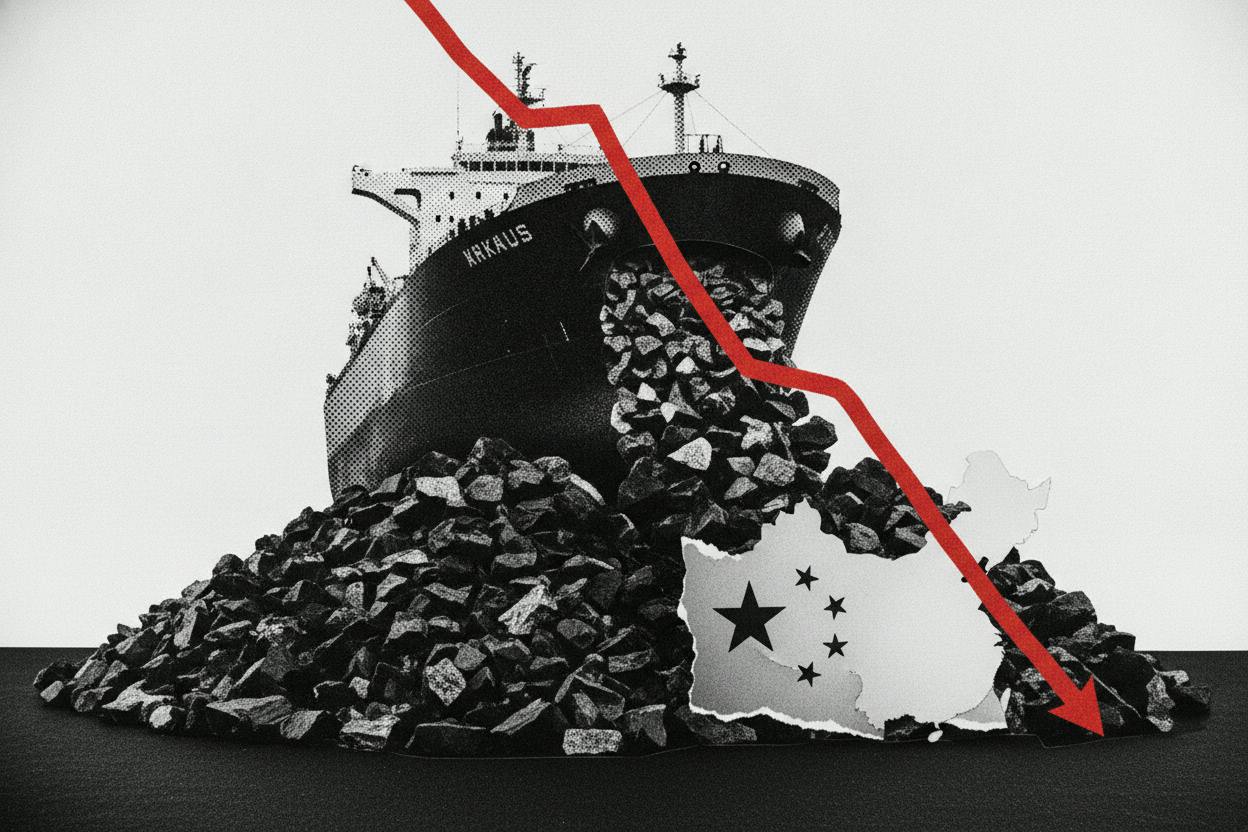
Iron ore prices slipped on Tuesday after fresh data showed a pickup in seaborne supply from Australia and Brazil, while Chinese steelmakers continued to hold back on restocking as their profit margins remain under pressure.
According to industry data provider Mysteel, cited by Reuters, shipments from Australia and Brazil rose 1.3% week-on-week to 27.9 million tons as of November 2. That increase in supply comes at a time when demand from the world's biggest steel producer is subdued.
China's most-traded Dalian iron ore futures contract fell 0.59% to 672 yuan a ton, while Singapore Exchange iron ore futures also declined by a similar amount. The moves reflect a market that is increasingly focused on the balance between incoming cargoes and how much ore mills are actually willing to buy.
Why are mills holding back?
The key issue is demand. Chinese steelmakers are operating with weak profit margins, and finished-steel inventories remain high. In such conditions, mills tend to shift from actively rebuilding stockpiles to what traders call “hand-to-mouth” buying — sourcing only the ore they need for near-term production, rather than building up inventories for future use.
That behavior matters because inventories normally act as a shock absorber in the iron ore market. When mills are adding to stockpiles, they can absorb extra supply without much price impact. But when they are not restocking, additional seaborne cargoes have to find buyers in the spot market, which often means lower prices.
The current situation is a classic inventory downturn. With mills reluctant to carry stock, even a modest increase in supply can translate into a bigger move in futures prices, because there is no “inventory bid” to cushion the flow of cargoes.
What it means for investors
For investors, the focus now shifts to who will hold the extra ore. In an inventory downturn, iron ore benchmarks can start trading more off weekly shipment and port-arrival swings than off day-to-day moves in finished-steel prices. That means data from Mysteel and other providers on vessel arrivals and port stockpiles will likely drive short-term price action.
The Dalian contract at 672 yuan a ton and SGX's December price are both sensitive to these supply-demand dynamics. If shipments continue to rise while mills stay cautious, prices could face further downward pressure. Conversely, any sign that steelmakers are rebuilding inventories — perhaps as margins improve or as they prepare for winter restocking — could provide support.
For now, the market is waiting to see if Chinese steel demand picks up. The broader economic backdrop remains cautious, with investors judging recent support measures as too small to spur a strong recovery. That caution is filtering through to the steel and iron ore complex.
Meanwhile, the Baltic Dry Index has slipped, reflecting softer demand for dry bulk shipping, which is often seen as a bellwether for commodities demand. And in a related note, natural gas prices have also slipped, though cold-weather bets are capping losses.
For everyday investors, the takeaway is that iron ore prices are likely to remain volatile as long as Chinese steelmakers are not restocking. The market is in a wait-and-see mode, and any sustained recovery in prices will probably require an improvement in steelmaker profitability or a pick-up in end-user demand.
As always, it's important to remember that commodity prices can be unpredictable, and this analysis is not a recommendation to buy or sell any asset. Investors should consider their own risk tolerance and do their own research.