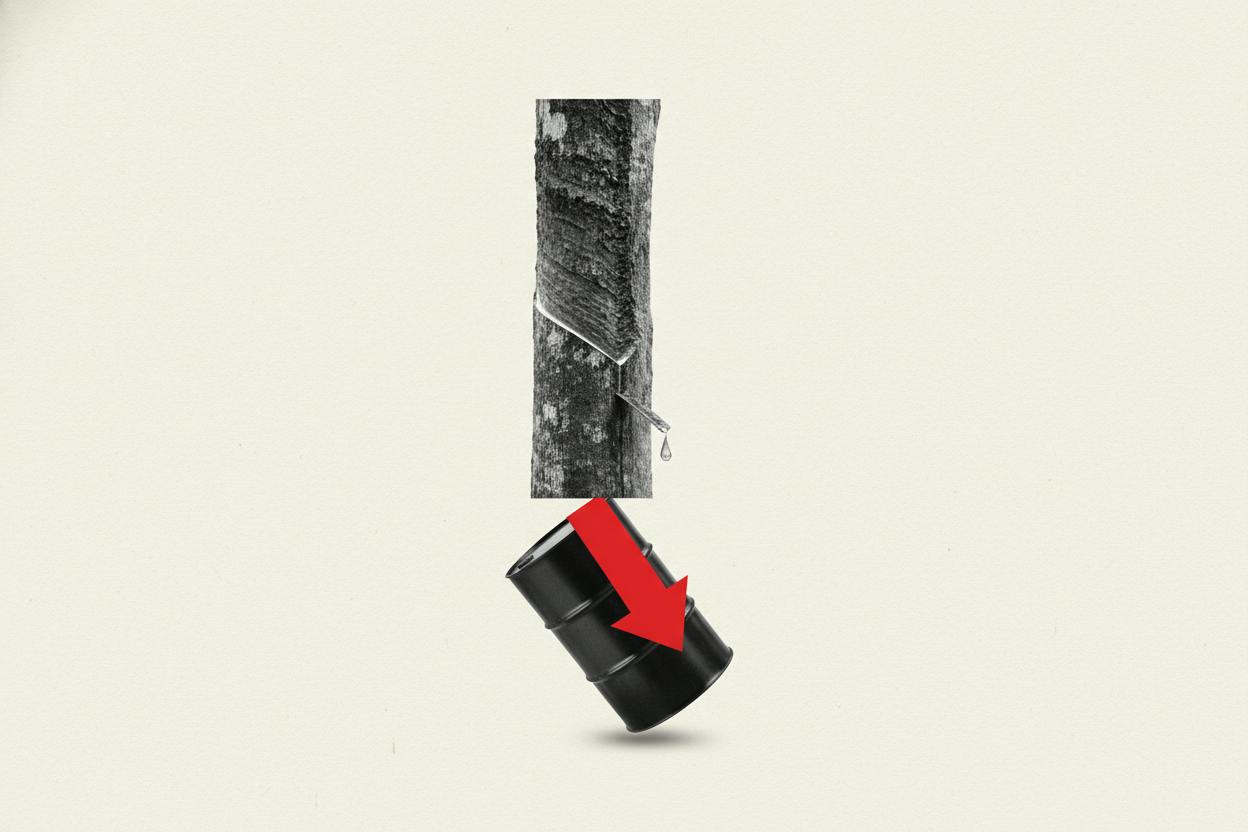
Japanese rubber futures managed a small gain on Tuesday, defying a broader risk-off mood in markets. The May contract on the Osaka Exchange settled 0.36% higher at 423.3 yen per kilogram, even as crude oil prices slid more than 1% and Japan's Nikkei index dropped nearly 3%.
The move was less about demand optimism and more about supply constraints. Everbright Futures, a brokerage research firm, pointed to year-on-year output declines in key producing regions. In parts of China, tapping is nearing its seasonal end, which can limit physical supply and keep prices supported.
Supply vs. oil: a tug of war
Natural rubber prices often move in tandem with crude oil, because oil is a key input for synthetic rubber. When oil prices fall, synthetic rubber becomes cheaper, making it more attractive to manufacturers who can substitute it for natural rubber in some products. That dynamic typically pressures natural rubber prices.
But Tuesday's session showed that supply can sometimes trump that relationship. Despite the drop in oil, natural rubber futures held firm, suggesting that the market is more focused on the physical availability of the commodity than on the cost of alternatives.
The divergence was visible across benchmarks. In Shanghai, January natural rubber futures fell 1% to 18,230 yuan per ton, while January butadiene rubber—a synthetic alternative—eased just 0.17% to 14,685 yuan per ton. The relatively small declines in China, compared with the sharp drop in oil, underscore the supply support.
What it means for investors
For everyday investors, the key takeaway is that commodity prices are driven by a mix of factors, and sometimes supply fundamentals can outweigh broader market sentiment. The 423.3 yen close is a reminder that a 1% move in oil doesn't always dictate the direction of natural rubber.
The spread between natural and synthetic rubber is particularly important for tire makers, who are major consumers of both. When the gap widens, it can squeeze margins if manufacturers can't pass on higher costs. However, not all products can easily switch between the two, so the impact varies.
Demand for tires appears stable. Europe's auto registrations rose 3.4% in October to 1.13 million vehicles, suggesting that the automotive sector isn't falling off a cliff. That means relative input costs—not the day's risk mood—are likely to be the swing factor investors will keep tracking.
For those watching the broader commodity complex, the action in rubber echoes similar dynamics in other markets. For instance, natural gas futures rebounded recently as traders weighed cold forecasts against contract expiry, showing how supply and seasonality can drive prices. Similarly, palm oil futures bounced after a Dalian rally, highlighting the regional supply-demand balance.
Investors should also keep an eye on oil markets, as oil recently hit a three-month low on supply fears, which could continue to influence synthetic rubber costs. And with Latin American currencies sliding on fiscal worries and a stronger dollar, global risk sentiment remains fragile.
In the near term, the focus for rubber traders will be on production data from major growers and the pace of seasonal winding down in China. If supply remains tight, natural rubber could stay firm even if oil prices stay low. Conversely, any pickup in production or a sharp drop in demand could quickly reverse the current support.
For the average investor, the lesson is to look beyond headline market moves. Commodities like rubber are influenced by a complex web of supply, demand, and substitute costs. Understanding those drivers can help you make more informed decisions, whether you're investing directly in futures or in companies that rely on these materials.