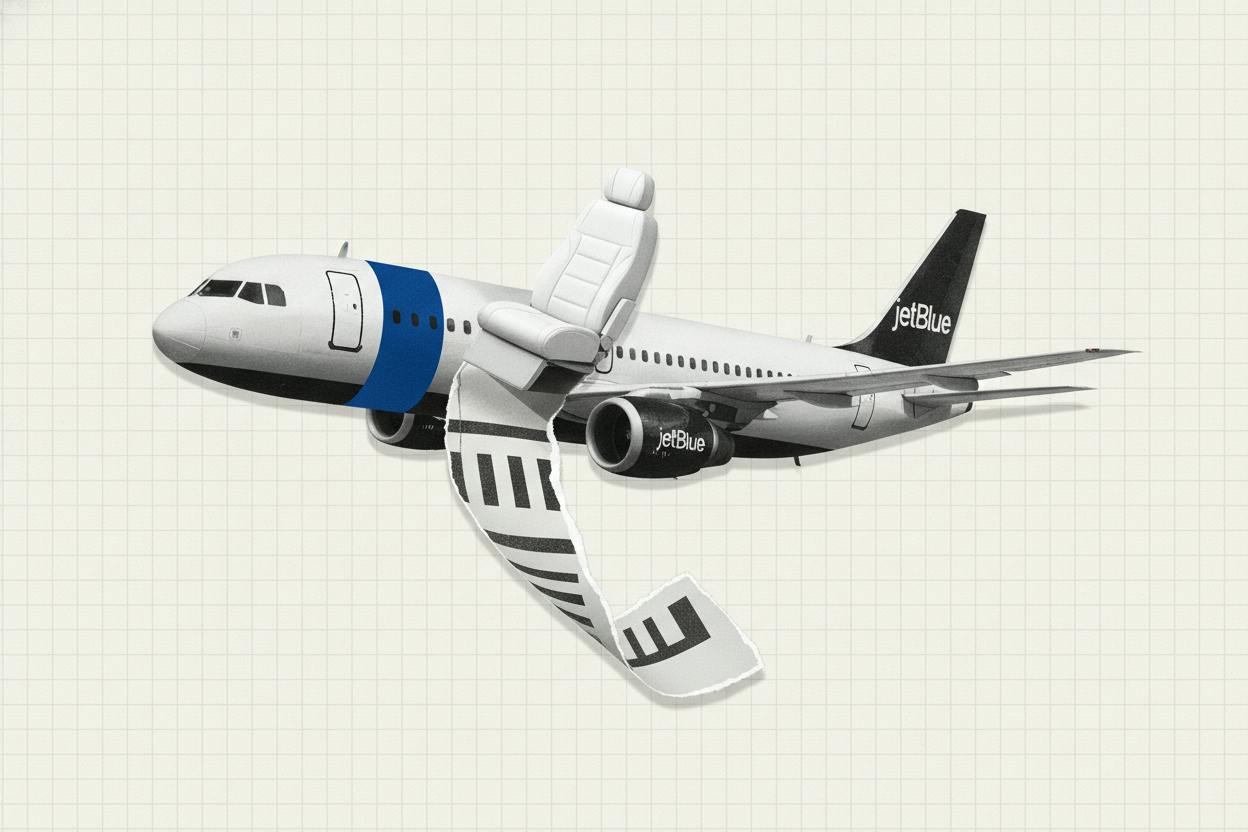
JetBlue is making a big bet on premium travel. The airline is rolling out a new domestic first-class cabin called BlueFirst, and management says the premium upsell could add nearly 5 percentage points of improvement in seat revenue as the carrier targets a return to operating profitability by 2027.
For an airline that has struggled to make money for years, that's a significant claim. It also signals where JetBlue thinks its future lies: not in competing purely on the lowest fares, but in selling more expensive seats to travelers willing to pay for extra legroom, earlier boarding and better service.
Why premium seating matters for airlines
Domestic first class used to be an afterthought for low-cost carriers. The traditional budget model was built on packing as many passengers as possible into economy and charging for extras like checked bags and seat selection. But that model has come under pressure as ultra-low-cost rivals compete aggressively on price and as fuel and labor costs rise.
Premium cabins change the math. A single first-class seat can generate several times the revenue of a coach seat on the same flight, and the incremental cost of offering it — a slightly larger seat, a few extra services — is modest compared with the extra fare. That's why major carriers like Delta, United and American have spent years expanding their premium offerings. JetBlue is now trying to catch up on its own routes.
The phrase "seat revenue improvement" refers to revenue per available seat mile, a key industry metric that measures how much money an airline brings in for each seat it flies one mile. A 5-point improvement would be meaningful, though it would be spread across the whole network rather than appearing overnight.
The financial pressure behind the plan
JetBlue hasn't posted an annual profit since 2019, before the pandemic upended global travel. The recovery has been uneven, and the airline's most recent quarter showed the strain: its net loss widened to $257 million from $143 million a year earlier, with higher fuel costs among the culprits.
The balance sheet adds to the urgency. According to Reuters, JetBlue carries roughly $8.4 billion in debt and finance lease obligations. That's a heavy load for a company that isn't currently generating annual profits, and it limits how much room management has to absorb further setbacks. Creditors have already shown they are paying close attention — a group of them recently moved to block side deals as debt pressure mounts, a reminder that lenders want to protect their position.
Against that backdrop, BlueFirst isn't just a product refresh. It's a financial strategy. If JetBlue can sell more premium seats without adding much cost, the extra revenue flows almost directly to the bottom line — exactly what a leveraged airline needs.
What it means for investors
For everyday investors, the key question is whether the premium strategy can actually move the needle. Airlines are notoriously cyclical, and even the best cabin redesign can be overwhelmed by fuel prices, economic slowdowns or route-specific competition. A 2027 profitability target is also several years out, which means investors are being asked to trust a multi-year turnaround plan.
There are a few things to watch:
- Execution speed. Retrofitting aircraft takes time and money. The sooner BlueFirst seats are flying, the sooner they can generate revenue.
- Take rates. Airlines watch how often premium seats sell versus how often they go empty or get upgraded for free. High take rates are the proof the strategy is working.
- Cost control. Revenue gains only help if costs stay in check. Fuel and labor are the two biggest wildcards.
- Debt trajectory. Reducing leverage would give JetBlue more flexibility and reassure creditors.
It's also worth noting that JetBlue isn't alone in chasing premium dollars. Rivals are doing the same, and some are experimenting with technology to protect their booking channels — for example, United's move to block third-party AI agents shows how carriers are trying to control how tickets get sold. Competition for high-paying travelers is only getting fiercer.
For now, BlueFirst is a bet that JetBlue can convince enough travelers to pay up. If it works, the airline gets a path back to profitability. If it doesn't, the debt load becomes an even heavier burden. Investors will get incremental clues each quarter as the rollout progresses and as management updates its timeline.