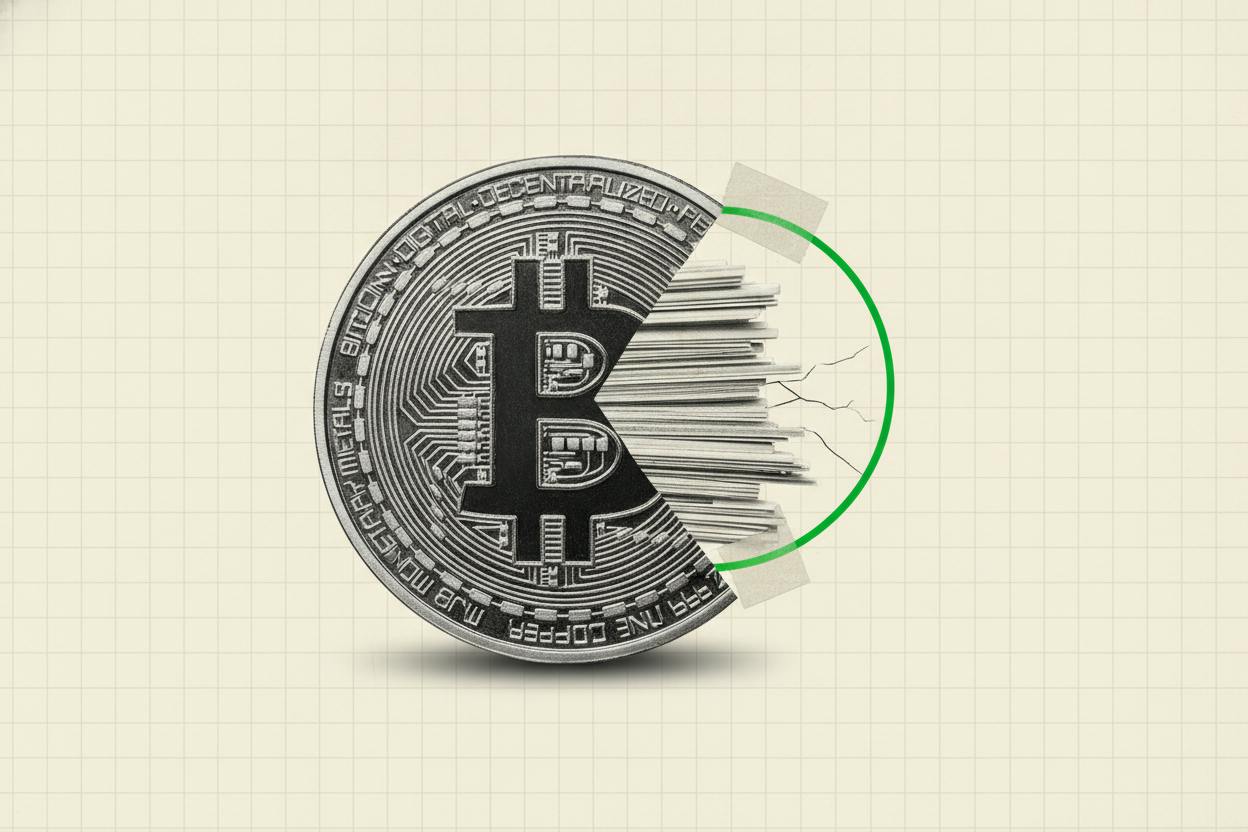
Bitcoin and gold are both having a tough year, but a JPMorgan model suggests the world's largest cryptocurrency may be significantly undervalued. The bank's "fair value" framework, first floated in 2022, benchmarks bitcoin against gold as a way to check its price. While the approach is far from perfect, it offers a useful lens for everyday investors trying to make sense of crypto's wild price swings.
How JPMorgan calculates bitcoin's fair value
The investment bank's model starts with a simple premise: if bitcoin were to eventually match the total market value of all gold held for investment purposes, what would that imply for the price of a single bitcoin? Gold's investment market is estimated at roughly $12 trillion to $14 trillion, while bitcoin's total market cap hovers around $500 billion to $600 billion. By that math, bitcoin's fair value could be 20 to 25 times higher than its current price.
But JPMorgan doesn't stop there. The bank adjusts for volatility, liquidity, and the fact that gold has thousands of years of history as a store of value. The result is a more conservative fair value estimate that still suggests bitcoin has room to run, even after a rough year that has seen both assets decline. The model essentially treats bitcoin as a riskier, younger version of gold—one that could eventually close the gap as it matures.
What the model gets right
The framework's biggest strength is its simplicity. By comparing bitcoin to gold, JPMorgan gives investors a tangible benchmark for an asset that is notoriously hard to value. Unlike stocks, which can be priced based on earnings or cash flow, bitcoin produces no income. So comparing it to gold—a traditional store of value with no yield—makes intuitive sense.
The model also captures the idea that bitcoin shares key attributes with gold: it is scarce (only 21 million will ever be mined), durable, portable, and increasingly seen as a hedge against inflation and currency debasement. As central banks around the world continue to print money, both assets benefit from the narrative that they cannot be devalued by government policy. For investors looking to diversify beyond traditional assets, the comparison provides a useful starting point.
JPMorgan's approach also highlights the potential upside if bitcoin continues to gain adoption. If institutional investors, pension funds, and even central banks begin to treat bitcoin as a reserve asset, its market cap could grow significantly. The model suggests that even a small shift of gold allocations into bitcoin could drive prices much higher.
Where the model falls short
Critics argue that the gold comparison ignores some of bitcoin's strongest attributes. Bitcoin is not just a store of value; it is a global, decentralized payment network that can settle transactions in minutes, 24/7, without intermediaries. Gold, by contrast, is heavy, expensive to store, and difficult to move. The model does not factor in bitcoin's utility as a medium of exchange or its potential to disrupt traditional finance.
Another limitation is volatility. Bitcoin's price can swing 10% or more in a single day, making it far riskier than gold. JPMorgan's model adjusts for this, but critics say the adjustment is too small. If investors demand a higher risk premium for holding bitcoin, its fair value could be much lower than the model suggests.
Regulation is another wild card. Governments around the world are still figuring out how to treat cryptocurrencies. A crackdown in a major economy like the US or China could send prices tumbling, while clear, friendly regulation could boost adoption. The model does not account for these political risks, which are unique to crypto.
What it means for investors
For everyday investors, JPMorgan's fair value model is a useful tool—but not a crystal ball. It suggests that bitcoin may be undervalued relative to gold, but that does not mean the price will rise tomorrow. The model is a long-term framework, not a short-term trading signal.
Investors should also remember that gold itself has had a tough year, with prices falling as the US dollar strengthened and interest rates rose. Both assets are sensitive to macroeconomic forces like inflation, Fed policy, and global uncertainty. As we've seen in European markets, oil rallies and rate decisions can shift sentiment quickly.
The key takeaway is that bitcoin and gold are both competing for the same role in portfolios: a hedge against fiat currency risk. JPMorgan's model provides a framework for thinking about that competition, but it is not a recommendation to buy or sell. As with any investment, diversification and a long-term horizon are critical.
For those interested in the broader crypto market, the model also raises questions about other digital assets. If bitcoin's fair value is tied to gold, what about ethereum or smaller coins? The answer is far from clear, but the framework at least gives investors a starting point for comparison.
Ultimately, JPMorgan's fair value model is a reminder that even the most sophisticated Wall Street analysis has limits. Bitcoin's price will ultimately be determined by supply and demand, adoption, and regulation—not just a comparison to a shiny metal. But for investors trying to navigate the noise, it is a helpful anchor in a sea of uncertainty.