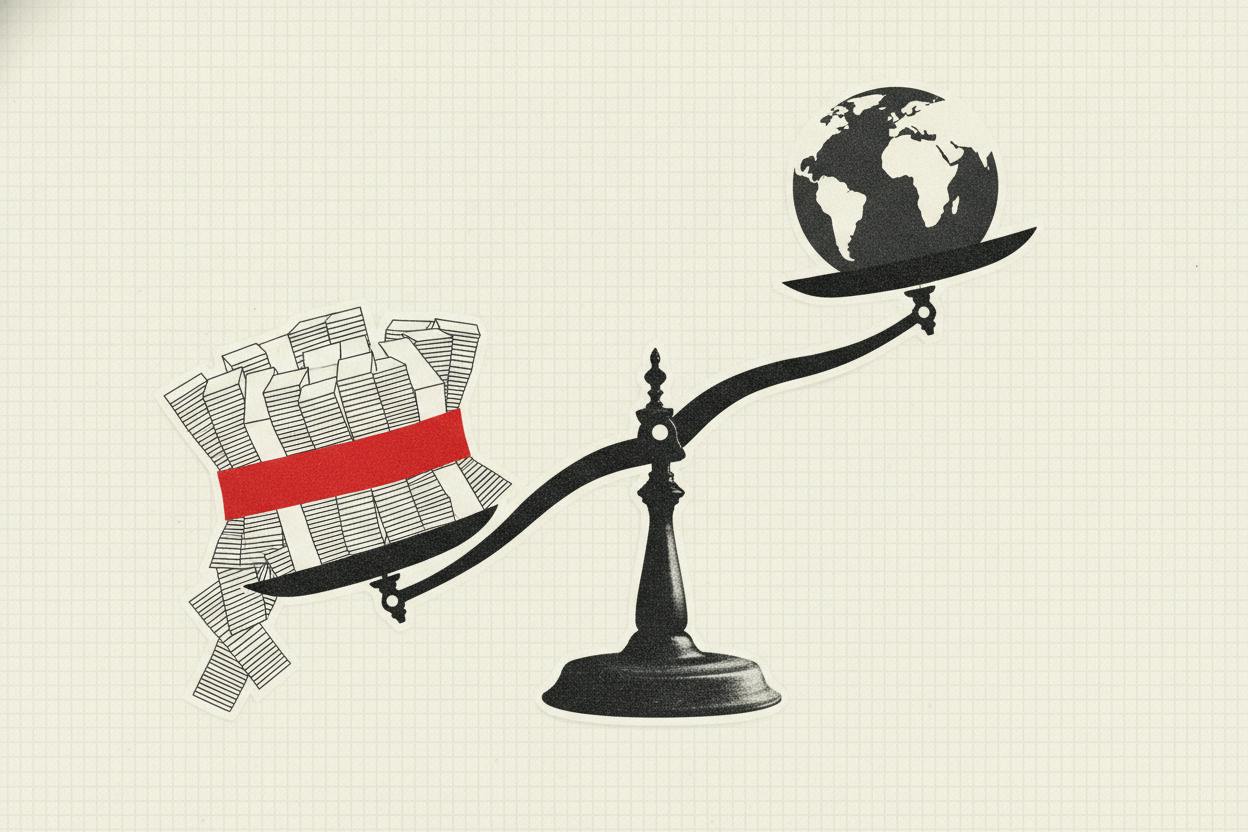
Governments in the world's richest countries are still borrowing as if they are fighting a crisis, even though the emergency has passed. That is the warning from JPMorgan, which expects developed markets to run a combined budget deficit equal to 5.5% of their economic output this year — and that is without a recession forcing spending up or tax revenues down.
In a note published Tuesday, the bank's analysts said fiscal policy in many advanced economies has become "disconnected from the business cycle." In plain terms, governments are no longer tightening their belts during good times, which is the traditional way to rebuild room for manoeuvre before the next downturn hits.
Debt keeps climbing
The numbers help explain why economists are paying attention. JPMorgan estimates that government debt across developed markets has risen by about 7 percentage points of GDP since 2019. More than 70% of those countries still have weaker budget positions than they did before the pandemic, according to the bank.
That matters because the pandemic-era borrowing was supposed to be temporary. Governments around the world spent heavily to support households and businesses during lockdowns, and many promised to return to more sustainable budgets once growth recovered. Instead, spending has stayed elevated — on everything from defence and ageing populations to green-energy subsidies and industrial policy — while tax revenues have not kept pace.
The result is a structural gap. JPMorgan calculates that stabilising debt levels would require an improvement of nearly 4.6 percentage points in countries' primary balances, which measure the budget excluding interest payments. That is a huge adjustment, and one that is politically very difficult to deliver.
Why deficits matter for investors
For everyday investors, the size of government deficits is not just a wonky statistic. It has direct consequences for the money in their portfolios.
When governments borrow heavily, they issue more bonds. That increases the supply of government debt, which can push bond prices down and yields up. Higher yields on safe government bonds tend to ripple through the financial system, making borrowing more expensive for companies and households, and often putting pressure on stock valuations.
There is also the question of who pays for all this borrowing. If governments cannot close the gap through spending cuts or tax rises, they may rely on inflation to erode the real value of their debt. That is one reason investors watch central banks closely: if inflation stays stubbornly high, interest rates may need to stay higher for longer, which hits growth and asset prices.
JPMorgan's warning comes at a time when markets are already jittery about the outlook for global growth and inflation. The bank's own analysts have been busy across regions — from upgrading stocks in the UAE and Turkey while cutting Greece on valuation, to naming a new chief financial officer in a long-planned handover. But the deficit issue is a macro-level concern that affects all markets.
What to watch next
The key question for investors is whether governments will act to rein in borrowing, and how central banks will respond if they do not. In the United States, the fiscal path is a recurring theme in election years. In Europe, the European Union's new fiscal rules are meant to push countries toward lower deficits, but enforcement is often flexible. In Japan, debt levels are already among the highest in the world, yet the government continues to run large deficits.
Canada is a case in point: the country's parliamentary budget watchdog recently warned that the 2026 budget uses nearly all of the government's fiscal buffer, leaving little room for surprises. That kind of tightrope act is becoming common across developed markets.
For investors, the practical takeaway is to pay attention to bond markets as a signal. If investors start demanding higher yields to hold government debt, that is often the first sign that deficits are becoming unsustainable. It can also lead to currency weakness, which affects international portfolios.
JPMorgan's note is a reminder that the post-pandemic era of easy money and big government is not over. The deficits are not going away on their own, and the longer they persist, the more they will shape the investment landscape. Whether that means higher taxes, higher inflation, or higher interest rates remains to be seen — but investors should be prepared for at least one of those outcomes.