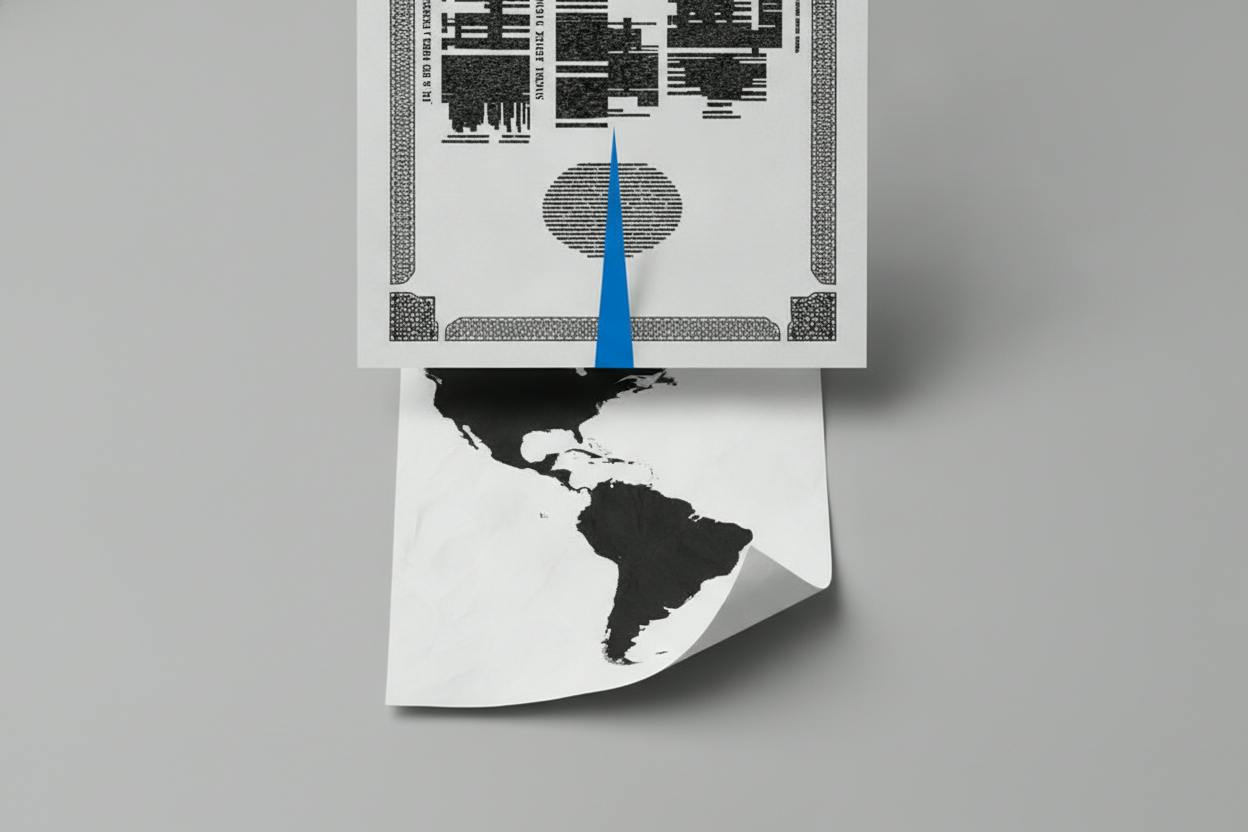
Latin American financial markets took a hit on [day] as the US 10-year Treasury yield climbed to 5.34%, its highest level since 2002. That surge in US borrowing costs lifted the dollar to its strongest point since mid-May 2025, and the ripple effect was felt across emerging markets, with currencies and stocks in the region sliding.
The MSCI index tracking Latin American currencies fell 0.67%, while the region's equities gauge dropped 0.89%. The moves were broad-based, with pressure on currencies from Mexico to Chile. Chile's peso was a standout loser, falling 1.2% to 983.43 per dollar, its weakest level since July 2025.
Why higher US yields hit emerging markets
When US Treasury yields rise, the payoff for holding US government debt increases. That makes dollar-denominated assets more attractive to global investors, who may pull money out of riskier markets like Latin America and move it into the safety of US bonds. As capital flows out, local currencies weaken and stock markets lose support.
For overseas investors, the math is straightforward: if they hold Brazilian or Mexican assets, they must eventually convert their returns back into dollars. A stronger dollar and weaker local currencies eat into those returns. At the same time, a higher “risk-free” rate in the US gives investors a more compelling alternative to emerging-market risk.
This dynamic is not new, but the scale of the move is notable. A 10-year yield above 5% is a level not seen in over two decades, and it signals that the market expects US interest rates to stay higher for longer. That expectation can persist even if the Federal Reserve cuts its short-term policy rate, because long-term yields are driven by inflation expectations, economic growth, and the supply of government debt.
The carry trade gets trickier
The recent market action also highlights the growing complexity of “carry trades,” a popular strategy in emerging markets. In a carry trade, an investor borrows money in a currency with low interest rates and uses it to buy assets in a currency with higher rates, pocketing the difference. For example, an investor might borrow in Japanese yen or Swiss francs and invest in Brazilian real or Mexican peso bonds.
These trades work best when exchange rates are stable. But when the dollar strengthens and volatility rises, the potential for currency swings can wipe out the interest-rate advantage. BBVA, a Spanish bank with a large presence in Latin America, noted that positioning has become a “more complex and challenging environment” for such strategies.
Chile's peso is a clear example. Because Chile's interest rates are relatively low compared with some of its neighbors, the peso has been used as a funding currency in carry trades—meaning investors borrow in pesos to invest elsewhere. When the dollar strengthens and volatility spikes, those investors rush to buy back the pesos they borrowed, which can push the currency down even further. That helps explain why the peso fell more than the broader regional index, even though Chile's economic fundamentals may differ from other countries in the region.
What it means for investors
For everyday investors, the key takeaway is that rising US yields and a stronger dollar don't just affect Wall Street—they have real consequences for global markets and, indirectly, for your portfolio. If you hold international funds or emerging-market ETFs, you may see increased volatility and potential losses as these dynamics play out.
It's also a reminder that diversification doesn't mean immunity. Even if you don't directly invest in Latin America, the interconnectedness of global markets means that a move in US Treasury yields can ripple through stocks, bonds, and currencies worldwide. For instance, the euro recently hit a 17-month low as US yields climbed, and the South African rand slipped despite better local data.
For those with exposure to emerging-market debt or currencies, the current environment calls for caution. The carry trade, once a reliable source of income, now carries more risk. As BBVA's comment suggests, the market is entering a phase where positioning and risk management are more critical than ever.
Investors should also watch how central banks in Latin America respond. Some may raise rates to defend their currencies, which could slow economic growth. Others may let their currencies depreciate, which can boost exports but increase inflation. Each country will face its own trade-offs.
In the near term, the direction of US yields will be a key driver. If the 10-year Treasury continues to climb, expect more pressure on emerging-market assets. If yields stabilize or fall, some of the recent losses could reverse. But with the yield at a 22-year high, the market is signaling that the era of cheap money is firmly in the rearview mirror.
For now, investors should brace for continued volatility and keep an eye on how these global forces play out in their own portfolios.