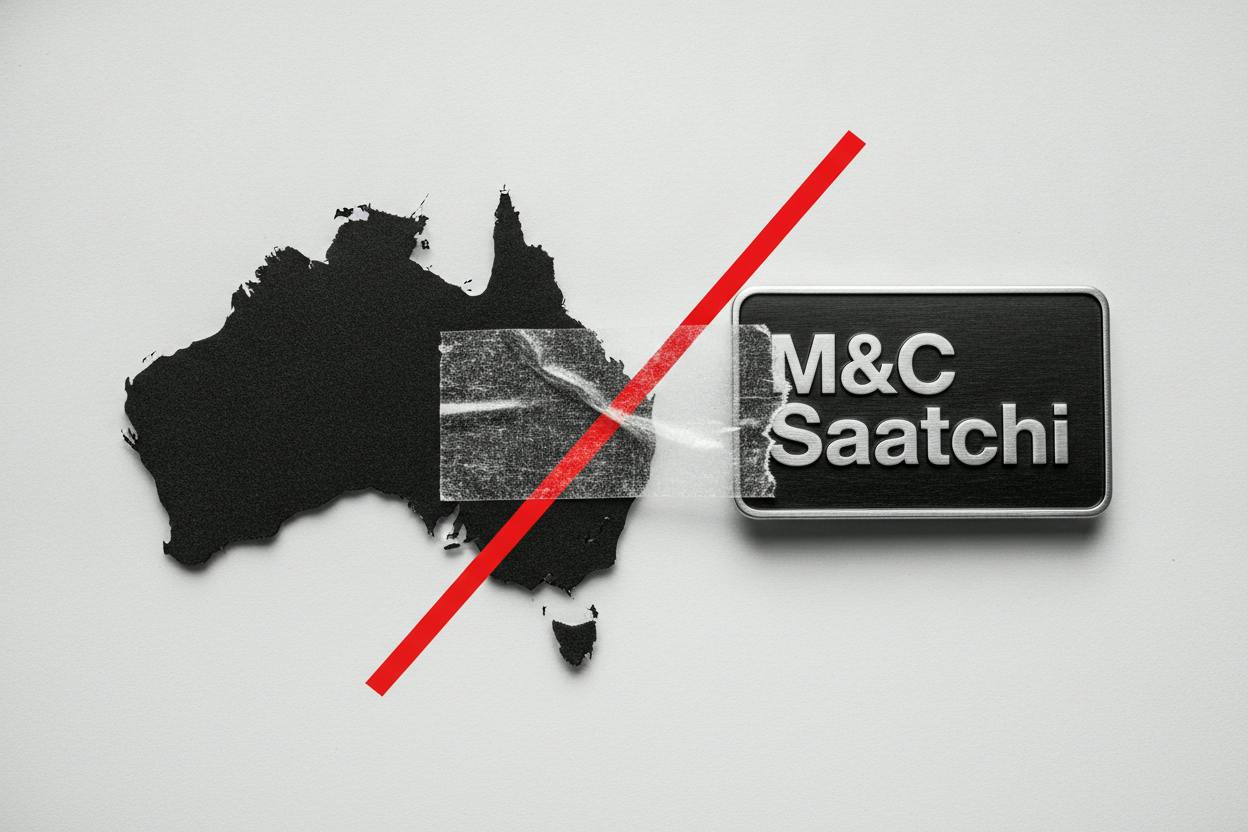
Advertising group M&C Saatchi has walked away from a plan to sell its Australia and New Zealand business to local managers for just A$1, after the two sides could not agree on terms. The collapse of the deal sent the company's shares down 6.8% to 137 pence, a sharp move for a stock that has already had a turbulent stretch.
The nominal A$1 price tag tells you most of what you need to know about how the company views the unit. This was never a deal designed to raise cash. It was a way to hand off a business the group has argued runs on thin margins, while keeping the brand in familiar hands. When even a token-price transaction falls apart, it usually signals that the complications — liabilities, contracts, pension obligations or client commitments — are harder to untangle than either side expected.
Why Australia matters more than the price suggests
Australia is the backbone of M&C Saatchi's Asia-Pacific operations. The region generated nearly 18% of the group's 2025 revenue, which makes it a meaningful slice of the pie even if profitability has lagged. That combination — big on sales, light on profit — is exactly the kind of business a parent company might look to offload when it wants to tidy up its portfolio and focus on stronger-margin markets.
There is an accounting wrinkle that makes the reversal more awkward. M&C Saatchi had been reporting Australia and New Zealand as "discontinued operations." In plain English, that means the company had effectively told investors: treat this business as if it is already gone, separate from the ongoing group. Discontinued operations are excluded from the headline numbers that analysts use to judge a company's core performance, and they are only meant to be used when a sale is likely or already agreed.
Now that the sale is off, that treatment becomes harder to justify. Investors will want to know whether the unit gets folded back into continuing operations — and if so, what that does to the group's reported revenue, margins and earnings profile. A business that was being quietly set aside may now be back in the headline figures.
What the company says happens next
M&C Saatchi has indicated it may move some client work to other parts of the group. That is a telling detail. It suggests management still wants to extract value from the region's client relationships, even without owning the local operating entity in its current form. Shifting accounts between agencies within a network is common in the ad industry, but it can be disruptive — clients do not always follow, and local teams can lose morale when their future is unclear.
For a services business like an advertising group, people and relationships are the assets. A failed sale can prompt senior staff to look elsewhere, and rival agencies are often quick to circle. That is the quiet risk in a story that otherwise looks like a minor corporate housekeeping item.
What it means for investors
The 6.8% share price drop reflects disappointment more than disaster. A nominal A$1 deal was never going to move the needle on valuation, but the failure removes a tidy outcome management had been working toward. Investors are now left with a unit that is neither sold nor fully integrated, and with questions about how it will be reported.
There are a few things to watch from here:
- Reporting treatment. Whether Australia and New Zealand stay classified as discontinued operations, or get pulled back into the main numbers, will change how the group's results look quarter to quarter.
- Margin trajectory. The company has argued the unit carries low margins. If it stays inside the group, those margins drag on the overall picture unless management can improve them.
- Client retention. Any reshuffling of accounts to other parts of the group is worth tracking, because lost clients are harder to win back than lost revenue is to replace.
- Alternative outcomes. A scrapped sale does not rule out a future deal, a restructure, or a different buyer. Management has not closed the door on options.
It is also worth putting this in a wider context. Deal activity involving Australian assets has been picking up, with private equity circling listed companies and cross-border buyers showing renewed appetite. Against that backdrop, a failed sale stands out — it suggests the problem here was specific to this asset and these terms, not a sudden freeze in the market.
For everyday investors, the takeaway is straightforward. This is a small, messy corporate event at a mid-cap advertising group, not a signal about the broader economy. But it is a reminder that when a company books a business as "discontinued," that label is a promise about the future — and promises can be broken. Reading the fine print on how revenue is classified, and asking whether a sale is actually likely, is one of the simplest ways to avoid being surprised by headlines like this one.
M&C Saatchi now has to show that the Australia and New Zealand business can earn its keep inside the group, or find another route to a clean exit. Until then, the unit sits in an uncomfortable middle ground — too important to ignore, too unprofitable to celebrate.