Morgan Stanley has upgraded auto parts supplier BorgWarner, arguing that the company's push into on-site power generation could become its next major growth driver as artificial intelligence data centers put increasing strain on electricity grids.
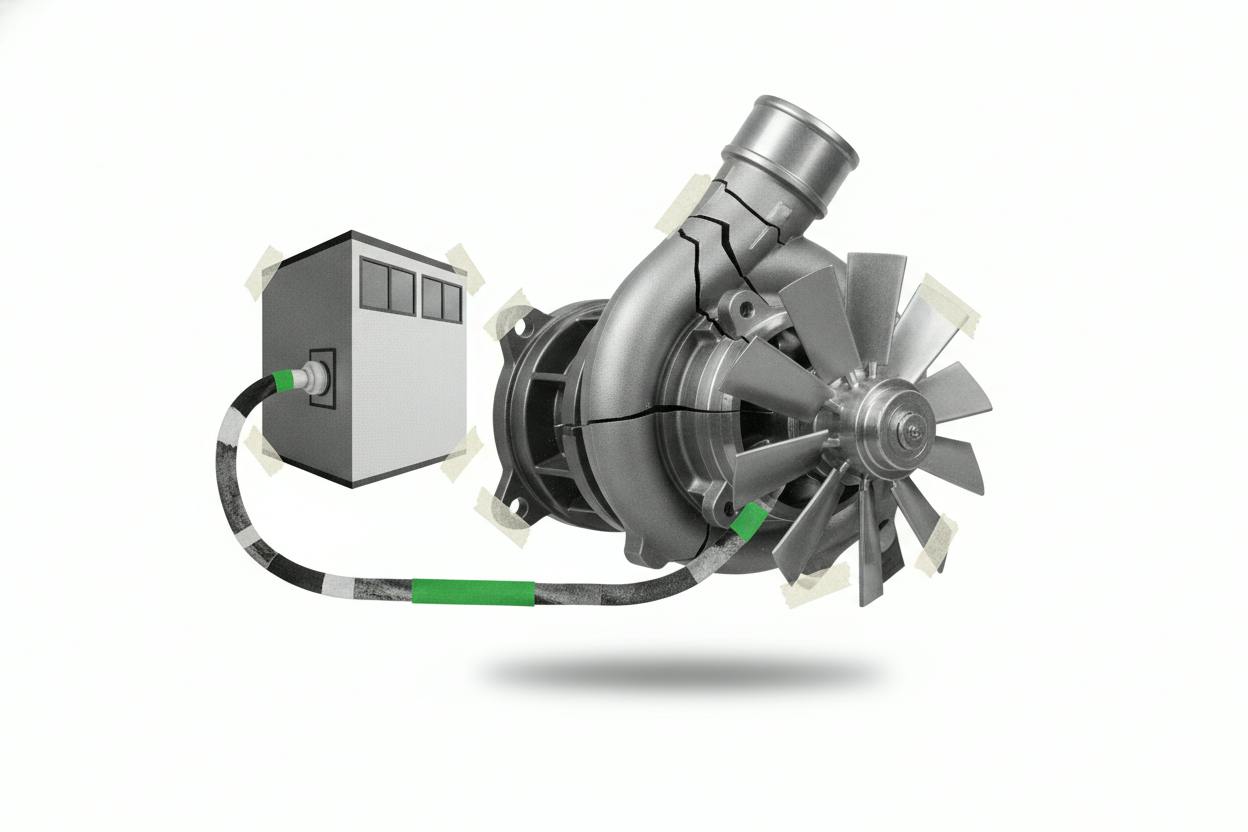
The bank's analysts believe BorgWarner's "distributed power" business—which sells turbine generator systems that can supply electricity locally when the grid cannot keep up—is well positioned to benefit from the surging demand for reliable power from data centers. At the same time, they expect the company's traditional automotive operations to remain resilient, providing a stable base while the newer power business scales up.
Still an auto company at heart
BorgWarner is still predominantly an automotive supplier. Morgan Stanley estimates that its drivetrain, turbo, and thermal management units will account for roughly 79% of the company's 2025 sales. That core business, which serves both internal combustion engine and hybrid vehicles, is expected to keep generating steady revenue even as the industry transitions toward electrification.
The company has been working to diversify beyond traditional auto parts, and its distributed power segment is a key part of that strategy. Turbine generators are not new technology, but they are gaining attention as a way to provide backup or supplemental power in places where the grid is unreliable or overloaded. Data centers, which require enormous amounts of electricity to run servers and cooling systems, are a natural fit for such equipment.
The broader context is that AI development has dramatically increased electricity demand. Training and running large language models requires vast computing power, and data center operators are scrambling to secure enough energy. This has led to a surge of interest in everything from nuclear power deals to renewable energy agreements for data centers. Morgan Stanley has also noted that power has become the bottleneck for AI, shifting focus from chips to energy infrastructure.
Why turbine generators matter
Turbine generators are essentially small power plants that can be installed on-site. They burn natural gas or other fuels to produce electricity, and they can be brought online quickly when needed. For data centers, this offers a way to ensure uninterrupted operations even if the local grid experiences outages or capacity constraints.
BorgWarner's distributed power unit has been growing, but it still represents a small fraction of overall revenue. The upgrade from Morgan Stanley suggests the bank sees significant upside potential as data center construction accelerates. The analysts reportedly believe that demand for on-site power equipment could help fill the gap left by any slowdown in the traditional auto market.
This is not the first time Morgan Stanley has highlighted the intersection of AI and power. The bank recently named Nvidia a top pick, arguing that the AI bottleneck is shifting to power availability. It has also pointed to Siemens Energy's potential to beat expectations as a sign of strength in the power equipment sector.
What it means for investors
For everyday investors, the key takeaway is that BorgWarner is no longer just an auto parts maker. The company is positioning itself to benefit from the AI-driven power crunch, which could provide a new source of growth beyond its traditional business.
However, it is important to keep expectations in check. The distributed power business is still relatively small, and the auto segment remains the dominant driver of revenue. The upgrade is a positive signal, but it does not guarantee that the power business will become a major profit center overnight.
Investors should also consider the broader risks. The auto industry is facing uncertainty as electric vehicles gain market share, and BorgWarner's reliance on internal combustion engines and hybrids could be a headwind in the long term. At the same time, the data center power market is competitive, with many companies vying for contracts.
Morgan Stanley's upgrade is a vote of confidence in BorgWarner's ability to navigate these challenges. Whether the company can turn its distributed power business into a meaningful growth engine will depend on execution and the pace of data center expansion.
For now, the story is one of diversification: a traditional auto supplier trying to ride the AI wave. If successful, BorgWarner could become a dual play on both the automotive transition and the power infrastructure buildout. If not, it remains a solid, if unspectacular, auto parts company.