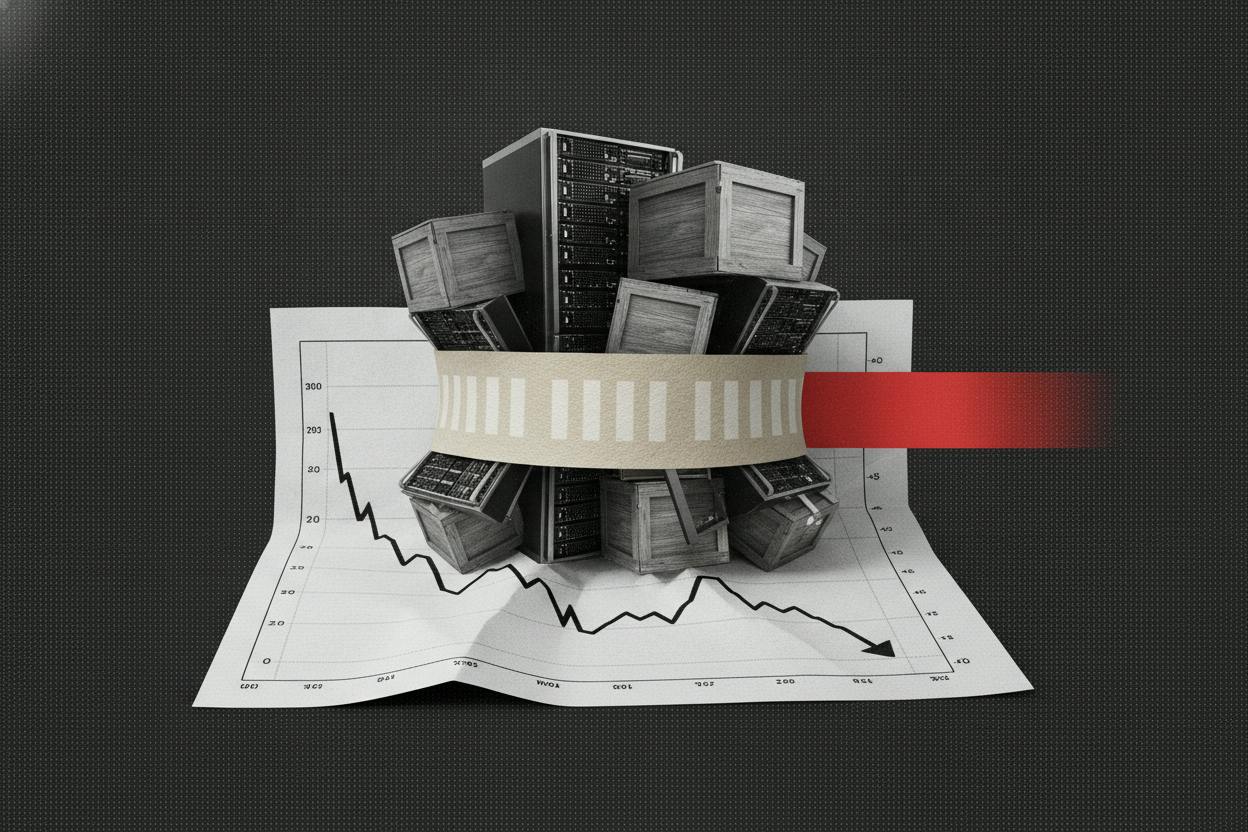
The Nasdaq 100 is on course to lose more than $2 trillion in market value this October, as investors grow uneasy about the massive sums Big Tech is pouring into artificial intelligence and the rising cost of financing those ambitions. The selloff marks a sharp reversal for an index that had been powered higher all year by enthusiasm for AI.
At the heart of the unease is a simple question: how much will it cost, and when does the money start coming back? Meta, Alphabet and Amazon have all recently raised their forecasts for spending on data centers and chips — the physical backbone of AI. Those outlays are necessary to train and run the large language models behind tools like chatbots and image generators, but they are also expensive, and they hit the income statement long before any related revenue shows up.
Why the AI bill is suddenly a problem
For most of the past two years, investors have been happy to fund the AI buildout as long as revenue kept growing. Cloud computing divisions, in particular, have been a bright spot, and advertising businesses have remained resilient. But the mood is shifting as the price tag climbs.
Data centers require land, power, cooling systems and specialized chips — many of them from Nvidia, whose processors have become the industry standard for AI training. Building at scale takes years, and the costs are booked as capital expenditures, which reduce near-term profits. When companies repeatedly lift their capex guidance, as Meta, Alphabet and Amazon have done, investors start to wonder whether the spending is outrunning the demand.
There is also a second, more immediate worry: how the buildout gets paid for. In a world of higher interest rates, borrowing is no longer cheap. Companies can fund expansion through cash flow, new debt or issuing new shares. Each option has a cost. Debt means interest payments that eat into earnings. New shares dilute existing investors. And if rates stay elevated, the present value of future AI profits — the very thing justifying today's spending — looks less impressive.
The rate backdrop makes everything harder
Central banks have kept interest rates well above the near-zero levels that prevailed for much of the 2010s. While inflation has cooled from its peak, it remains above many central banks' targets, and policymakers have signaled they are in no hurry to cut aggressively. That matters for high-growth technology stocks, which are valued largely on the promise of profits far in the future. When rates rise, those future profits are worth less in today's dollars, and share prices tend to adjust.
The result is a market that is far less forgiving of companies that spend heavily without a clear, near-term return. That is a change from the easy-money era, when investors rewarded growth at almost any cost.
What it means for investors
For ordinary investors, the October slide is a reminder that even the most powerful market themes can wobble. The Nasdaq 100 is a market-cap-weighted index, meaning its performance is dominated by its largest members — the very companies now under scrutiny for their AI spending. If those giants stumble, the index feels it disproportionately.
It also highlights the difference between a company's story and its numbers. AI may well transform the economy, but the companies building the infrastructure must eventually show that the investment pays off. Until then, investors are being asked to be patient — and patience is harder to come by when borrowing costs are high.
Here are a few things worth watching in the weeks ahead:
- Capex guidance: Any further increases in AI-related spending plans from Meta, Alphabet, Amazon or Microsoft will be scrutinized for signs of discipline.
- Cloud and ad revenue: These are the main near-term sources of cash that fund the buildout. Slowing growth would intensify the debate.
- Bond yields: If long-term interest rates keep climbing, pressure on tech valuations could build. If they ease, some of that pressure may lift.
- Financing choices: Watch for new debt issuance or equity raises tied to AI projects. Both can weigh on shares.
The broader market has also felt the ripples. Recent sessions have seen sharp declines in tech-heavy futures and related stocks, with AI spending fears and warnings about cash flow from companies like Amazon and Intel contributing to the volatility. Those moves show how quickly sentiment can turn when the market's biggest spenders are seen as overshooting.
None of this means the AI trade is over. Many analysts still expect the technology to drive earnings growth for years. But the October drawdown is a clear signal that investors are no longer willing to write blank checks. They want to see the bill — and the return — come into balance.