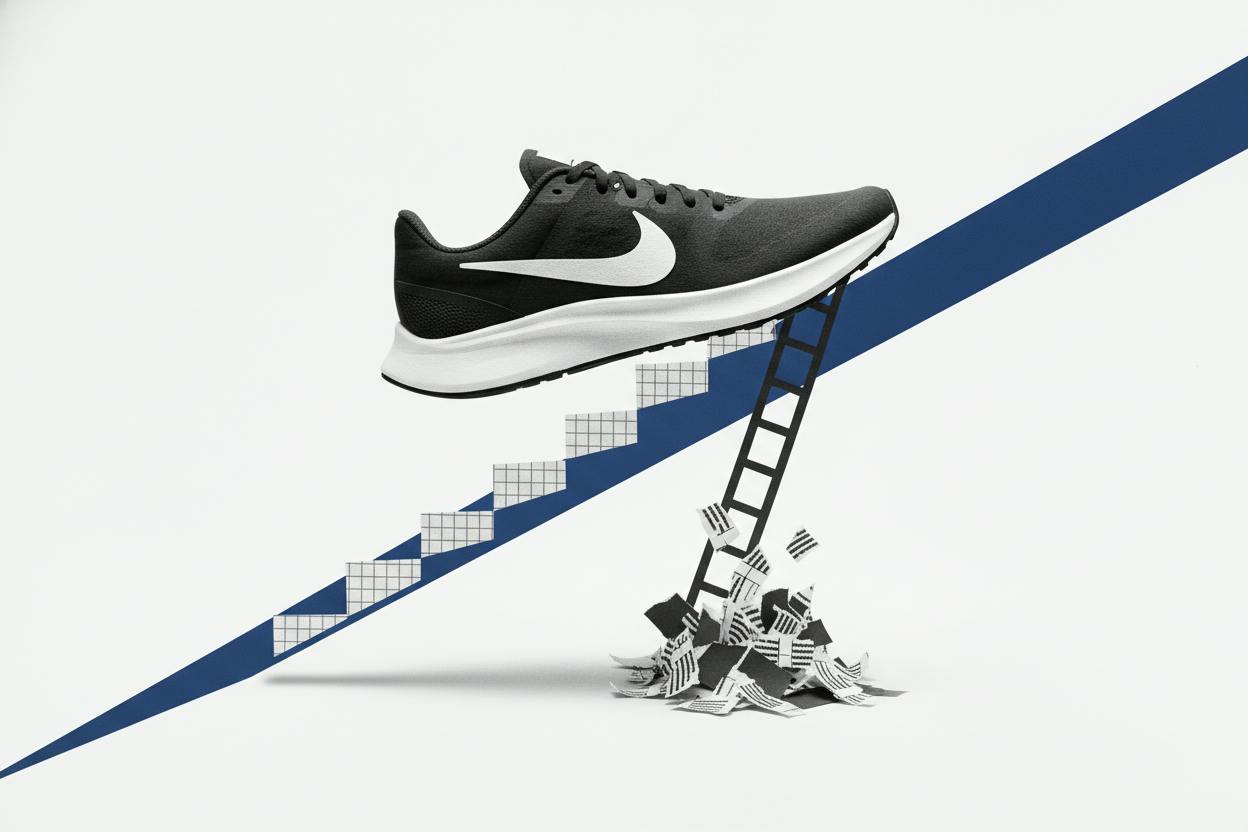
Nike used its Investor Day to lay out a long-term growth strategy, but the message to investors was clear: the road to recovery will take years. The athletic-apparel giant unveiled its “Full Stride Ahead” plan, targeting $5 billion in incremental revenue by fiscal 2031, alongside operating margins of 12% to 14% and adjusted earnings per share of $3.00 to $3.50.
That upbeat long-term vision, however, comes with a near-term reality check. Nike reaffirmed its fiscal 2027 guidance for a high-single-digit revenue decline, a 6% adjusted operating margin, and adjusted earnings per share of $1.15 to $1.35. That range sits close to Wall Street’s expectations of about $1.27, according to LSEG I/B/E/S data.
Bridging the gap: PACE and the ‘Connected’ model
To close the gap between a weak near term and a stronger long term, Nike is leaning on a cost and productivity program called PACE. The company expects PACE to deliver $2.50 billion in annual run-rate savings by fiscal 2031. But that efficiency push comes with a price: Nike flagged $1.30 billion in pre-tax charges in fiscal 2027 as it restructures operations.
Operationally, Nike’s “Connected” model shifts more decision-making to priority countries and cities. The company is also continuing a reset in Greater China, a market that has been a drag on growth, while aiming to accelerate momentum elsewhere. Its “Fast” initiative uses data, technology, and artificial intelligence to improve planning, shorten product cycles, and raise efficiency across the supply chain.
Nike is concentrating resources on 23 priority countries, where it expects priority sports and sportswear categories to drive more than 90% of revenue growth through fiscal 2031. That focus suggests the company is betting on its strongest markets rather than spreading itself thin globally.
Shareholder returns: dividends in focus
Nike also leaned into shareholder returns, projecting $2.40 billion in dividends for fiscal 2027 and $12 billion in cumulative dividends from fiscal 2027 through fiscal 2031. That signals confidence in its ability to generate cash even during a period of restructuring and slower sales.
For everyday investors, the dividend outlook is a key part of the story. Nike has a long history of returning cash to shareholders, and the projected payouts provide some income support while the company works through its turnaround.
What it means for investors
Nike is asking investors to look past a softer fiscal 2027 and focus on an earnings and margin recovery that lands years later. The $3.00 to $3.50 adjusted EPS target for fiscal 2031 is a significant jump from the $1.15 to $1.35 range expected for fiscal 2027.
When more of a company’s value rests on profits expected further out, the stock can act like a “long-duration” equity. That means changes in discount rates—the rates used to translate future profits into today’s dollars—can move the valuation more than a single quarter’s results. In other words, Nike’s stock price may become more sensitive to interest-rate expectations and the market’s confidence in its long-term plan than to near-term sales updates.
Until Nike delivers clearer proof points that it can bridge the gap from fiscal 2027’s 6% operating margin to its fiscal 2031 goal of 12% to 14%, day-to-day moves in the stock could hinge as much on macroeconomic factors as on company-specific news. Investors will likely watch for signs that the PACE savings are materializing and that the “Connected” and “Fast” initiatives are translating into better product cycles and stronger demand.
For context, Nike’s challenges are not unique. Many consumer brands are navigating shifting consumer preferences, supply chain disruptions, and a competitive landscape. But Nike’s size and brand power give it resources that smaller rivals lack. The question is whether the company can execute its plan effectively in a fast-changing market.
As always, investors should consider their own time horizon and risk tolerance. A long-term growth plan can be attractive, but it also carries execution risk. Nike’s ability to hit its fiscal 2031 targets will depend on how well it manages the transition, and whether the global economy and consumer spending cooperate.
For now, the market’s focus will be on Nike’s near-term performance and any signs that the turnaround is gaining traction. The company’s next earnings report will be a key test of whether the “Full Stride Ahead” plan is on track.



