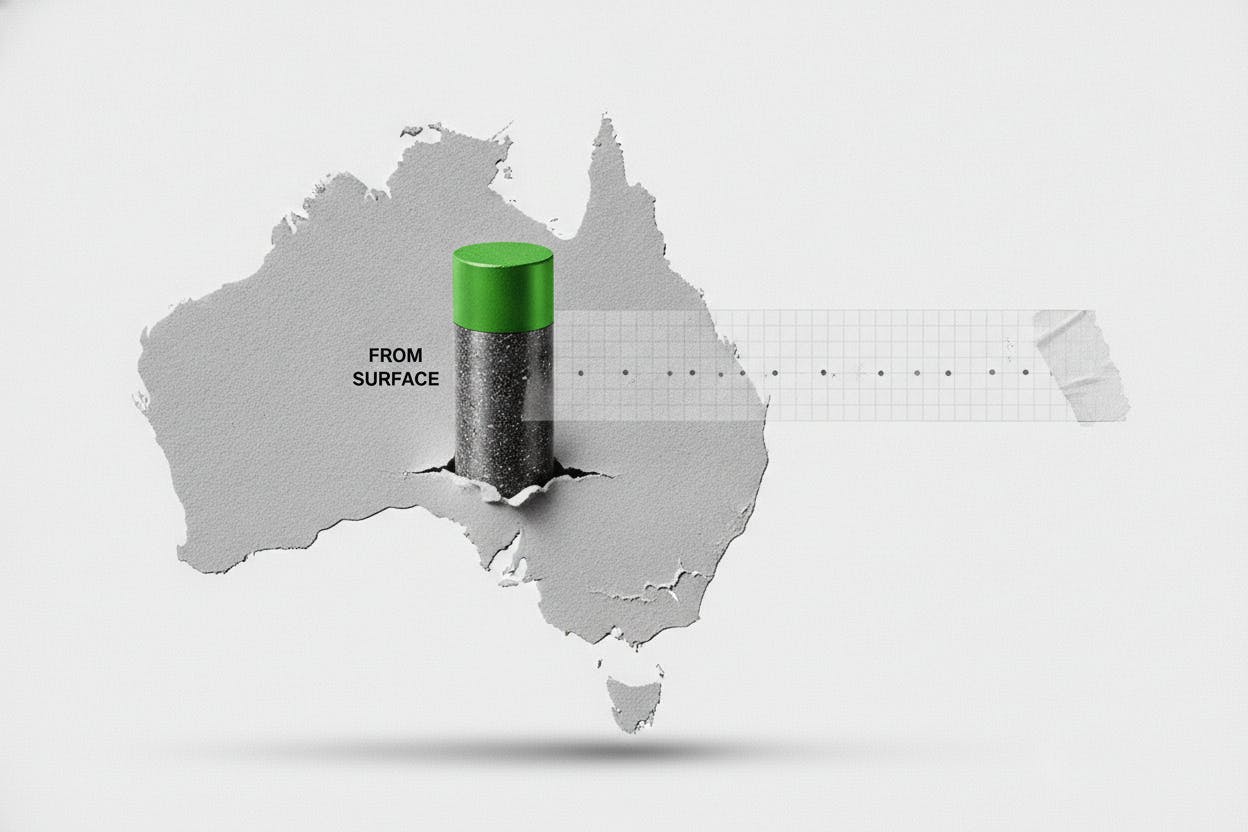
Novo Resources has announced its first drilling results from the Wyloo SE project in Western Australia, and the early returns are promising. The maiden holes intersected 9 meters of mineralization grading 92 grams per tonne (g/t) silver and 1,280 parts per million (ppm) antimony, starting right from the surface.
At the same time, the explorer expanded its adjacent Toolunga land position to 2,242 square kilometers, signaling a broader push into the region. The news comes as junior mining companies continue to search for critical minerals and precious metals in Australia's mineral-rich Pilbara and Gascoyne regions.
What the Drilling Results Mean
The intercept at Wyloo SE is notable for two reasons. First, the mineralization begins at surface, which could mean lower mining costs if the project ever advances to development. Second, the grades are high: 92 g/t silver is well above the typical cutoff for silver mines, and antimony at 1,280 ppm is a significant concentration for a metal that is increasingly classified as critical by governments worldwide.
Antimony is used in flame retardants, batteries, and military applications, and supply is concentrated in a few countries, including China and Russia. That has made it a focus for Western nations seeking to diversify sources. Silver, meanwhile, is a precious metal with industrial uses in solar panels, electronics, and medical devices, as well as being a store of value.
For context, similar high-grade silver discoveries have drawn investor attention recently. For example, Trinity One Metals shares jumped 9.5% on a high-grade silver find in Ecuador, and analysts at RBC and Morgan Stanley have flagged the Sinda silver project in Mexico as a potential top-tier mine by 2032, as seen in this analysis and this report.
Expanding the Land Position
Novo also expanded its Toolunga land package to 2,242 square kilometers. That is a large area for a single project, roughly the size of a small country. The expansion suggests the company sees potential for multiple mineralized zones beyond the initial Wyloo SE discovery.
Exploration companies often consolidate land positions early in a project's life to secure access to prospective ground before competitors move in. The move also gives Novo room to test different geological targets, which could include gold, silver, antimony, or other metals.
The broader market context is also relevant. Precious metals and critical minerals have seen increased interest as investors seek hedges against inflation and geopolitical uncertainty. However, exploration-stage companies like Novo are high-risk investments, as drilling results can be unpredictable and development timelines are long.
What It Means for Investors
For everyday investors, this news is a reminder that early-stage exploration can produce exciting headlines, but it comes with significant risk. The drilling results are from maiden holes — the very first tests — so they do not yet define a resource or guarantee that a mine will ever be built.
Investors should watch for follow-up drilling to confirm the extent and consistency of the mineralization. If subsequent holes also hit high grades over wider intervals, the project could attract more attention from larger mining companies or joint venture partners. Conversely, if results are mixed, the stock could lose momentum.
The expansion of the Toolunga land package is a positive signal that management is committed to the region, but it also means higher exploration spending. Investors should monitor the company's cash position and burn rate to ensure it can fund its drilling programs without excessive dilution.
In the broader market, silver and antimony prices are influenced by industrial demand, supply chain dynamics, and macroeconomic trends. Recent moves in precious metals have been tied to trade tensions and inflation data, as seen in TSX futures dipping 0.2% as gold, silver, and oil retreated and stocks edging higher as wholesale inflation cooled.
Ultimately, Novo's Wyloo SE results are an early but encouraging data point. For investors, the key is to treat it as one piece of a larger puzzle — and to stay tuned for the next round of drilling.