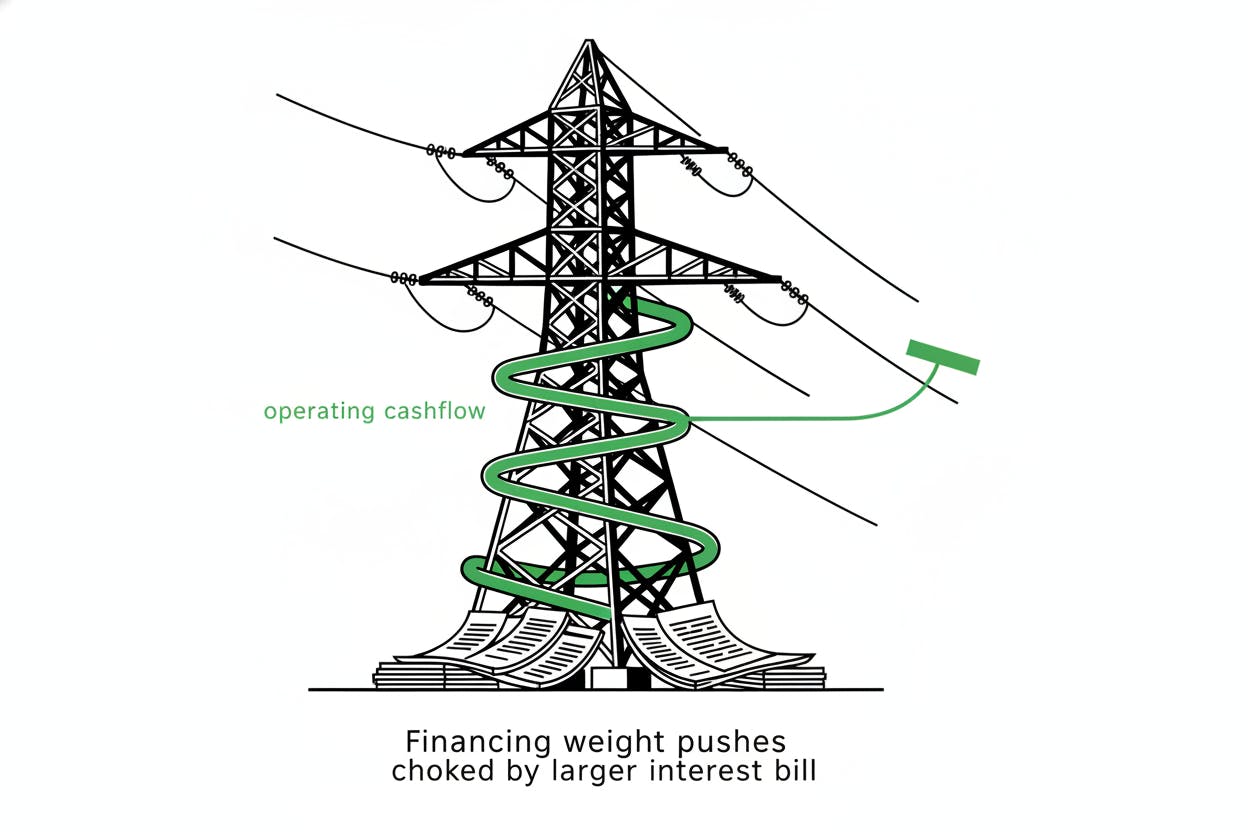
NRG Energy's second-quarter earnings came in below analyst forecasts, as the Houston-based power company's interest expenses ballooned while it worked through its $12 billion acquisition of LS Power's generation assets. The utility reported net interest expense widened to a $310 million loss, up from a $148 million loss a year earlier, according to the company's latest filing.
The higher financing costs helped pull adjusted earnings down to $1.49 per share, missing the $1.70 estimate from LSEG. The miss came even as operating performance improved, with adjusted EBITDA rising—a sign that the underlying business is healthy but the financial drag from the deal and the rate environment is weighing on the bottom line.
Why interest costs are biting
Utilities are among the most capital-intensive businesses in the market. They borrow heavily to buy power plants, upgrade transmission lines, and build new capacity to meet growing electricity demand. When interest rates stay elevated for longer, the cost of that debt climbs quickly, and the impact shows up directly in the income statement as a larger interest expense line.
NRG's $12 billion LS Power deal, which closed earlier this year, added a significant amount of debt to the company's balance sheet. That debt, combined with the Federal Reserve's decision to keep its benchmark rate at a two-decade high, has made the financing burden much heavier than it was a year ago. The company's net interest expense more than doubled year over year, a stark illustration of how rate-sensitive the utility sector has become.
For everyday investors, this is a reminder that a company's earnings aren't just about how much it sells or how efficiently it operates—they're also about how much it costs to fund the business. When a company takes on big debt to grow, higher rates can eat into profits even if operations are running smoothly.
What it means for investors
NRG's miss is a cautionary tale for investors in utilities and other debt-heavy sectors. The company's core business appears to be performing well, with adjusted EBITDA improving, but the financial engineering is currently working against it. This is a common pattern across the utility industry right now, as many companies that borrowed cheaply in the past are now refinancing at much higher rates.
Investors should watch how NRG manages its debt load in the coming quarters. The company may look to pay down debt, refinance at lower rates if the Fed eventually cuts, or sell assets to raise cash. Any of those moves could help ease the interest burden and boost future earnings.
The broader takeaway is that higher-for-longer interest rates are still rippling through the economy, and companies that are heavily leveraged are feeling the pinch. This is not just a utility problem—it affects everything from industrial firms to steelmakers that have taken on debt for acquisitions.
For those invested in NRG or similar companies, the key is to focus on the long-term fundamentals. The LS Power deal is meant to expand NRG's generation capacity and position it for future growth, particularly as electricity demand rises from data centers and electric vehicles. If the company can integrate the assets successfully and eventually reduce its debt, the current profit miss could be a temporary setback rather than a lasting problem.
Looking ahead
NRG's next earnings report will be closely watched for signs that the interest expense is stabilizing or declining. The company may also provide guidance on its debt reduction plans. In the meantime, the stock's reaction to the miss will depend on whether investors see it as a one-off or a sign of deeper issues.
For the broader market, this earnings season has been a mixed bag, with some companies beating expectations and others falling short due to financing costs. The FTSE 100's recent rebound and Metro Bank's turnaround show that strong operational performance can still drive gains, but the interest rate environment remains a headwind for many.
Ultimately, NRG's story is a reminder that in a high-rate world, the cost of capital matters as much as the return on it. Investors should keep an eye on balance sheets, not just income statements, when evaluating companies that rely on debt to grow.