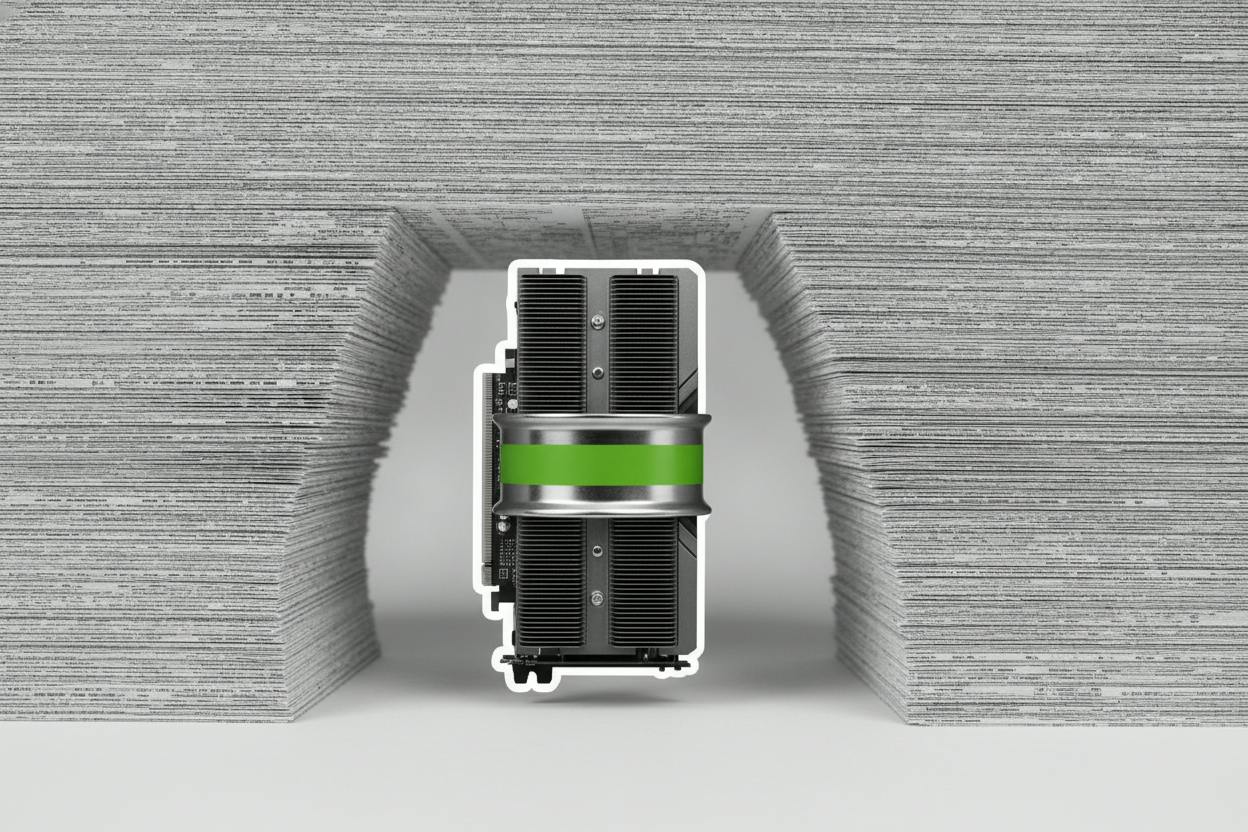
China's largest internet companies are racing to secure a rare commodity: Nvidia graphics chips that still comply with US export rules. According to a Reuters report, ByteDance, Tencent, and Alibaba have together ordered more than 3 million units of Nvidia's RTX PRO 5500 GPU, a deal valued at over $35 billion. However, Nvidia has cautioned that it may not be able to fulfill every order, leaving a significant supply gap.
The compliant chip bottleneck
The RTX PRO 5500 is one of the few Nvidia data-center GPUs that can be legally sold to Chinese customers under current US export controls. These restrictions, tightened over the past few years, aim to limit China's access to advanced AI and computing technology. As a result, Chinese firms have been aggressively stockpiling whatever compliant hardware they can get.
Reuters' sources indicate that total orders from China for the RTX PRO 5500 already exceed 6 million units. In contrast, Nvidia has signaled it might produce up to 3 million of these chips in 2027. That potential shortfall makes Nvidia's "no guarantee" warning credible—and it underscores the intense demand for AI infrastructure in China.
This is not a single mega-deal but rather a bottleneck around a specific product line. The RTX PRO 5500 is based on Nvidia's professional GPU architecture, designed for AI training and inference workloads. For Chinese tech firms, securing these chips is critical to maintaining their competitive edge in AI development, especially as domestic alternatives remain less mature.
Why this matters for investors
For everyday investors, this story highlights two key trends. First, the global AI boom continues to drive enormous demand for computing power, even amid geopolitical tensions. Nvidia's ability to sell compliant chips to China represents a significant revenue stream, but it is also a delicate balancing act between satisfying US regulators and meeting customer needs.
Second, the supply constraint suggests that Nvidia's revenue from China could be capped in the near term. While the company has diversified its customer base, China remains a major market. If Nvidia cannot produce enough RTX PRO 5500 chips to meet demand, it may miss out on billions in potential sales. On the other hand, the scarcity could allow Nvidia to command premium pricing, which might offset some of the volume shortfall.
Investors should also watch how this plays out in the broader context of US-China tech relations. The export controls are unlikely to be relaxed soon, and Chinese firms are increasingly looking for domestic alternatives. For instance, Huawei and DeepSeek have teamed up to design AI chips for the Chinese market, a sign that local innovation is accelerating. This could eventually reduce China's reliance on Nvidia, but for now, the RTX PRO 5500 remains a critical piece of the puzzle.
The demand for AI infrastructure is also reflected in other sectors. ABB's data center orders have surged as AI demand powers growth, showing that the ripple effects of the AI boom extend beyond chipmakers. Similarly, China's Q3 growth beat forecasts, but exports did the heavy lifting, indicating that the country's tech sector remains a key driver of economic activity.
What to watch next
Investors should keep an eye on Nvidia's earnings calls and any updates on production capacity. The company's ability to ramp up RTX PRO 5500 output will be crucial in determining whether it can capitalize on the Chinese demand. Additionally, any changes to US export policy could significantly alter the landscape, either opening up more opportunities or further restricting sales.
For those holding Nvidia stock, the key takeaway is that demand remains robust, but supply constraints could limit near-term growth. For those watching the broader tech sector, this story is a reminder that geopolitical factors can have a direct impact on corporate earnings and market dynamics.
In the meantime, Chinese tech giants are likely to continue their stockpiling efforts, even if they have to pay a premium. As long as the AI arms race continues, the demand for compliant chips will remain high, and Nvidia will be at the center of it all.