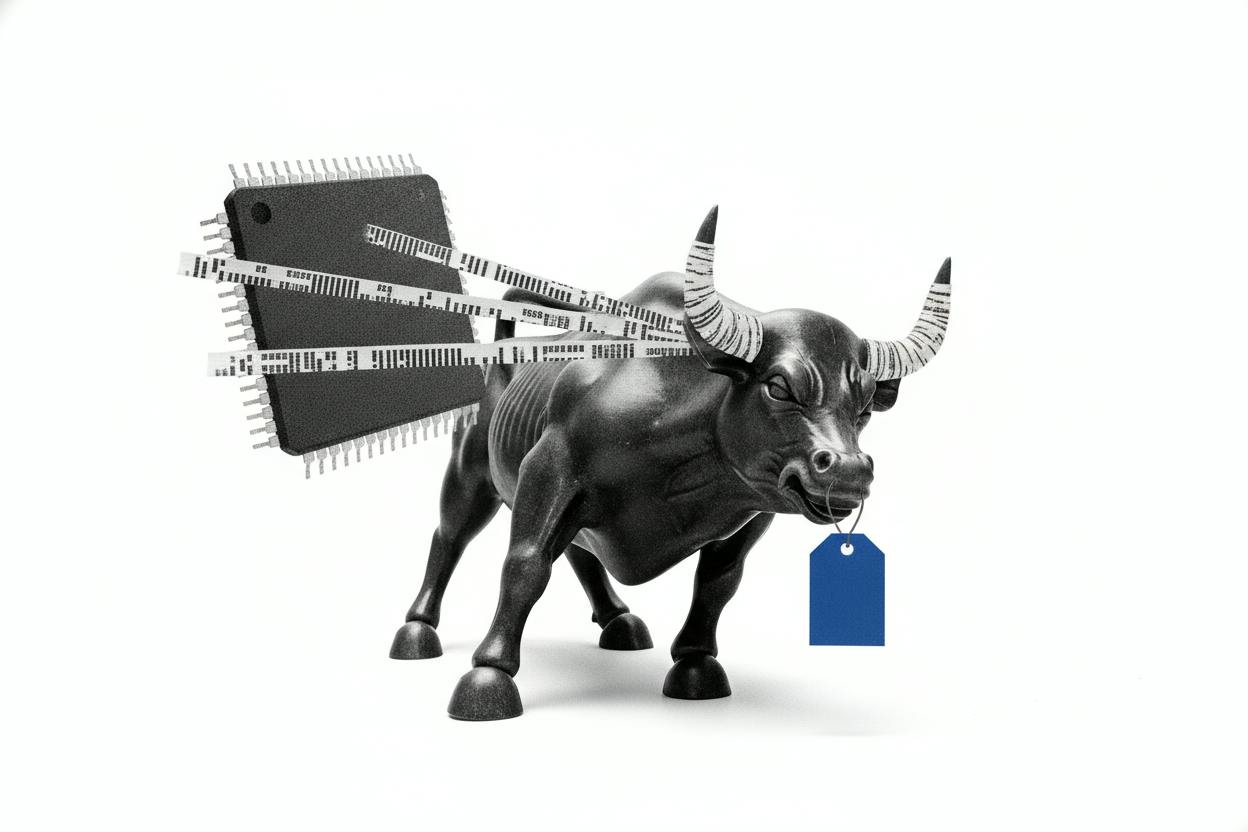
Wall Street's attention shifted from Nvidia's blockbuster sales forecast to a different kind of bellwether: Anthropic's upcoming IPO. While the Nasdaq edged higher, Nvidia shares dipped despite projecting about $130 billion in quarterly revenue, a figure that topped analysts' expectations. The muted reaction signals that investors are looking beyond the next quarter to longer-term concerns.
Why Nvidia's good news wasn't enough
Nvidia's revenue outlook was undeniably strong, but the stock's lackluster response points to two persistent worries. First, competition in the AI chip market is intensifying, with rivals like AMD and custom chip designers chipping away at Nvidia's dominance. Second, the company faces a leadership transition after CEO Jensen Huang's exit, a change that Reuters notes is still on investors' minds. As Nvidia falls despite beating estimates, the market seems to be pricing in future challenges rather than celebrating current wins.
Adding to the pressure, Federal Reserve Governor Christopher Waller told CNBC that the central bank should consider a larger December rate hike or at least signal a quicker path for future increases. That message tends to hit high-growth stocks hardest, because more of their value comes from profits expected years down the road. When rates rise, those future profits are worth less today, which can compress valuations across the tech sector.
Anthropic's IPO: a real-time test for AI valuations
With Nvidia's headline digested, attention turned to Anthropic, the maker of the Claude chatbot. Reuters reports the company is eyeing a valuation as high as $1.4 trillion in its IPO. That pricing is being treated as a live check on demand for "frontier AI" stories—companies pushing the boundaries of artificial intelligence.
An IPO doesn't just raise cash for one company; it creates a public-market "clearing price" that investors can use to value similar businesses. If Anthropic prices strongly, it could lower the perceived risk premium for frontier-AI bets and support richer valuation multiples across adjacent listed names. Reuters flagged AI infrastructure "neocloud" players like CoreWeave and Nebius as likely beneficiaries, with knock-on effects for the Nasdaq's AI-heavy cohort. As Anthropic's $1.4 trillion IPO approaches, the outcome will ripple through the sector.
But if the deal needs a meaningful discount to get done, it could have the opposite effect: a reminder that investors want a higher return to hold long-duration growth stories. That can compress multiples even when the underlying technology narrative stays intact. In other words, Anthropic's IPO is not just about one company—it's a barometer for the entire AI trade.
What it means for everyday investors
For the average investor, the key takeaway is that AI enthusiasm is still strong, but it's becoming more selective. Nvidia's forecast shows demand for AI chips remains robust, yet the stock's reaction suggests the market is already looking for the next catalyst. Meanwhile, Anthropic's IPO will provide a fresh data point on how much investors are willing to pay for AI growth.
Rate hikes are another factor to watch. If the Fed moves faster than expected, high-growth tech stocks could face headwinds, as we've seen in previous cycles. As Nvidia's rosy outlook lifts futures but Fed minutes loom, the interplay between earnings and monetary policy will continue to drive market moves.
For now, the market is sending mixed signals: the Nasdaq is holding up, but individual AI names are volatile. Investors should keep an eye on Anthropic's pricing and the Fed's next move, as both could set the tone for the weeks ahead. As always, diversification and a long-term perspective remain prudent strategies in a market that's balancing optimism with caution.