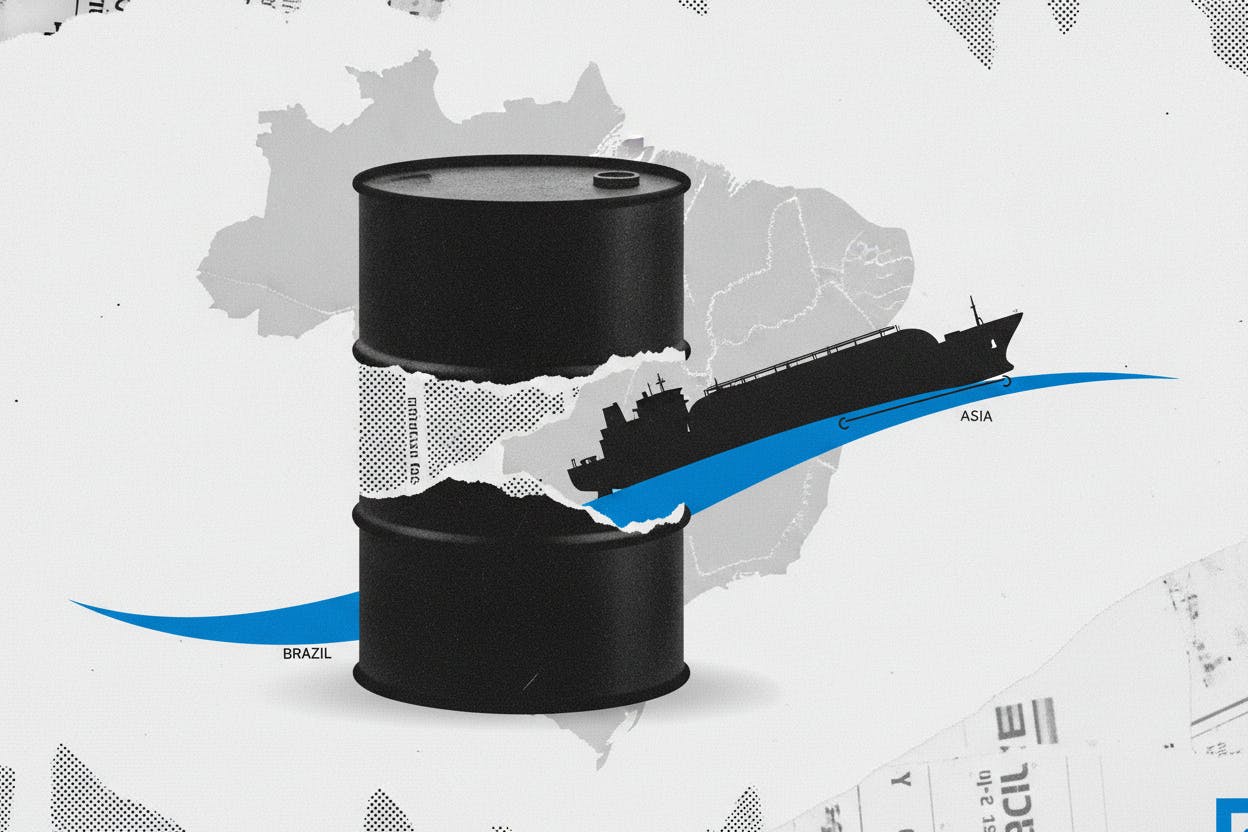
Oil prices took a step back on Tuesday, but Brazil's state-controlled energy giant Petrobras managed to buck the trend, rising on news that it's considering shipping liquefied natural gas (LNG) to Asia. The report, from Bloomberg, said the company is weighing exports to a region where buyers are scrambling to replace lost supply from Qatar.
The divergence between crude and Petrobras' share price is a reminder that energy companies aren't just oil plays anymore. For everyday investors, it's worth understanding why a producer's fortunes can be tied to more than just the daily ups and downs of West Texas Intermediate or Brent.
What happened in the oil market
The headline numbers were straightforward. West Texas Intermediate, the US benchmark, fell about 1% to $82.73 a barrel. Brent, the global benchmark, slipped 0.5% to $89.30. The moves were modest, and traders pointed to a mix of profit-taking and ongoing uncertainty about global demand.
That backdrop is familiar to anyone who's watched energy markets this year. Crude has been buffeted by concerns about supply disruptions, particularly around the Strait of Hormuz, and by hopes that central banks might soon cut interest rates, which could boost economic activity and fuel demand. As Brent crude neared $90 recently, the market has been on edge.
But Petrobras' move on Tuesday wasn't about crude. It was about natural gas.
Why LNG is a different game
Liquefied natural gas is natural gas that's been cooled to a liquid state so it can be shipped across oceans in special tankers. It's a growing part of the global energy trade, and it's priced differently than crude oil. While oil is a globally traded commodity with a fairly uniform price, LNG prices can vary widely by region, driven by local supply and demand, shipping costs, and the availability of liquefaction and regasification capacity.
That's why a report about Petrobras considering LNG exports to Asia can move its stock even when oil is falling. Asia, particularly countries like Japan, South Korea, and China, is a major buyer of LNG. If supply from Qatar—one of the world's biggest LNG exporters—is disrupted, buyers in Asia have to look elsewhere, and they're often willing to pay a premium to secure cargoes.
For Petrobras, which already produces natural gas as a byproduct of its oil operations, exporting LNG could open up a new revenue stream. It's a way to sell gas that might otherwise be used domestically or flared, and it could fetch higher prices than the local Brazilian market.
What it means for investors
For investors, the key takeaway is that energy companies are increasingly multi-faceted. A company like Petrobras isn't just an oil stock; it's also a gas play, and its profits can be influenced by events in far-flung markets.
That can be a source of volatility, but it can also be a diversifier. If oil prices slump but gas prices spike, a company with both oil and gas exposure might hold up better than a pure oil producer. Conversely, if gas prices collapse, it could drag on results.
The report also highlights the importance of supply disruptions. When a major exporter like Qatar has problems, it sends ripples through the entire global gas market. That's a reminder that energy prices are often driven by geopolitics and logistics as much as by supply and demand fundamentals.
For Petrobras specifically, the potential LNG exports would be a new venture. The company has traditionally focused on oil production, but it's been expanding its gas business. If it follows through, it could become a more significant player in the global LNG trade, which is dominated by companies like QatarEnergy, Shell, and Cheniere Energy.
That said, the report is just a report. Petrobras hasn't confirmed any plans, and there are many hurdles between considering an idea and actually shipping cargoes. The company would need to secure liquefaction capacity, either by building its own facilities or by contracting with existing ones, and it would need to navigate the complex logistics of shipping LNG across the Atlantic or through the Panama Canal.
The bigger picture
Tuesday's price action is a microcosm of the broader energy market. Oil and gas are related, but they're not the same. Investors who lump them together might miss important signals.
For now, the oil market remains focused on the usual suspects: OPEC+ production decisions, global demand, and geopolitical tensions. The recent rise in Brent crude toward $90 was driven in part by worries about the Strait of Hormuz, a key shipping lane for oil and gas. Any disruption there would affect both crude and LNG, but the impact could be different.
Meanwhile, other commodities have been moving on their own dynamics. Copper prices have been rising as exchange stockpiles tighten, and zinc has hit multi-year highs on supply worries. These moves are a reminder that each commodity has its own supply-demand story.
For Petrobras investors, the LNG report is a reason to keep an eye on the company's strategy. If it moves forward, it could change the way the market values the stock. If it doesn't, the company remains a solid, if volatile, oil play.
Either way, the episode underscores a simple truth: in today's energy markets, the story is rarely just about oil.