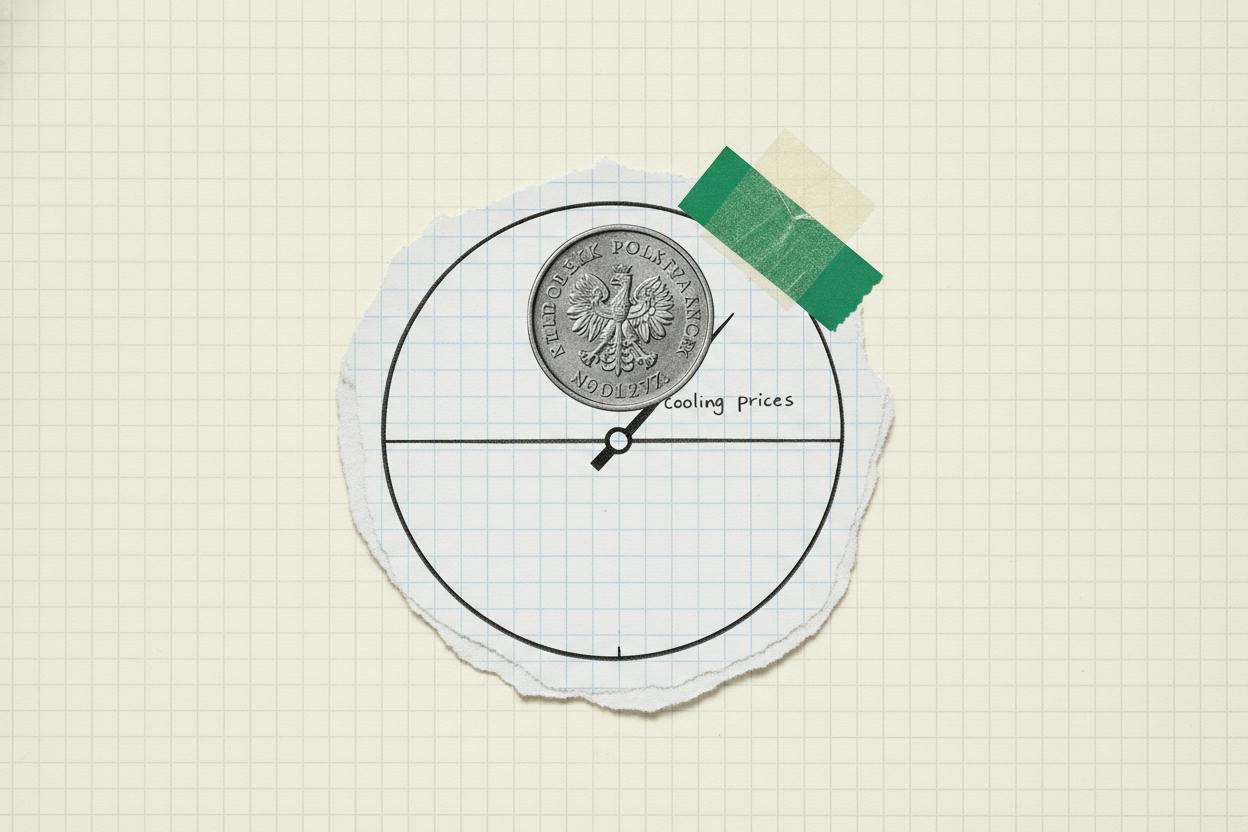
Poland's central bank left its main interest rate unchanged at 3.75% on Wednesday, citing a fresh cooldown in inflation that has brought price growth back inside its official target range. The decision, widely expected by economists, marks a pause after a period of uncertainty over whether another hike might be needed.
Preliminary data for October showed inflation slowed to 3.5% year-on-year, down from 4.1% in September. That puts the reading back within the National Bank of Poland's target of 2.5%, plus or minus one percentage point — a band that runs from 1.5% to 3.5%. The latest figure sits right at the top of that range.
Why the pause was expected
Most analysts had predicted no change. According to a Reuters poll, 26 of 29 economists expected rates to stay at 3.75%, while three forecast a hike to 4.00%. The softer inflation print helped tilt the balance toward holding.
Piotr Bielski, an economist at Erste Bank Polska, said the weaker reading "significantly decreased" the risk of a hike. He also noted that the central bank's updated inflation and growth projections, released alongside the decision, did not look worrying enough to force action.
The hold suggests the Monetary Policy Council sees current policy as sufficiently restrictive. With inflation back inside the target band, the argument for an "insurance" hike — one designed to guard against future price pressures — loses much of its force.
What investors are watching next
The focus now shifts to the details. The central bank's new forecasts, which cover inflation and economic growth, will be scrutinised for clues about the future path of rates. Governor Adam Glapinski is scheduled to hold a press conference on Thursday, and his tone could move markets.
If Glapinski sounds confident that inflation is under control, traders may start pricing in a longer hold at 3.75%. If he hints that cuts could come sooner than previously thought, that would be a more dovish signal. Either way, the conversation is likely to move from "will they hike again?" to "how long will they sit still?"
That shift matters for Polish assets. Short-term government bonds are particularly sensitive to changes in rate expectations. When the market believes the peak rate has been reached, yields on short-dated paper often adjust quickly. Money markets will be watching Thursday's press conference for any hint that the hold could turn into easing.
The zloty is also in play. A relatively high interest rate can support a currency by attracting foreign capital, but that support can fade if investors start to expect earlier cuts. A steady, hawkish hold tends to be positive for the currency; a dovish hold could weigh on it.
What it means for everyday investors
For Polish households and savers, the pause means borrowing costs are likely to stay elevated for a while. Anyone with a variable-rate mortgage or loan won't see immediate relief, but they also won't face another increase. On the savings side, deposit rates at banks may remain attractive as long as the central bank keeps its key rate at 3.75%.
For investors holding Polish bonds or the zloty, the key question is how long the central bank stays on hold. If inflation continues to fall, the next move could eventually be a cut — but that's not expected in the near term. The central bank's own projections, along with Glapinski's comments, will provide the clearest signals.
Poland's situation is part of a broader regional picture. Central banks across Central and Eastern Europe have been navigating similar trade-offs between fighting inflation and supporting growth. In the Czech Republic, for example, inflation has also cooled, though a rate hike is still expected there. Meanwhile, the eurozone is dealing with its own inflation challenges, as energy costs remain a wildcard.
For now, Poland's central bank appears comfortable with its current stance. The question is whether that comfort lasts — and what it means for the next move.