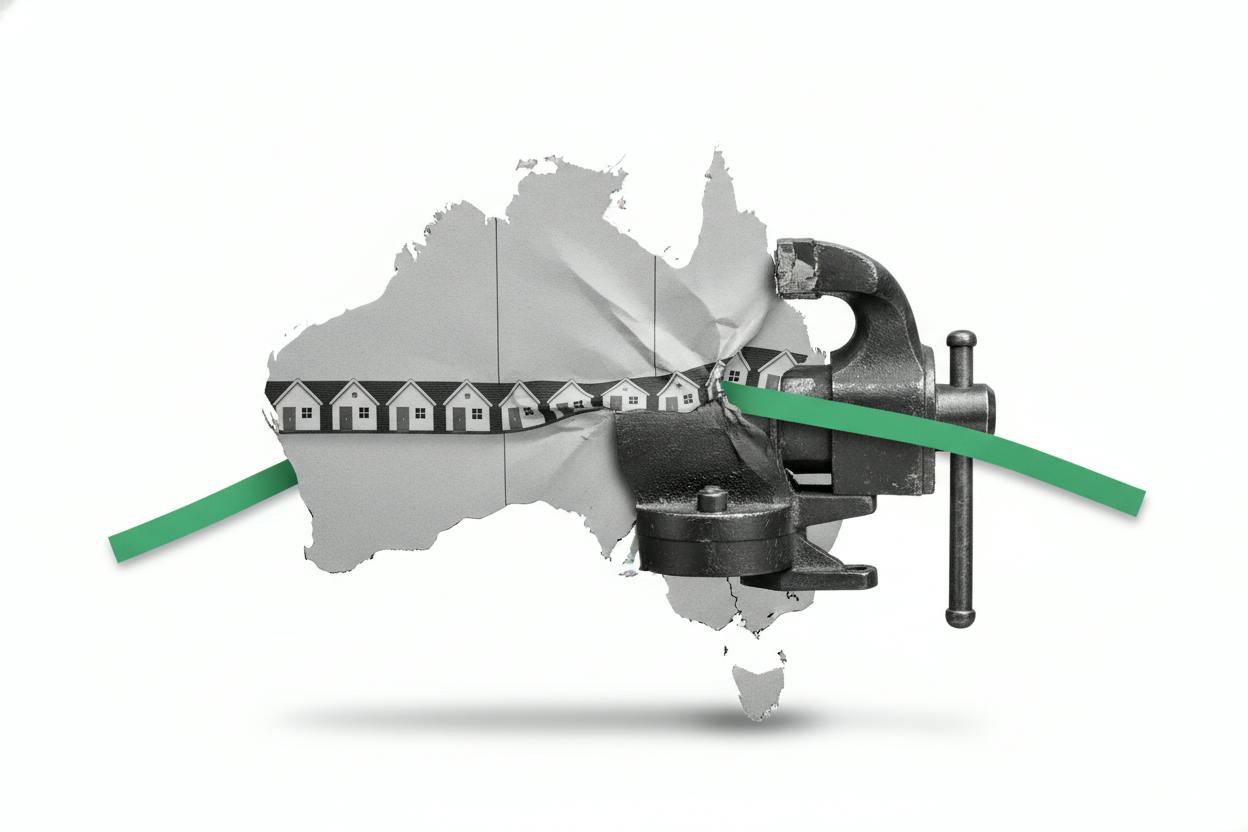
The Reserve Bank of Australia (RBA) has delivered a clear message: after five interest rate hikes that took the cash rate to 4.85%, monetary policy is now doing its job of restraining the economy. But the central bank's own officials admit the signals are not all pointing in the same direction.
Speaking at an event in Sydney, David Jacobs, the RBA's head of domestic markets, said financial conditions are "clearly" restrictive, with housing the most obvious stress point. His argument rests on the "real" cash rate — the policy rate adjusted for inflation expectations — which now sits above most estimates of a "neutral" level, the rate that neither heats up nor cools down the economy.
Yet Jacobs also explained why that tightness isn't showing up everywhere. Credit spreads — the extra interest lenders charge above a benchmark to compensate for risk — are unusually low, and business lending remains solid. That means many companies' all-in borrowing costs haven't risen as much as the cash rate alone would suggest.
Why the mixed signals matter
The uneven squeeze is more than a curiosity. It complicates the RBA's job of judging how much more damage higher rates might do. If some parts of the economy are still borrowing cheaply, the overall impact of policy may be less than the headline rate implies.
Jacobs warned that policy could "bite harder" if weakness in housing spills over into jobs and income. That's the channel the RBA is watching closely: when households cut back because mortgage repayments are higher, businesses lose customers, and that can lead to layoffs and slower wage growth.
For now, markets are leaning toward the view that the hiking cycle is over. Reuters reported that traders see the first rate cut possibly arriving in the second half of next year, after a sharp rise in unemployment. That timeline is not guaranteed, but it reflects a growing belief that the RBA's next move will be down, not up.
What it means for investors
For everyday borrowers, the RBA's message is a reminder that the cash rate is only part of the story. The central bank sets the benchmark price of money, but lenders decide how much extra to charge different borrowers. With credit spreads low, some businesses can still borrow on relatively favorable terms, which can make the economy look more resilient than "restrictive" policy usually implies.
Mortgages, however, often reprice more directly off the cash rate. That means households can feel the hit faster through higher repayments and tougher refinancing conditions. So the timing of relief is less about whether corporate borrowing looks comfortable and more about the labor-market knock-on effects Jacobs highlighted.
If housing weakness starts weighing on employment and wage growth, that is what typically changes the RBA's calculus. Investors should watch jobs data and consumer spending for signs that the housing stress is spreading. A sharp deterioration in the labor market could bring rate cuts sooner than expected, which would be a tailwind for rate-sensitive sectors like property and consumer discretionary stocks.
On the other hand, if business lending stays solid and credit spreads remain low, the RBA may feel less urgency to cut. That would keep the cash rate higher for longer, which is generally a headwind for growth-oriented investments.
The RBA's own language suggests it is in no rush. "Restrictive" is a deliberate word — it signals that policy is working, but also that the central bank is prepared to hold its ground until it sees convincing evidence that inflation is under control.
For investors, the key takeaway is that the path of rates is not a straight line. The mixed signals mean the RBA will likely need more data before it moves. Until then, expect volatility in rate-sensitive assets and keep an eye on the labor market as the most important indicator to watch.