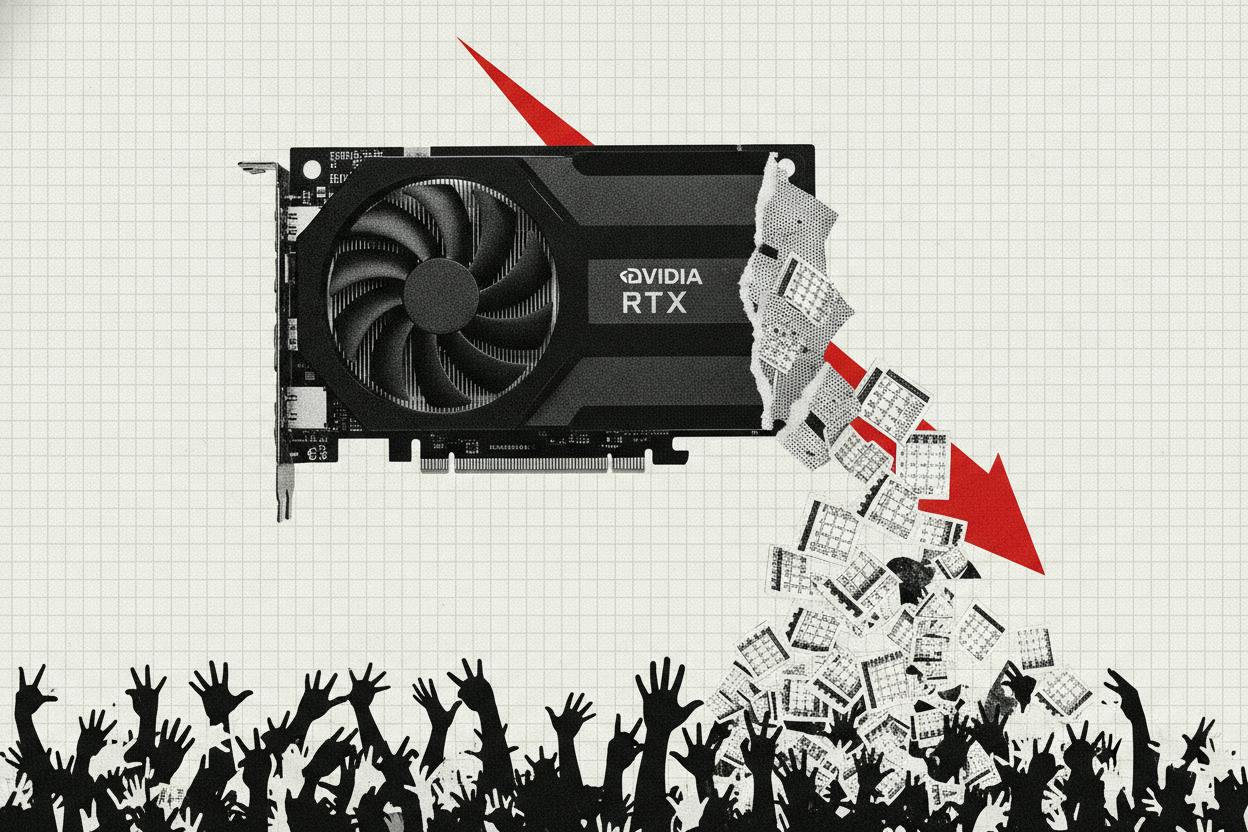
Retail investors rushed to buy Nvidia shares on Thursday, pouring $111 million into the stock in the first half-hour of trading, according to data from Vanda Research. The buying came even as the stock slid about 5%, extending a weekly loss that has wiped out roughly $550 billion in market value.
The rush to buy the dip highlights how quickly individual investors still reach for beaten-down tech names, especially those tied to the artificial intelligence boom. But this decline is not just a routine pullback. It follows the sudden resignation of longtime CEO Jensen Huang, a move that has injected fresh uncertainty into a company that had become a Wall Street favorite.
Why the stock is falling
Nvidia's shares opened sharply lower on Thursday before trimming some losses. The drop comes on top of a brutal week for the chipmaker, which has seen its market capitalization shrink by more than half a trillion dollars. The trigger was Huang's departure, which was announced amid reports of an affair. The board has named CFO Colette Kress as interim CEO, and Harvey Jones has been appointed as the company's first board chair.
Leadership changes at a company as closely tied to one founder as Nvidia are rarely smooth. Huang had been the face of the company and a driving force behind its rise to become one of the world's most valuable firms. His exit leaves a leadership vacuum that could take time to fill, and investors are now weighing how the company will navigate its next chapter without its longtime chief.
For context, Nvidia's stock had been on a remarkable run, fueled by explosive demand for its graphics processing units (GPUs) used in AI data centers. The company's chips are considered the gold standard for training large language models, and its earnings have repeatedly beaten expectations. But that success also means the stock trades at a premium, leaving it vulnerable to sharp selloffs when sentiment shifts.
What the retail buying means
The $111 million in first-half-hour inflows is a sign that many individual investors see the drop as a buying opportunity rather than a reason to flee. This behavior is consistent with a pattern seen throughout the recent AI rally, where retail traders have repeatedly bought dips in big-name tech stocks, often with success.
However, this time the dip comes with an added layer of risk. The leadership change is a fundamental shift, not just a temporary market wobble. While retail investors may be betting that Nvidia's business will remain strong regardless of who is at the helm, the market is also pricing in the possibility that the company's strategic direction could change.
Wall Street analysts are also shifting their focus. The debate is no longer just about next quarter's earnings, but about what demand for Nvidia's chips looks like further out. Baird, an investment bank, has reportedly cut its outlook, reflecting concerns about the sustainability of AI spending and the competitive landscape.
What it means for everyday investors
For the average investor, the key takeaway is that Nvidia's stock is now more volatile than it has been in years. The combination of a leadership vacuum, a high valuation, and questions about future demand means that sharp swings in either direction are likely to continue.
Buying the dip can be a profitable strategy in a strong uptrend, but it carries real risk when the underlying story changes. Investors who already own Nvidia shares should be prepared for more turbulence. Those considering adding to positions should weigh the potential for further declines against the company's still-dominant market position.
It's also worth noting that the broader AI trade has held up relatively well, with rivals like AMD and other chipmakers seeing gains even as Nvidia stumbles. That suggests investors are not abandoning the AI theme, but they are becoming more selective about which companies they trust to lead it.
As the situation develops, all eyes will be on the interim CEO and the board's next moves. The company's ability to reassure investors about its leadership and long-term strategy will likely determine whether the stock can stabilize or if the selloff has further to run.
For now, the retail buying spree shows that many individual investors remain confident in Nvidia's fundamentals. But the $550 billion weekly loss is a stark reminder that even the most beloved stocks can fall hard when the news turns sour.