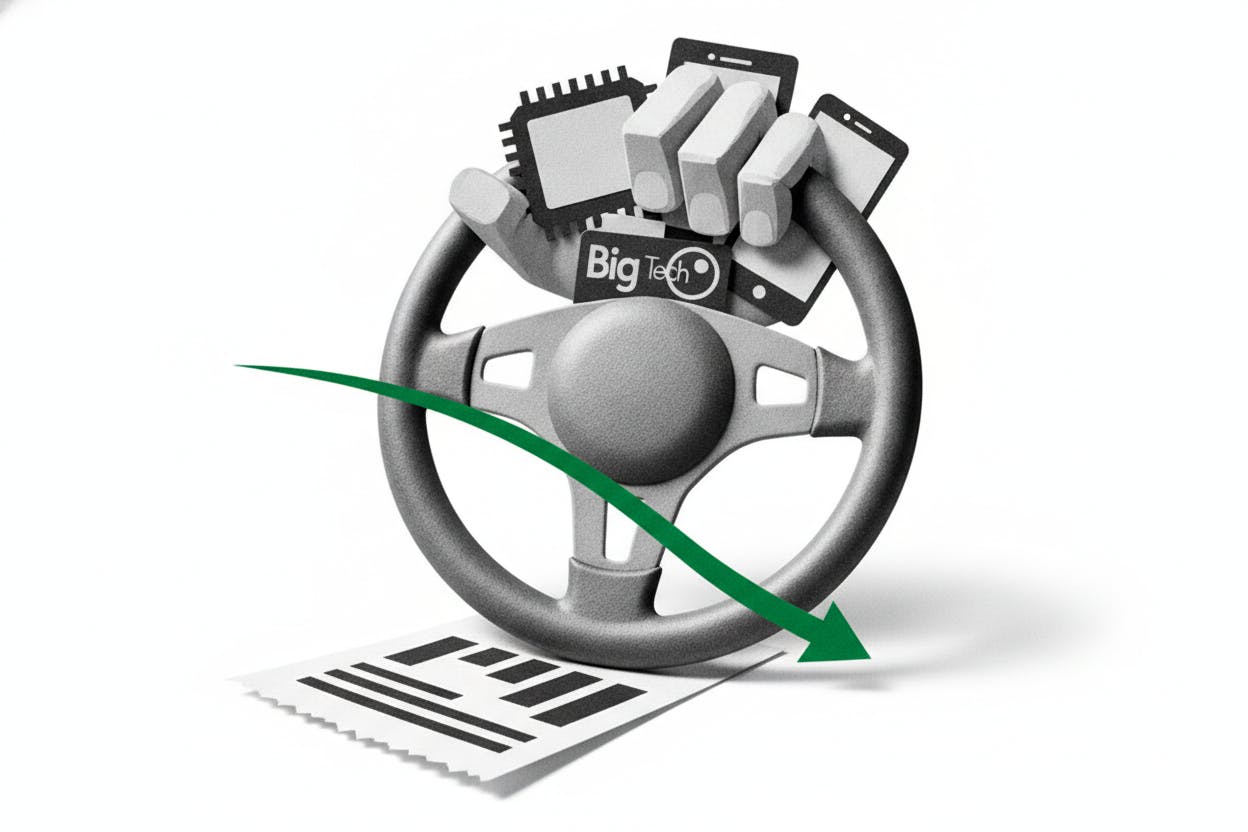
Wall Street's main benchmark touched a fresh intraday record on Thursday, as a softer-than-expected reading on producer prices and a sharp drop in oil prices helped pull investors back into the technology giants that have powered the market's rally for much of the year.
The S&P 500 rose 0.73%, while the tech-heavy Nasdaq Composite climbed 0.92%. The Dow Jones Industrial Average, which is less weighted toward tech, added 0.36%. The move was broad, but technology did the steering: the S&P's information technology sector gained 1%, led by Microsoft (up 1.4%), Nvidia (up 0.6%), and Apple (up 0.5%).
That marks a reversal of the rotation that dominated early July, when investors shifted money into more economically sensitive sectors like financials and industrials, betting that the Federal Reserve would soon cut rates and boost the broader economy. Thursday's action suggests that, for now, the market's appetite for Big Tech remains strong.
What drove the rally?
The immediate catalyst was a softer-than-expected July producer price index (PPI), which measures the prices that businesses receive for their goods and services. A cooler reading suggests that inflationary pressures at the wholesale level are easing, which could give the Federal Reserve more room to hold interest rates steady—or even cut them later this year.
At the same time, Brent crude, the international oil benchmark, fell 2.2%. Lower energy prices tend to reduce costs for businesses and consumers, which can help keep inflation in check and support corporate profit margins. The drop in oil also eased concerns that rising fuel costs might force the Fed to keep rates higher for longer.
Traders responded by pricing in a 65% chance that the Fed will hold rates at its next meeting, according to futures markets. That's a shift from earlier in the summer, when many investors expected a rate cut as soon as September. The Fed has kept its benchmark rate at a two-decade high for over a year, and officials have repeatedly said they need more confidence that inflation is sustainably moving toward their 2% target.
Why Big Tech is leading again
The return to Big Tech reflects a simple dynamic: when inflation fears ease and the economic outlook stabilizes, investors often gravitate back to the companies with the strongest earnings growth and most reliable cash flows. Microsoft, Nvidia, and Apple are among the largest companies in the S&P 500, so their moves have an outsized impact on the index.
Nvidia, in particular, has been a bellwether for the artificial intelligence boom, with its chips powering everything from data centers to AI models. Microsoft and Apple are also heavily tied to AI and cloud computing, making them key beneficiaries of the ongoing tech spending cycle.
Brock Weimer, an analyst at wealth management firm Edward Jones, noted that Thursday's action was a clear reversal of the early-July rotation into value and cyclical stocks. That rotation had been driven by hopes that the Fed would soon cut rates, which would disproportionately help economically sensitive sectors. But with the Fed now seen as more likely to hold, investors are once again favoring the growth and stability of mega-cap tech.
What it means for investors
For everyday investors, the record high is a reminder that the market's path is rarely a straight line. Even as the S&P 500 sits at all-time highs, there are still crosscurrents: inflation data, oil prices, and central bank policy all remain in flux.
The fact that the Fed is now seen as more likely to hold rates than cut them suggests that borrowing costs will stay elevated for a while longer. That can be a headwind for smaller companies and those with heavy debt loads, but it hasn't deterred investors from paying up for the earnings growth of the tech giants.
If you're invested in a broad index fund, Thursday's move is a good example of why diversification matters. While tech led the charge, the Dow's smaller gain shows that not every sector is moving in lockstep. And if you're holding cash, the continued strength in stocks—even with rates high—might make you wonder whether you're missing out. But it's worth remembering that market records can be followed by pullbacks, and timing the market is notoriously difficult.
Looking ahead, investors will be watching next week's consumer price index (CPI) report, which measures what consumers actually pay for goods and services. A hot CPI reading could reignite rate-hike fears, while a cool one could reinforce the case for a hold. Also on the radar: earnings from more tech companies and any further moves in oil prices, especially given geopolitical tensions in the Middle East that have kept energy markets on edge.
For now, the market's message is clear: as long as inflation stays contained and the economy avoids a sharp slowdown, investors are willing to keep paying up for the companies that are driving the AI and tech revolution. But as always, the future is uncertain, and today's record could be tomorrow's correction.