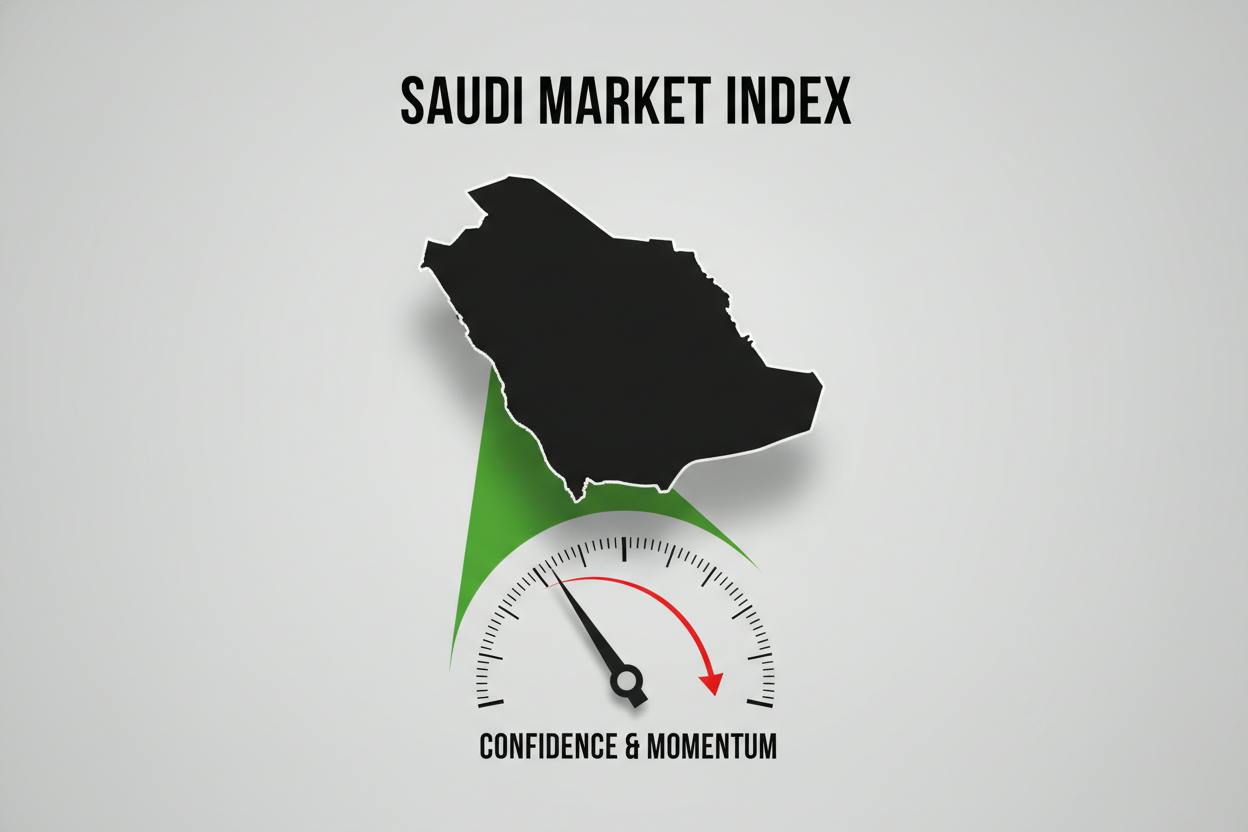
Saudi Arabia's stock market opened the week on a positive note, with the Tadawul All Share Index closing 0.90% higher. The gain came even as the kingdom's business confidence index eased to 55.5 in October, according to the General Authority of Statistics.
The reading is down from 56.6 in the previous survey, but it remains above the 50-point threshold that separates expansion from contraction in diffusion-style surveys. In plain terms, more businesses still report improving conditions than worsening ones, which can help keep investors comfortable with the overall growth picture.
What the confidence dip really tells us
While the headline number stayed in positive territory, the breakdown showed softer momentum. Sub-indices for industry, construction, and services all declined, hinting that optimism is becoming less broad-based. That matters because markets often care as much about breadth as the headline figure: when fewer parts of the economy are improving at the same time, earnings expectations can start to diverge across sectors.
The construction and services sectors are particularly important for Saudi Arabia's economy, given the government's large-scale infrastructure and tourism projects. A slowdown in those areas could signal that some of the growth drivers are cooling, even if the overall economy remains on an expansionary path.
Monday's trading reflected that pattern. Stocks tied to upbeat third-quarter updates did better: Al-Babtain Power and Telecommunication jumped 7.44% and Derayah Financial added 1.87% after reporting higher profit and revenue. Meanwhile, Almunajem Foods slid 9.13% after weaker results for the three months ended September 30th.
What it means for investors
For the broader market, a confidence reading of 55.5 supports the index by reinforcing the idea that the economy is still expanding. As long as the gauge stays above its neutral line, it can underpin the Tadawul, providing a floor under investor sentiment.
The catch is in the breakdown. Declines in construction, services, and industry can mean fewer sectors are likely to see earnings upgrades at the same time. That's how you get an index that holds up – like Monday's 0.90% gain – while individual stocks swing more on results. In that kind of market, strong beats can be rewarded quickly, while disappointments can be punished hard, as the contrast between Al-Babtain and Derayah's gains versus Almunajem's drop showed.
For everyday investors, this suggests a market where stock-picking matters more than just riding the index. Companies that deliver solid earnings growth may see their shares outperform, while those that miss expectations could face sharp sell-offs. It's a reminder to focus on company fundamentals rather than assuming the whole market moves in lockstep.
Looking ahead, investors will likely watch whether the confidence sub-indices recover in coming months. If the softening in industry, construction, and services proves temporary, the market's breadth could improve, supporting a more sustained rally. If not, the divergence between winners and losers may widen further.
For context, Saudi stocks have been part of a broader regional trend, with European stocks rising as oil retreats and UAE stocks gaining on softer Iran rhetoric, showing how global and regional factors can influence Gulf markets. Oil prices, in particular, remain a key driver for Saudi Arabia's economy and corporate earnings.
As always, no single indicator tells the whole story. The business confidence survey is one piece of the puzzle, but investors should also consider corporate earnings, government spending plans, and global economic conditions when assessing the Saudi market.