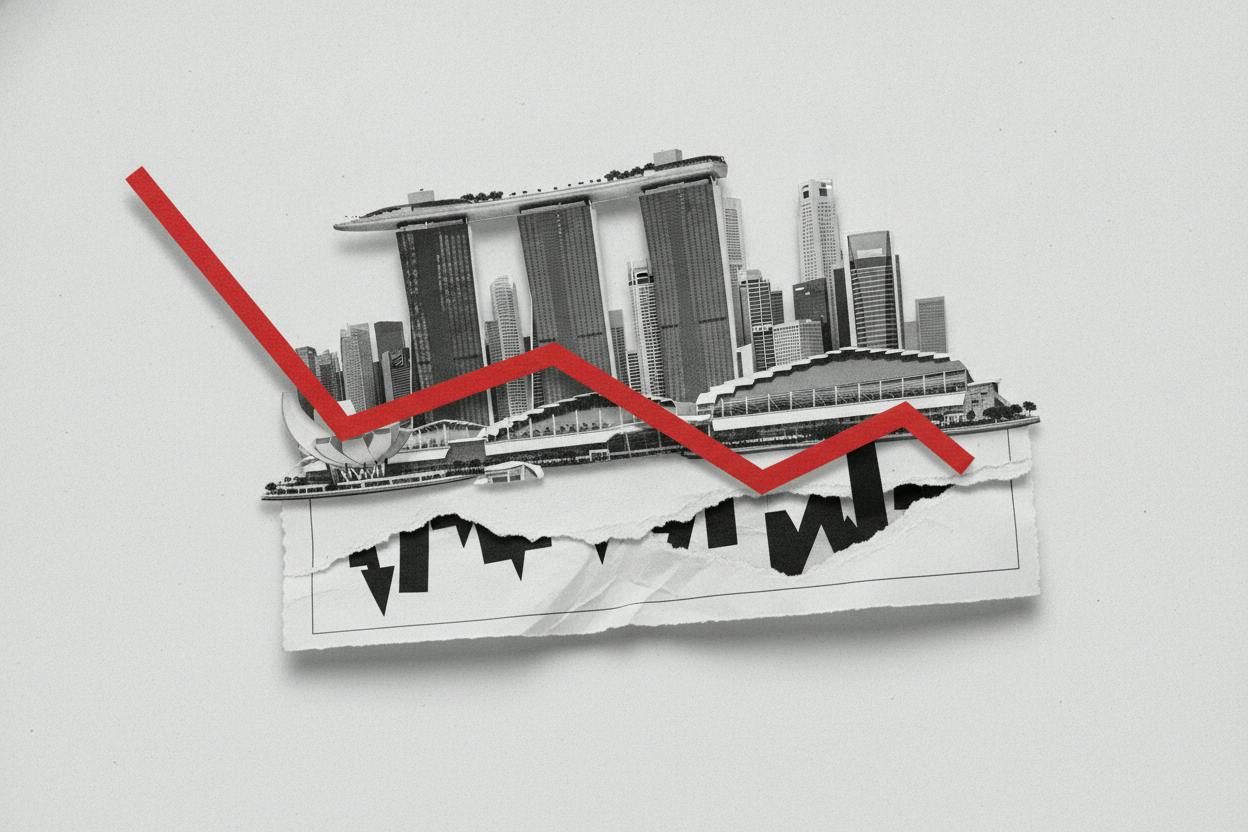
Singapore's banking heavyweights steadied on [day] after three bruising sessions, but the relief is tentative. DBS, UOB and OCBC were set to lose about $27 billion in combined market value over the past three trading days, according to Reuters, as higher long-term bond yields rattled investor sentiment.
The pullback highlights how tightly Singapore's stock market is tied to its lenders. The three banks account for more than half of the Straits Times Index, so their swings can move the entire benchmark. When bond yields climb, the impact on banks is direct: funding costs can rise faster than the interest they earn on existing loans, squeezing expected profitability.
Why higher yields hurt banks
Banks borrow short and lend long. They take in deposits and wholesale funding, then lend that money out over longer periods. When long-term bond yields rise, the cost of that funding can reprice quickly, especially for wholesale borrowing and some deposits. But the rates on many existing loans are fixed or reset slowly. That mismatch can compress net interest margins, a key measure of bank profitability.
Investors often respond by trimming their earnings forecasts and lowering the price-to-book multiple they are willing to pay for bank shares. That is exactly what appears to be happening now. The $27 billion drop is not a sign of a looming credit crisis; it is a recalibration of what "normal" earnings look like when rates stay higher for longer.
Morningstar analyst Kathy Chan echoed that view. She said fundamentals remain solid, but expectations had been "somewhat elevated." Wealth management and trading income, which were strong in the first half of 2026, could cool as comparisons get tougher. In other words, the easy gains may be behind us.
What it means for investors
For everyday investors, the takeaway is that Singapore bank stocks are not just a bet on the local economy; they are a proxy for global interest rates. When long-term yields move, these stocks move with them, often more than the broader market.
The recent selloff in Singapore banks shows how quickly sentiment can shift. But it also underscores the importance of diversification. If you hold a Singapore-focused fund or ETF, you are effectively making a concentrated bet on three banks. That concentration can amplify both gains and losses.
Investors should watch the direction of long-term bond yields and any signals from the US Federal Reserve or other major central banks. A pause in rate hikes could ease pressure on bank margins, while further increases could extend the slide.
It is also worth noting that the banks' fundamentals remain intact. Loan quality is stable, and capital levels are strong. The selloff is more about valuation than about the health of the banks themselves. For long-term investors, that can sometimes create opportunities, but it is never wise to try to catch a falling knife.
As Indonesia's state investor has said it stands ready to buy stocks in a selloff, some institutional players see dips as buying opportunities. But retail investors should focus on their own time horizon and risk tolerance.
The broader picture
The Straits Times Index's heavy reliance on banks means it can trade less like a broad measure of Singapore's economy and more like a gauge of "bank-multiple risk." When yields rise, the index can fall even if other sectors are doing fine. That is a reminder that index-level moves can be driven by a single theme.
Elsewhere in the region, markets have been mixed. Chinese blue chips hit an eight-month low as AI stocks sold off, while Indian stocks rebounded on optimism about AI growth. These moves show that global investors are rotating based on interest rate expectations and sector-specific news.
For Singapore bank investors, the key question is whether the recent selloff is overdone. With fundamentals solid and valuations more reasonable after the drop, some analysts see the pullback as a chance to enter at better prices. But no one can predict the next move in yields.
The best approach for most investors is to stay diversified and avoid making emotional decisions based on short-term market swings. If you own bank stocks or funds, understand that they will be volatile when rates move. And if you are considering adding to your position, do so gradually and with a long-term perspective.
As always, past performance is not a guide to future returns. The $27 billion loss is a reminder that even the most stable-looking stocks can fall when the macro backdrop shifts.