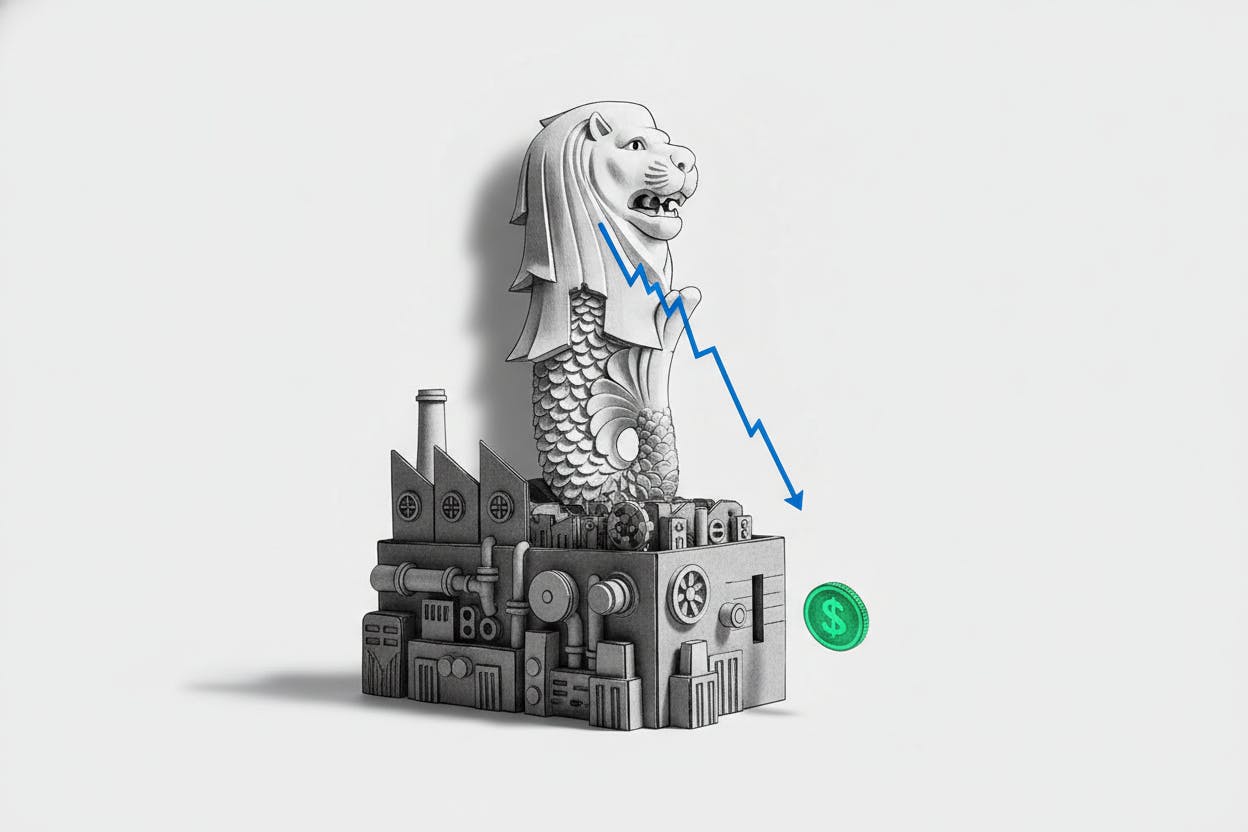
Singapore stocks edged lower on Friday, with the benchmark Straits Times Index (STI) falling 0.5%, even as fresh data showed the country's factory output remained robust. The divergence between a soft market and solid economic numbers highlights how global headwinds, rather than domestic weakness, are driving investor sentiment.
Part of the drag came from external factors. Singapore shares followed broader declines across Asia as investors digested Apple's recent price hikes on iPads and MacBooks, and what they could mean for demand in the chip supply chain. That weighed on tech-related stocks, which have been a key driver of regional markets. For context, Singapore's electronics sector is a major component of its manufacturing base, so any sign of softening demand from big customers like Apple can ripple through local suppliers.
At home, the economy didn't read as fragile. According to the Singapore Economic Development Board, manufacturing output climbed 13% year on year in May, cooling from a revised 16.5% gain in April but still showing strong momentum. The data suggests that the city-state's factory sector continues to benefit from robust global demand for semiconductors and electronics, even as other parts of the economy face headwinds. For a deeper look at the trends beneath the headline number, see our earlier piece on Singapore Factory Growth Slows in May as AI-Driven Electronics Boom Masks Weakness Elsewhere.
Niche Winners in a Soft Market
Zoom in and the day was less about 'Singapore Inc.' and more about specific themes. While the broad market dipped, a few smaller names climbed on company-specific news, showing that individual catalysts can still drive share prices even when the benchmark is under pressure.
Serial Achieva jumped nearly 5% after winning a contract in Malaysia to provide co-location services — essentially renting out data center space and supporting facilities — to a local cloud provider. This deal taps into the growing demand for data center capacity across Southeast Asia, as cloud computing and artificial intelligence drive a surge in computing needs. For investors, it's a reminder that companies with exposure to the data center boom can see outsized gains, even in a quiet market.
JustCo rose almost 3% after opening a new co-working site at the Octagon in Singapore. The flexible office space provider continues to expand its footprint as hybrid work models persist, though the sector remains competitive.
The other standout was GSH, up almost 4% after raising SG$80 million through an issuance of digital securities on SDAX, a platform for tokenized assets. That's a signal that even when the benchmark is soft, stocks can move on news that changes how quickly and reliably companies can fund growth.
What Digital Securities Mean for Investors
GSH's SG$80 million SDAX raise highlights a new capital-raising lane that could become more important for Singapore-listed companies. Digital securities — also known as tokenized assets — are blockchain-based representations of traditional financial instruments like bonds or equity. They aim to streamline the behind-the-scenes steps of raising money: more automated issuance and settlement can cut paperwork, shorten timelines, and potentially broaden who can take part.
For small and mid-cap firms, this could be a game-changer. Traditional fundraising through bank loans or bond issuances can be slow and costly, especially for smaller companies. Digital securities offer a potentially faster and cheaper alternative, though the market is still in its early stages. If that infrastructure scales, Singapore-listed small and mid-cap firms could gain a more repeatable way to fund projects or refinance existing debt.
In choppy risk sentiment, 'funding access' can become a bigger driver of individual share prices than the day's macro data — even when factory numbers look solid. Investors should watch for more companies following GSH's lead, as it could signal a shift in how Singapore's smaller firms finance growth.
Broader Market Context
The STI's decline on Friday was part of a wider regional trend. Asian markets were under pressure from a combination of factors, including a stronger US dollar and ongoing concerns about interest rates. The yuan, for example, headed for its biggest weekly drop since March as the strong dollar pressured the People's Bank of China's policy stance. That currency weakness can weigh on export-oriented economies like Singapore, as it makes their goods relatively more expensive in global markets.
Meanwhile, commodity markets showed mixed signals. Copper prices headed for a weekly drop as a strong dollar and tariff jitters reshuffled inventories, while palm oil rose on Friday on China demand but still posted a weekly loss. These moves reflect the broader uncertainty in global trade and demand.
For everyday investors, the key takeaway is that Singapore's economy remains on solid footing, but stock prices are being driven more by global sentiment and company-specific news than by domestic data. That means paying attention to individual company developments — like data center contracts or innovative fundraising — can be just as important as watching the macro numbers.