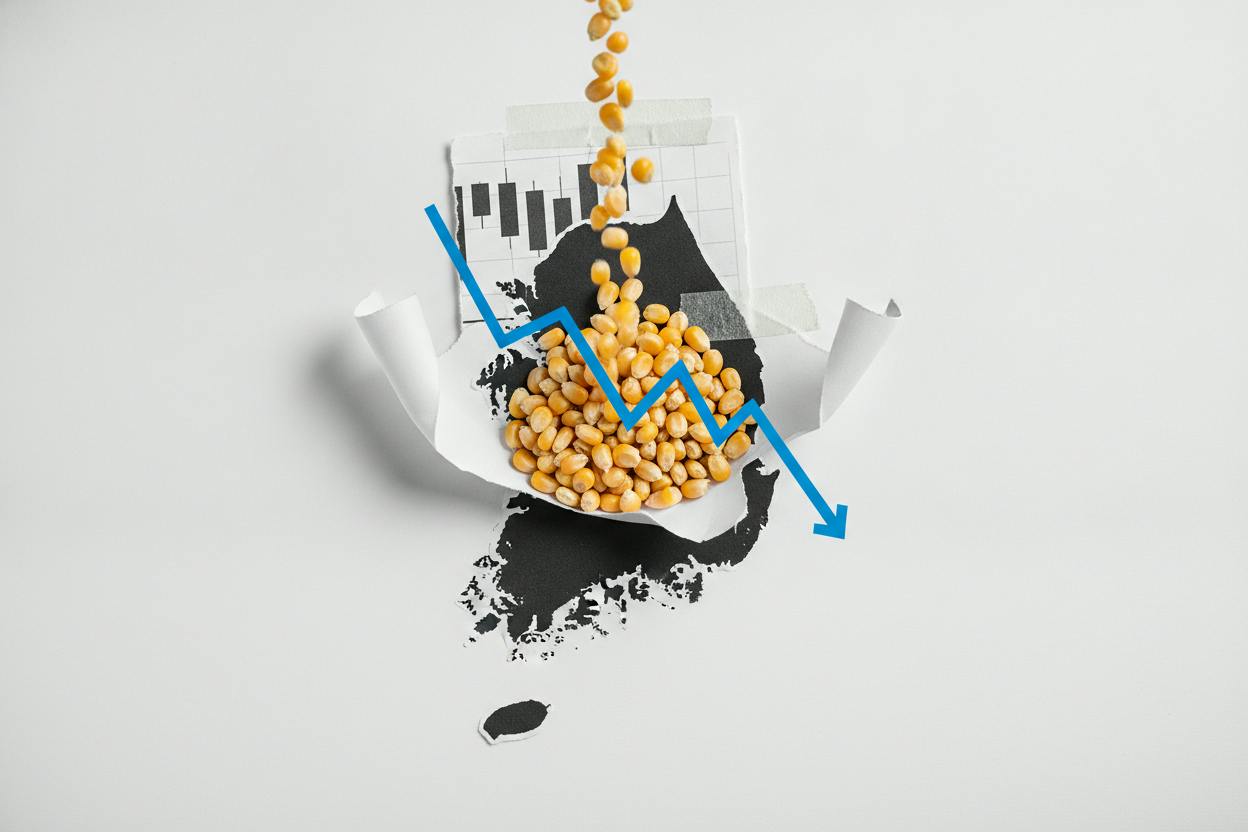
South Korea's Feed Leaders Committee, a purchasing group that buys grain on behalf of the country's livestock feed makers, bought roughly 60,000 to 66,000 metric tons of feed corn in a tender this week, according to traders. The purchase followed a drop in Chicago Board of Trade corn futures on Wednesday, giving the importer a cheaper window to lock in supply.
The move is a neat illustration of how the futures market connects to the physical world. When prices on the screen fall, buyers in Asia often step in quickly to secure cargoes before the market can rebound.
Why corn prices fell in Chicago
The trigger was a US Department of Agriculture report showing higher US corn inventories. When the government signals that more grain is sitting in silos than the market expected, it usually points to ample supply — and that tends to push prices lower. Chicago corn futures slid on Wednesday in response.
For importers, that dip is an opportunity. Feed corn is a bulk commodity used to feed livestock, and countries like South Korea rely heavily on imports because they don't grow enough domestically. Buying in a tender — a formal request for suppliers to bid — lets them compare offers and secure volume at a set price.
What South Korea actually bought
The tender sought "optional origin" corn, which means the seller can ship from more than one approved region rather than a single named country. That flexibility matters: it lets the supplier pick the cheapest or most readily available origin that still meets the delivery schedule.
Traders said at least one cargo was booked from ETG, a global grain trading firm, at roughly $283.47 a ton cost-and-freight (C&F). C&F includes the grain itself plus the cost of shipping it to the destination port. The corn is aimed to arrive around January 15th, with different shipment windows depending on where it is sourced.
Early details of tenders often come from trader estimates, and the final supplied volume is due by October 15th. That means the picture could still shift slightly as the deal is finalised.
The number that matters: delivered price, not just futures
That $283.47 a ton C&F level is about more than the Chicago futures price. It is a bundle: the futures-linked value of the grain, plus freight, plus "basis" — the premium or discount that reflects a specific delivery location and month versus the Chicago contract.
Because the deal allows optional origins, South Korea is effectively paying for flexibility. The seller absorbs some of the uncertainty around freight costs, route availability and regional supply, and that gets folded into the delivered price rather than left entirely to the futures screen.
In practice, market watchers often learn more from the delivered-to-Asia premium — how a reference like $283.47 a ton C&F moves relative to CBOT — than from day-to-day swings in Chicago alone. If that premium widens, it can signal tighter shipping capacity or stronger regional demand. If it narrows, supply is likely comfortable.
What it means for investors
For everyday investors, this story is less about one cargo of corn and more about the signals it sends. Corn is a key input for livestock producers, food companies and ethanol makers. When feed costs fall, margins can improve for poultry, pork and dairy businesses; when they rise, those companies often face pressure.
The tender also highlights how global trade flows respond to price moves. A dip in US futures can quickly translate into buying interest from Asia, which in turn supports prices. That feedback loop is why corn futures rarely stay low for long when demand is steady.
Investors watching agricultural commodities should keep an eye on a few things from here:
- Whether CBOT corn rebounds after the USDA's higher inventory estimate, or continues to drift lower.
- How firm delivered prices into Asia stay as freight rates and origin availability shift. The C&F premium is the clearest read on real-world demand.
- The final volume from this tender, due by October 15th, which will confirm how much South Korea actually secured.
Broader market conditions also matter. A weaker dollar can make US grain cheaper for foreign buyers, while higher energy costs push up freight and, in turn, delivered prices. Those cross-currents are worth tracking alongside the futures screen.
For now, the takeaway is simple: a softer Chicago market gave South Korea a chance to buy, and the price it paid tells us as much about shipping and logistics as it does about corn itself. Investors in food, farming and shipping stocks will want to watch whether other Asian buyers follow suit — and whether that keeps a floor under prices.