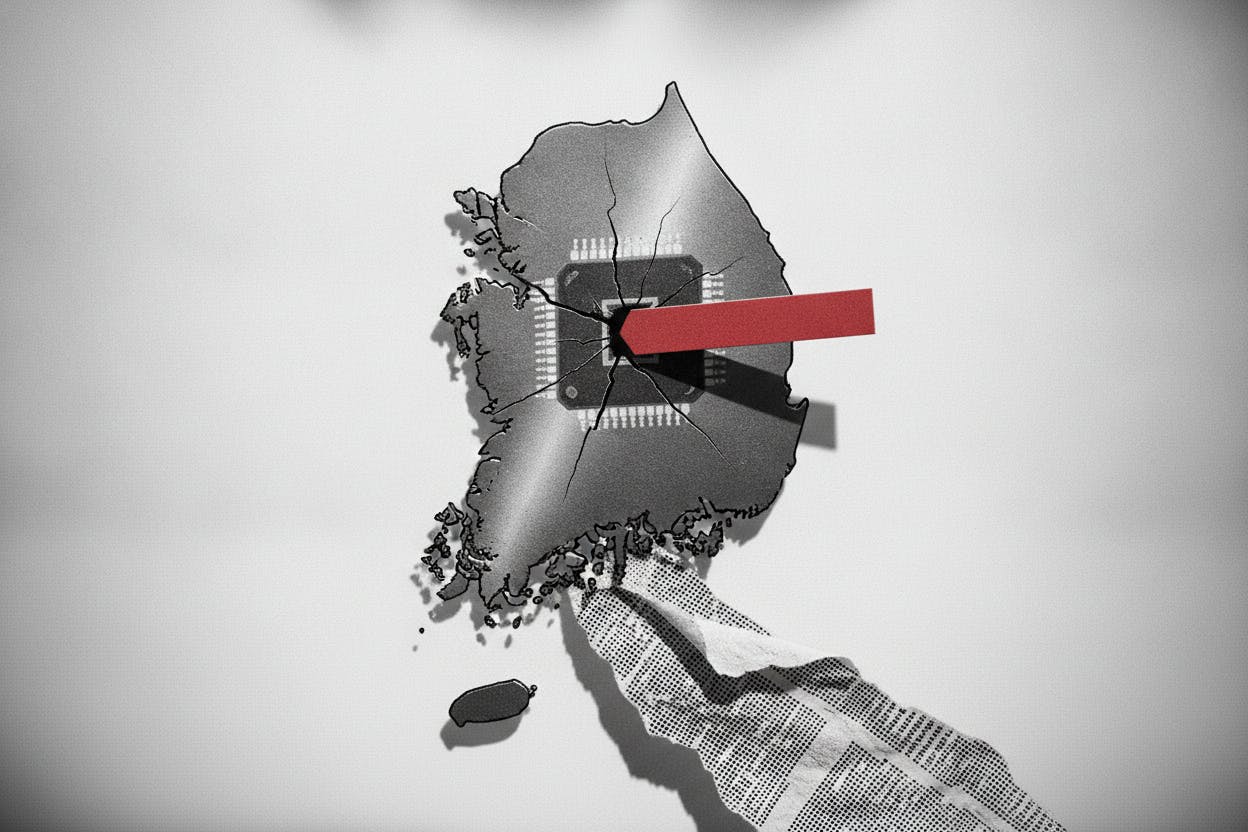
South Korean stocks suffered their worst day in months on Thursday, with the benchmark KOSPI plunging 5.84% after a sharp selloff in US technology shares reignited doubts about whether Big Tech's enormous investments in artificial intelligence will ever pay off. The drop was so severe that it briefly triggered a so-called "sidecar" curb, a market mechanism that pauses program trading when moves become too extreme.
The selloff was led by the two heavyweights that dominate the Korean market: Samsung Electronics and SK Hynix. Both are critical suppliers to the global AI supply chain, providing the high-end memory chips that power the data centers behind services like ChatGPT and Google Gemini. When US tech stocks fell late Wednesday, investors in Korea quickly de-risked, treating the entire AI theme as one crowded trade that could unwind in a hurry.
What triggered the selloff?
The immediate cause was a late-day drop in US technology shares, which fell on renewed concerns that the massive capital spending by companies like Microsoft, Amazon, and Alphabet may not produce the profits investors expect. AI requires huge upfront investment in chips, data centers, and energy — costs that only generate returns if revenue grows fast enough to cover them. Markets are now asking not just "how fast can AI revenue grow," but "who earns a return after all those costs?"
That question hits Korean chipmakers especially hard. Samsung and SK Hynix are at the center of the AI boom, but they are also exposed to any slowdown in demand. If Big Tech pulls back on spending, the chip orders that have fueled their recent growth could dry up quickly. The KOSPI's heavy weighting in semiconductors — the sector accounts for roughly a third of the index — means any wobble in tech sentiment hits the entire market.
What is a sidecar curb?
The KOSPI's 5.84% drop was enough to trigger a "sidecar" curb, a market-structure circuit breaker that temporarily halts program trading — not the entire market. Program trading includes basket-style selling like futures hedges and index-arbitrage trades that buy or dump many stocks at once. When that channel is switched off mid-move, liquidity can thin out, and prices may be set by fewer, discretionary orders, which can widen swings.
In an index as concentrated as the KOSPI, that dynamic tends to land first on the biggest stocks. Samsung Electronics and SK Hynix, which together account for a large share of the index's value, are the most vulnerable to this kind of short-term volatility. For everyday investors, the sidecar is a reminder that even broad market moves can become choppy when automated trading is paused.
What it means for investors
For investors holding Korean stocks or ETFs that track the KOSPI, the selloff is a sharp reminder of how concentrated the market is. A handful of chip stocks drive the index, and when sentiment turns against tech, the entire market can move violently. The sidecar curb, while designed to prevent panic, can actually amplify short-term swings by reducing liquidity.
The broader lesson is that AI enthusiasm is starting to face real scrutiny. For months, markets have rewarded any company with an AI story, but now investors are asking harder questions about profitability. That shift could mean more volatility ahead for chip stocks and the indexes that depend on them. While the long-term case for AI remains intact, the path is unlikely to be a straight line up.
For context, this is not the first time tech jitters have hit Asian markets. Earlier this year, Big Tech slumps triggered similar selloffs in the region, though chip stocks later rallied on renewed AI demand. The difference this time is that the doubt is not about interest rates or inflation, but about the fundamental economics of AI itself.
Investors should watch for earnings reports from US tech giants in the coming weeks. If companies like Microsoft or Amazon signal they are tightening their AI budgets, Korean chip stocks could face further pressure. If they double down, the selloff may prove to be just a temporary scare.