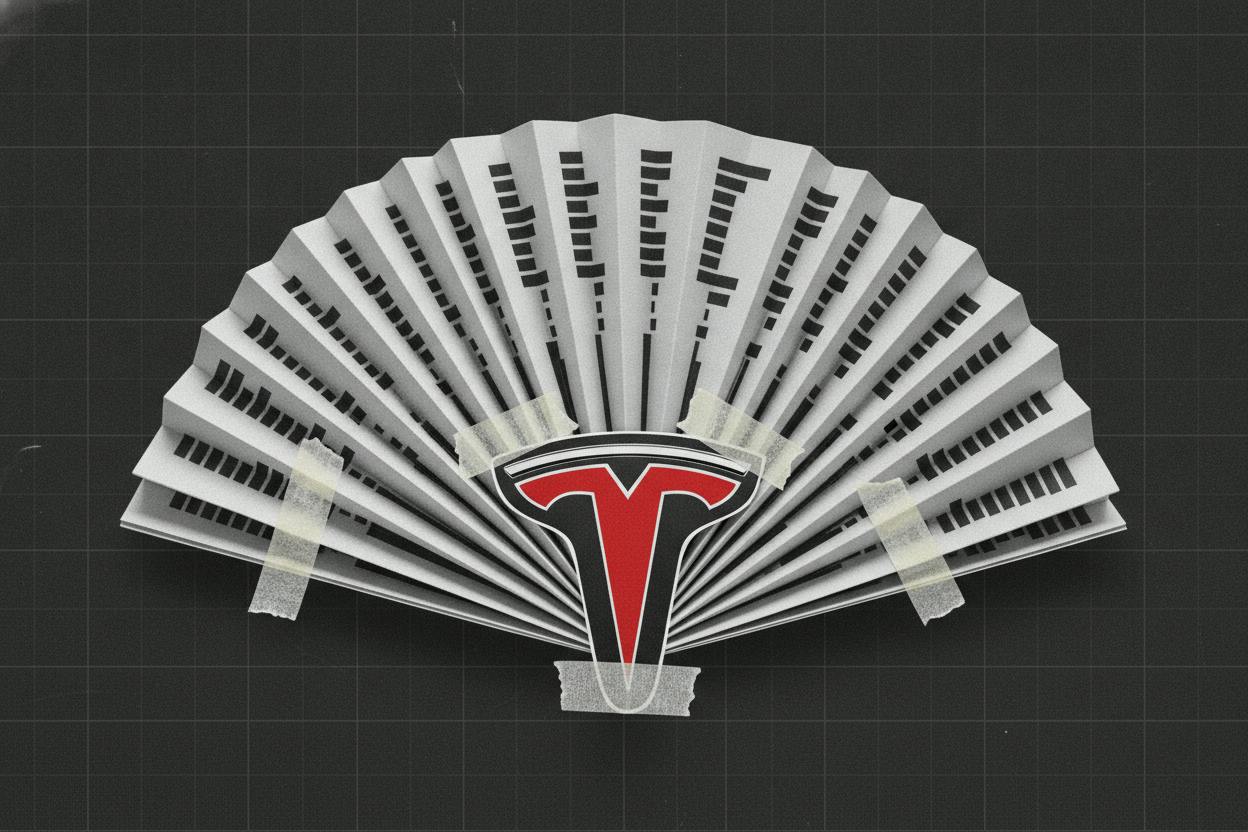
Tesla has lined up $30 billion in new credit facilities, according to a regulatory filing on Tuesday, giving the electric-vehicle maker significant financial firepower as it prepares for a period of unusually heavy investment. The company said it has not borrowed any money under the new agreements.
The package consists of three separate facilities: a $20 billion delayed-draw term loan, an $8 billion five-year revolving credit facility, and a $2 billion 364-day revolver. Tesla also replaced an older $5 billion revolving credit line that was due in January 2028 and had no borrowings outstanding. The company framed the move as adding flexibility rather than responding to an urgent cash need.
Why Tesla is raising so much credit now
The timing reflects Tesla's plans to ramp up spending on artificial intelligence compute infrastructure and solar manufacturing capacity, along with other expansion projects. AI compute — the specialized hardware and data centers needed to train and run machine-learning models — has become a major cost center for Tesla as it develops autonomous driving software and robotics. Solar manufacturing, meanwhile, ties into Tesla's energy division, which sells solar panels and battery storage systems.
Credit lines like these are not loans that are immediately drawn upon. Instead, they act as a financial backstop: the company can tap them when needed, but pays fees to keep them available. A delayed-draw term loan allows Tesla to borrow in stages over a set period, while a revolving credit facility works like a corporate credit card — money can be borrowed, repaid, and borrowed again. The 364-day revolver is a shorter-term option that gives the company quick access to cash for up to a year.
By replacing the older $5 billion revolver with a larger and more varied set of facilities, Tesla is effectively increasing its borrowing capacity without immediately adding debt to its balance sheet. That is a meaningful distinction for investors: the company is not taking on $30 billion in new liabilities today, but it is securing the option to do so in the future.
What it means for investors
For ordinary investors, the key takeaway is that Tesla is preparing for a capital-intensive phase. Building AI infrastructure and expanding solar manufacturing require significant upfront spending, and having credit lines in place reduces the risk of a cash crunch if those projects run over budget or take longer than expected.
The move also signals that Tesla's management expects to need more money than it currently generates from operations. That is not necessarily a red flag — many large companies maintain credit lines well above their immediate needs — but it does suggest that free cash flow may be tighter in the coming quarters as spending accelerates.
Investors will want to watch how much of these facilities Tesla actually draws down and at what interest rates. In a higher-rate environment, borrowing costs matter more than they did a few years ago. The company's ability to secure such large facilities on presumably favorable terms could be a vote of confidence from its lenders, but the ultimate test will be whether the investments in AI and solar generate returns that justify the spending.
It is also worth noting that Tesla's credit arrangements come amid broader scrutiny of corporate borrowing costs, particularly for technology companies. Recent market activity has shown that bond investors are demanding higher yields from even the largest tech firms, as seen in Meta's recent bond slide. Tesla's decision to secure credit lines rather than issue new bonds may reflect a desire to avoid locking in higher long-term borrowing costs.
Separately, Tesla continues to face regulatory and competitive challenges in its core auto business. The company recently received approval for its supervised Full Self-Driving system in Croatia, a small but symbolic step as it seeks broader European acceptance, as covered in Croatia's approval of Tesla's FSD. The success of those efforts could influence how quickly Tesla's AI investments pay off.
The bottom line
Tesla's $30 billion credit package is a preparatory move, not a distress signal. It gives the company room to fund ambitious projects without immediately tapping debt markets. For investors, the story to follow is how quickly Tesla deploys that capital and whether the returns on AI and solar justify the scale of the investment. As always, the details in future quarterly filings — especially cash flow and capital expenditure figures — will provide the clearest picture of whether this financial flexibility is being used wisely.