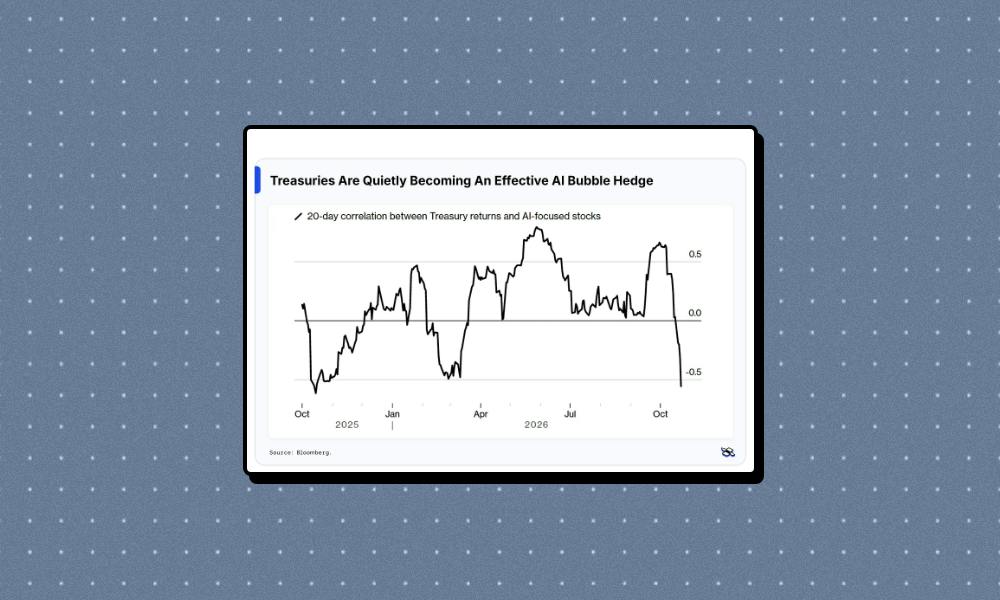
The relationship between AI stocks and US government bonds has turned sharply negative, and that is catching the attention of investors looking for a place to hide. According to recent market data, the correlation between the two asset classes is now at its most negative in a year. In plain terms, when AI stocks fall, Treasuries tend to rise — and vice versa.
That inverse relationship is not just a statistical curiosity. It points to a practical opportunity: if the AI boom loses steam, government bonds could provide a cushion for portfolios that are heavily weighted toward technology shares.
Why the correlation matters
For much of the past year, AI-related stocks have been the engine of market gains. Companies tied to artificial intelligence — from chipmakers to cloud providers — have seen their valuations soar on expectations of massive future growth. But that enthusiasm has also made those stocks vulnerable to sharp reversals if spending plans disappoint.
US Treasuries, by contrast, are seen as one of the safest assets in the world. When investors get nervous about growth or corporate profits, they often rotate into government bonds, pushing prices up and yields down. The recent widening of the negative correlation suggests that this classic flight-to-safety dynamic is back in force.
The shift has been visible in recent sessions. For example, Meta's AI spending warning sent Treasury yields to their biggest drop since 2023, a clear sign that bond markets are reacting to any hint that the AI investment cycle might be peaking. Similarly, AI funding worries have hit Asian shares while lifting Treasuries, reinforcing the pattern.
The case for Treasuries as a hedge
The argument for using Treasuries as a hedge is straightforward. If the AI spending frenzy suddenly loses steam, economic growth could take a hit. That would likely cool inflation, reduce energy demand, and give central banks new justification for cutting interest rates. Lower rates tend to boost bond prices, which would benefit Treasury holders.
In other words, the same scenario that would hurt AI stocks — a slowdown in tech investment — could actually help bonds. That makes Treasuries a natural counterweight in a portfolio that is heavy on growth stocks.
There is also the yield angle. With Treasury yields still relatively elevated compared with the past decade, bonds offer a decent income stream even before any price appreciation. That combination — a potential hedge plus a reasonable yield — is what makes the case compelling.
What could go wrong
No hedge is perfect, and Treasuries come with their own risks. If inflation proves stickier than expected, the Federal Reserve may keep rates higher for longer, which would pressure bond prices. Rising yields have been a recurring theme this year, with stocks slipping as oil hits $101 and Treasury yields near 5%. In that environment, bonds can fall alongside equities.
There is also the possibility that the AI trade keeps running, in which case holding Treasuries would mean missing out on further stock gains. But for investors who are already heavily exposed to tech, the insurance may be worth the cost.
What it means for everyday investors
For the average investor, the key takeaway is diversification. If your portfolio is dominated by AI-related stocks or tech funds, adding some Treasuries could reduce overall volatility. You don't need to make a bold call on whether the AI boom will end — you just need to acknowledge that it might.
That said, this is not a recommendation to dump stocks and buy bonds. It is simply an observation that the current market setup offers a rare opportunity: an asset that historically moves opposite to the hottest trade in the market, and that pays you to wait.
As always, consider your own time horizon and risk tolerance. And remember that market correlations can shift quickly — what holds true today may not hold tomorrow.