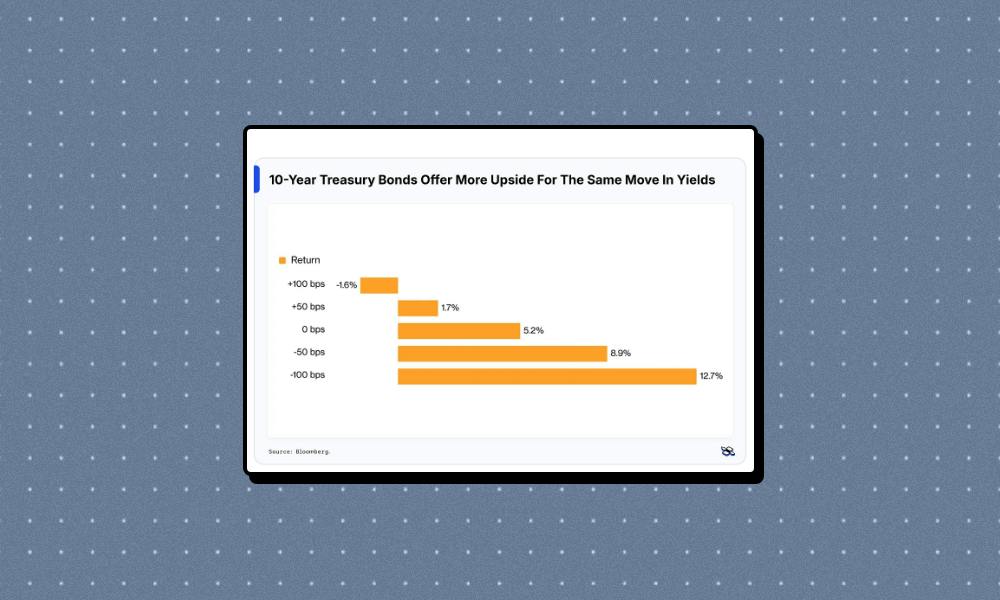
For investors weighing whether to lock in yields on long-term U.S. government debt, the math is getting more interesting — and more treacherous. According to data compiled by Bloomberg, buyers of 10-year Treasuries at current levels could see yields climb to around 6% over the next year before price losses fully erase the interest they collect. That sobering scenario sits alongside an unusually lopsided payoff: a one-percentage-point rise in yields would produce a loss of less than 2%, while an equivalent decline would deliver a return of roughly 13%.
The figures illustrate a concept known in bond circles as convexity — a measure of how a bond's price responds to changes in yields. For most bonds, the relationship is not perfectly linear: price falls are smaller than price gains for the same yield move. That asymmetry is exactly what the Bloomberg data highlights. A 100-basis-point increase in yields (one percentage point) would shave less than 2% off the value of a 10-year Treasury, but a 100-basis-point decrease would boost its price by about 13%. In plain terms, the downside is limited relative to the upside — at least for a single move.
Yet the longer-term picture is less forgiving. If yields were to grind steadily higher, reaching 6% within a year, the cumulative price losses would eventually match and then exceed the coupon income an investor receives. At that point, total return turns negative. For a bond bought today, that means the interest payments — currently around 4% to 4.5% for the 10-year — would not be enough to offset the decline in the bond's market value.
Why yields could keep climbing
The possibility of 6% yields is not a forecast but a scenario derived from current market pricing and historical patterns. It reflects the reality that the U.S. Treasury market has been under persistent pressure. Over the past year, yields on longer-dated government debt have climbed to levels not seen in decades, driven by a combination of factors: sticky inflation, a resilient economy that keeps the Federal Reserve from cutting rates aggressively, and heavy supply of new government debt as the federal deficit remains wide.
Investors have also demanded a higher premium for holding long-term bonds, worried about the risk that inflation could re-accelerate or that the government's borrowing needs will keep growing. That has pushed the so-called term premium — the extra compensation for holding a bond to maturity rather than rolling over short-term debt — into positive territory after years of being negative.
For context, a 6% yield on the 10-year Treasury would be a level not seen since the early 2000s. It would ripple through the entire economy, raising borrowing costs for mortgages, corporate loans, and government debt service. It would also put additional pressure on stocks, particularly rate-sensitive sectors like utilities and real estate, which have already felt the sting of the bond selloff. As we noted recently, utilities have been under pressure from the bond selloff, though some names still hold up.
What it means for investors
For everyday investors, the key takeaway is that buying long-term Treasuries today is not a one-way bet. The income is attractive relative to recent history, but the price risk is real. If yields rise further, the value of existing bonds falls, and the total return — income plus price change — could be negative.
However, the asymmetric payoff structure offers a silver lining. Because the downside for a single yield move is capped at less than 2%, while the upside for a similar move in the other direction is much larger, the risk-reward profile is tilted in favor of buyers. That is the "odds tilting in Treasuries' favor" that the data suggests. In other words, the market may be pricing in more downside than is justified, making the current entry point relatively attractive for those willing to hold to maturity.
But investors should be careful not to over-interpret a single data point. Convexity works both ways: it can amplify gains when yields fall, but it also means that if yields rise gradually over a long period, the cumulative losses can overwhelm the convexity benefit. The 6% scenario is a reminder that the bond market is not immune to sustained selloffs.
For those considering adding Treasuries to a portfolio, the decision often comes down to time horizon and risk tolerance. If you plan to hold to maturity, the yield you lock in today is your return, and price fluctuations along the way are irrelevant. If you might need to sell before maturity, the price risk matters more. Diversification across maturities — a bond ladder — can help manage that risk.
The broader market context also matters. The recent rise in long-term yields has been a headwind for equities, but it has also created opportunities in other corners. For instance, chipmakers helped power a weekly gain in the S&P 500 even as 30-year yields hovered near 2004 highs, showing that some sectors can still thrive in a higher-rate environment.
Investors should also keep an eye on the Federal Reserve. If the central bank signals that it is done raising rates and may cut them next year, that could push yields lower and deliver the kind of price gains the convexity math suggests. Conversely, if inflation proves stubborn and the Fed is forced to keep rates higher for longer, the 6% scenario becomes more plausible.
In the end, the data from Bloomberg is a useful reminder that bond investing is not just about collecting coupons. It's about understanding the relationship between yields and prices, and the asymmetric nature of that relationship. For now, the odds may be tilting in favor of Treasury buyers — but only if you can stomach the possibility of a bumpy ride.