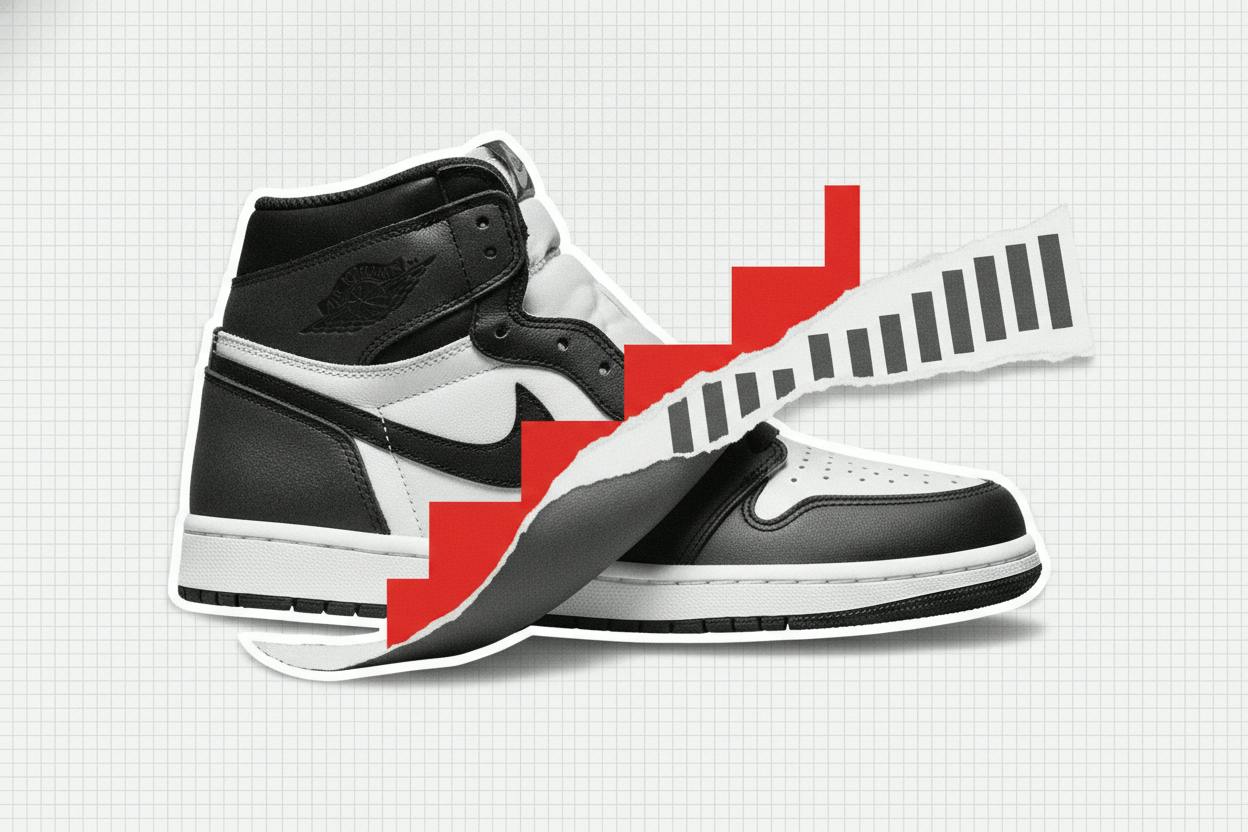
Nike's turnaround may be a longer slog than many investors hope, according to a new note from UBS. The investment bank cut its price target on the sportswear giant to $34 from $42 and lowered its revenue estimates for fiscal 2027 and 2028, citing the risk that fewer promotions could cool demand.
The move reflects a growing concern on Wall Street that Nike's efforts to wean shoppers off discounts—a strategy aimed at protecting the brand's long-term pricing power—could backfire in the short term. If customers only bought because of markdowns, sales could slip once the deals disappear.
What UBS is saying
UBS analysts argue that Nike's earnings estimates may keep drifting lower as the company works through what they describe as a "reset" in its sportswear and Jordan lines. They also flagged softer performance in Greater China, a key market that management has already said could weigh on results in fiscal 2027 and 2028.
The bank now sees revenue of $42.79 billion in fiscal 2027 and $43.83 billion in fiscal 2028. Those figures are below previous forecasts, and UBS warns they could slip further if fewer promotions translate into fewer units sold.
Nike's stock has been under pressure for some time, and the new price target—just above where shares currently trade—suggests UBS sees limited upside in the near term. The cut from $42 to $34 is a significant downgrade, reflecting a more cautious view on the company's growth trajectory.
Why promotions matter
For everyday investors, the key issue is how Nike balances brand strength with sales volume. Cutting promotions can help a company charge full price more often, which boosts profit margins. But it can also expose how much of recent revenue was being propped up by discounts.
If demand weakens when deals disappear, Nike could end up selling fewer shoes and apparel items, which would hurt revenue even if each sale is more profitable. That's the delicate balance UBS is worried about.
The "reset" in Nike's sportswear and Jordan lines adds another layer of uncertainty. These are core product categories for the company, and any disruption in their lineup or marketing could affect sales for several quarters.
What it means for investors
UBS's $34 price target keeps Nike tied to fiscal 2027-2028 estimate cuts. When a bank trims its target while shares are near that level, it's signaling that the next catalyst isn't a single quarter's earnings, but the direction of longer-range forecasts.
Downgrades to out-year revenue, like UBS's new numbers, often pull broader analyst consensus down over time as other firms adjust their models. That matters because falling profit expectations can pressure the "earnings" part of a stock's valuation. Meanwhile, ongoing uncertainty about the Jordan and Greater China reset can keep investors from paying a higher price for each dollar of profit.
The key watch item is whether fiscal 2027-2028 estimates stop getting revised down. If they don't, a sustained re-rating gets harder even if Nike beats near-term expectations.
For context, other companies have faced similar challenges when trying to reduce promotions. McCormick's recent experience shows that price increases can boost earnings while shoppers buy less—a trade-off that investors need to monitor.
Nike's situation is also part of a broader trend in consumer spending, where companies are navigating shifting demand patterns. Lindt's recent guidance cut and UBS's view on that reset highlight how even premium brands are facing headwinds.
Investors should also keep an eye on how Nike's competitors are handling similar challenges. The sportswear market is highly competitive, and any misstep in product launches or marketing could cede ground to rivals.
The bottom line
UBS's downgrade is a caution flag, not a death knell. Nike remains a dominant brand with strong global recognition, and its long-term strategy to reduce discounts could pay off if executed well. But the near-term path is uncertain, and the bank's revised estimates suggest that patience may be required.
For now, the focus will be on Nike's next earnings report and any updates on the Jordan and Greater China reset. If the company can show that demand is holding up without heavy promotions, sentiment could improve. But if sales weaken, more estimate cuts could follow.
As always, this is not a recommendation to buy or sell Nike stock. It's a look at what one major bank is thinking and what it could mean for the company's valuation.