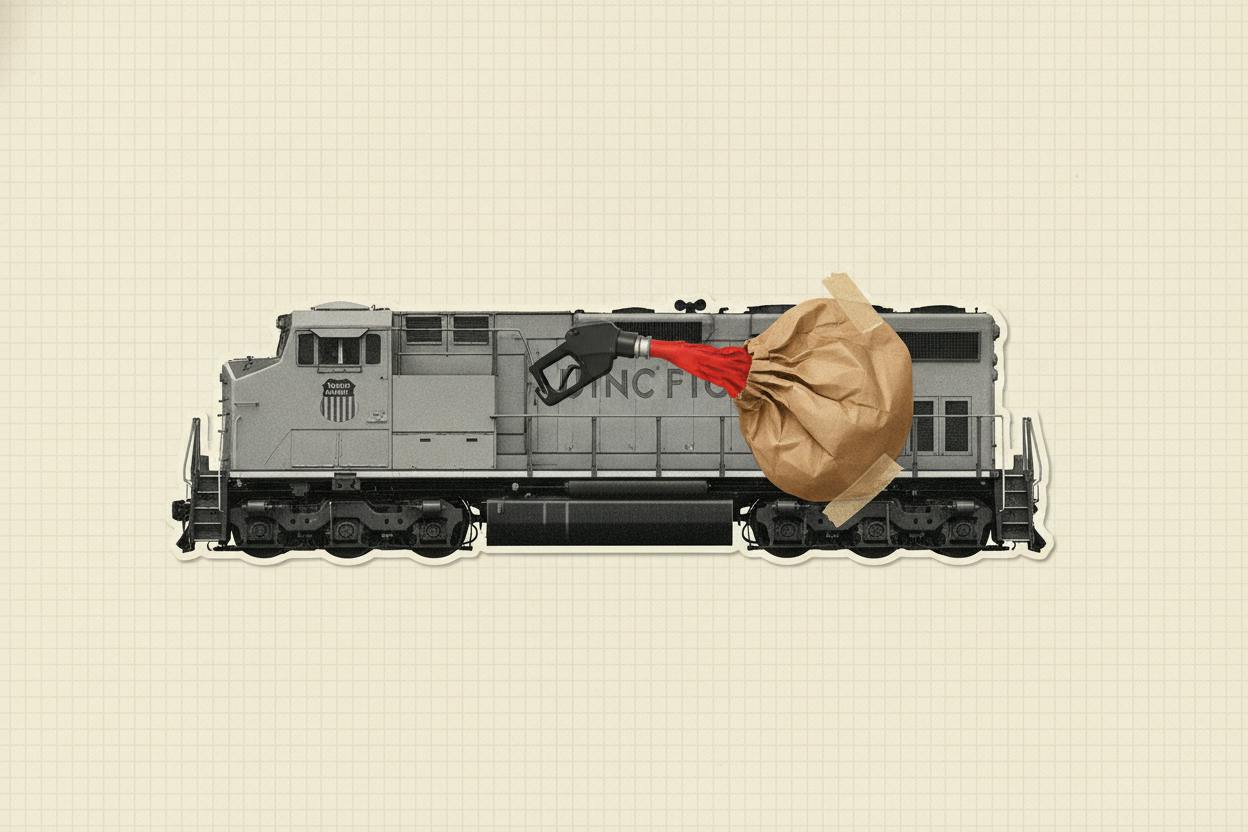
Union Pacific, one of the largest U.S. railroads, collected $131.8 million more in fuel surcharges than it actually spent on diesel during the third quarter, according to regulatory filings. The figure has drawn attention because the company has long argued that surcharges simply pass along the cost of expensive fuel to customers. The latest data suggests the mechanism may be doing more than covering costs.
The disclosure comes as the Surface Transportation Board (STB), the federal agency that regulates railroads, reviews Union Pacific's proposed $85 billion acquisition of rival Norfolk Southern. That deal, if approved, would create a rail giant spanning much of the country, and the fuel surcharge question is part of a broader debate about how railroads price their services.
How fuel surcharges work
Railroads like Union Pacific use fuel surcharges to adjust freight rates when diesel prices move. The idea is straightforward: when fuel costs rise, the railroad adds a fee to customers' bills to offset the higher expense. When fuel prices fall, the surcharge typically drops as well.
But the formulas used to calculate these surcharges are not always directly tied to a railroad's actual fuel costs. They are often based on an index of diesel prices, and the relationship between that index and what a railroad really pays can vary. In Union Pacific's case, the filings show that in the third quarter, the surcharges collected exceeded the amount spent on diesel by $131.8 million.
That gap does not necessarily mean the company is doing anything improper. Railroads are allowed to set their own surcharge formulas, and the STB has rules about how they must be disclosed. But the size of the difference has caught the eye of shippers and regulators, especially at a time when the industry is under scrutiny for pricing power.
The Norfolk Southern deal and regulatory review
The fuel surcharge data is part of the information the STB is examining as it considers Union Pacific's bid for Norfolk Southern. The $85 billion deal would be one of the largest railroad mergers in U.S. history, and it has sparked concerns about reduced competition and higher rates for shippers.
Regulators are looking at a range of issues, including how the combined company would set rates and whether customers would have fewer options. Fuel surcharges are a key part of that picture because they directly affect what shippers pay. If a railroad can collect more in surcharges than it spends on fuel, that could be seen as a way to boost profits without raising base rates.
Union Pacific has said its surcharges are designed to recover fuel costs, not to generate extra revenue. The company has also noted that fuel prices can be volatile, and that surcharge revenue can lag or lead actual costs from quarter to quarter. Over a longer period, the company says, the surcharges and fuel expenses tend to balance out.
What it means for investors
For everyday investors, the fuel surcharge gap is a reminder that railroad earnings can be influenced by factors beyond just how many goods are moving. Fuel surcharges are a significant revenue stream for railroads, and when they exceed costs, they can boost operating margins and profits.
Union Pacific's ability to collect more in surcharges than it spends on diesel is not necessarily a red flag. Many companies in fuel-intensive industries use similar mechanisms, and the timing of fuel purchases and surcharge billing can create temporary mismatches. But the size of the gap in the third quarter suggests that the company's pricing power is strong, which could be a positive for shareholders.
At the same time, the regulatory review of the Norfolk Southern deal adds uncertainty. If the STB imposes conditions on the merger, such as limits on surcharges or rate increases, that could affect the combined company's profitability. Investors should watch for any rulings or comments from the STB on the fuel surcharge issue, as they could signal how the agency views the deal.
The broader context is that railroads have been enjoying a period of strong demand and pricing power, as supply chain disruptions and a rebound in freight volumes have allowed them to raise rates. Companies like Union Pacific have also been focused on improving efficiency and controlling costs, which has helped margins. The fuel surcharge data is one more sign of that trend.
For those who own Union Pacific stock or are considering it, the key takeaway is that the company's financial performance is tied to both freight volumes and its ability to manage costs. Fuel surcharges are a tool that can work in the railroad's favor when diesel prices are high, but they can also be a source of controversy if customers or regulators feel they are excessive.
As the STB continues its review of the Norfolk Southern deal, the fuel surcharge issue is likely to remain in the spotlight. Investors should keep an eye on any developments, as they could have implications for the merger's outcome and for the railroad industry as a whole.



