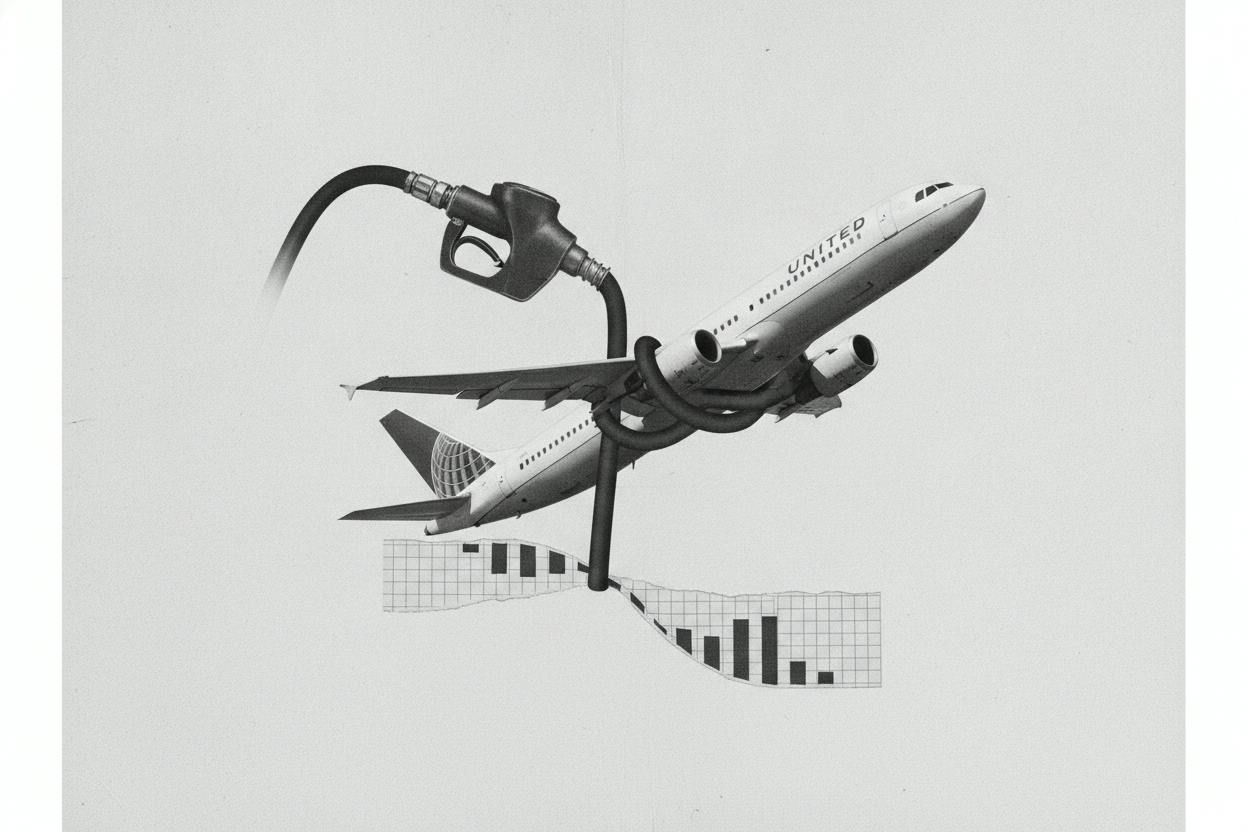
United Airlines gave investors a profit forecast that landed with a thud this week, telling Wall Street that its fourth-quarter earnings could come in far lower than expected because of soaring jet-fuel prices. The Chicago-based carrier guided to adjusted earnings of $0.50 to $1.50 per share for the quarter, and said that if jet fuel averages $4.80 a gallon, roughly $1 per share of that profit would disappear.
The warning is a sharp reminder that even when an airline is selling every seat it can, the cost of filling the tank can decide whether a quarter is a win or a miss. United also said it expects record revenue for the period, a sign that travel demand remains strong heading into the holiday season. But strong demand and strong profits are not the same thing when fuel prices are climbing.
Why jet fuel matters so much to airlines
Fuel is typically one of the two largest expenses for an airline, alongside labor. Unlike a software company, an airline cannot easily scale back its biggest cost when prices rise. Planes burn roughly the same amount of fuel per flight whether oil is cheap or expensive, so a move in jet-fuel prices flows almost directly to the bottom line.
That sensitivity is why airlines often talk about their "fuel bill" the way retailers talk about inventory. A single dollar-per-gallon increase across a large fleet can translate into hundreds of millions of dollars in extra annual costs. United's guidance makes that math concrete: at $4.80 a gallon, the company expects about $1 per share of quarterly profit to vanish compared with what it would have earned at lower fuel prices.
Jet fuel is refined from crude oil, so its price tends to track the global oil market, though it can move independently based on refinery capacity, regional supply and seasonal demand. When crude rallies, airlines usually feel it within weeks, not quarters.
Record revenue, thinner margins
The unusual part of United's update is the combination: record revenue alongside a profit warning. That tells investors the problem is not demand. Travelers are still booking flights, and pricing appears healthy enough to push sales to a new high.
Instead, the issue is margin — the share of each revenue dollar that an airline actually keeps. When costs rise faster than ticket prices, margins compress even as the top line grows. Airlines can try to offset fuel inflation by raising fares, cutting unprofitable routes, flying more fuel-efficient aircraft or hedging fuel purchases in advance. But those levers take time, and in the short run, a sudden spike in fuel prices hits earnings quickly.
United's guidance range of $0.50 to $1.50 per share is unusually wide, which itself signals uncertainty. The final number will depend heavily on where fuel prices settle during the quarter and how well the airline manages costs elsewhere.
What it means for investors
For everyday investors, United's warning is a useful case study in how commodity prices ripple through company earnings. If you own airline stocks — or funds that hold them — the key takeaway is that profits can swing sharply on factors the company does not control. That makes airlines more volatile than many other businesses, and it is why their shares often trade at lower valuations than steadier industries.
It also matters for the broader market. Fuel costs affect not just airlines but trucking companies, shipping firms, railroads and any business that moves goods. Persistent high energy prices can act like a tax on corporate profits across the economy, and they can feed into inflation, which in turn influences interest-rate decisions.
Investors will now watch a few things. First, whether oil and jet-fuel prices stay elevated or retreat. Second, how competitors respond — if other airlines also flag fuel pressure, it suggests an industry-wide issue rather than a company-specific one. Third, whether United and its peers can push fares higher without dampening demand. Recent earnings from other industrial and aerospace names have shown that strong order books and pricing power can offset cost pressure, as seen when Northrop and RTX lifted their profit outlooks on record orders.
For now, United's message is clear: the demand side of the business looks solid, but the cost side is doing the damage. That is a familiar pattern for cyclical industries, and it is why analysts often focus on unit costs and fuel hedges as much as passenger numbers.
Investors should also keep an eye on how the company frames its full-year outlook when it reports actual results. Guidance is a snapshot of expectations, not a guarantee, and fuel prices can move a lot in a few weeks. A drop in oil would quickly improve the picture; a further spike would make the low end of that $0.50-to-$1.50 range look optimistic.
In short, United is flying into a quarter with strong demand but a costly headwind. The airline can control schedules, staffing and pricing — but it cannot control the price of oil, and that is what is clouding its profit outlook right now.