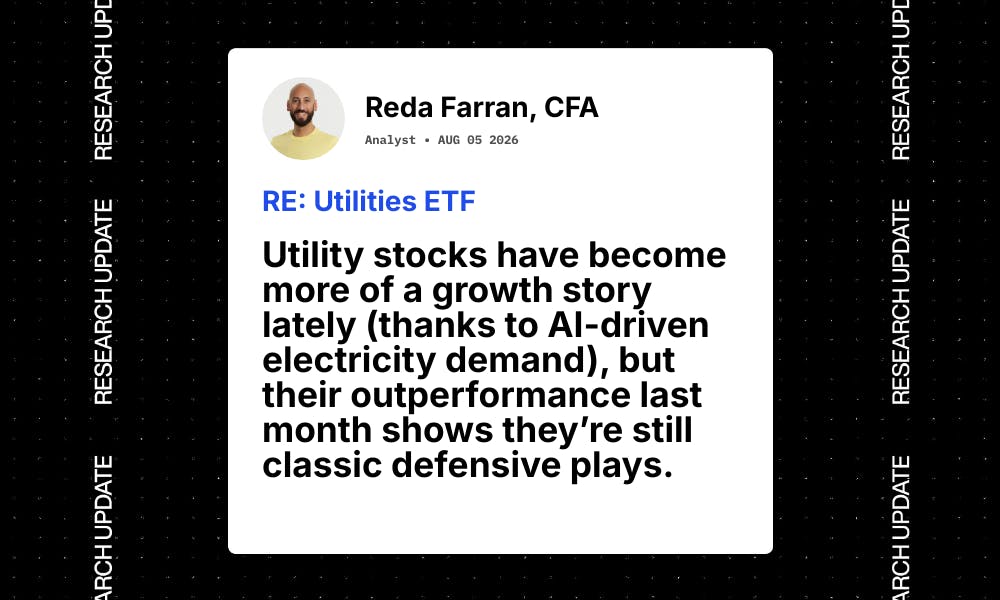
Utility stocks have a well-earned reputation for being sensitive to interest rates. When Treasury yields rise, these high-dividend shares often lose their appeal because investors can get similar income from safer government bonds. But last month, that long-standing pattern broke down: utilities barely reacted to higher yields and actually outperformed the S&P 500.
For investors who have long viewed utilities as a sleepy, defensive corner of the market, this is a notable shift. It suggests the sector is being repriced not just as a bond proxy, but as a growth story in its own right.
Why utilities usually struggle when yields rise
Utilities are classic income stocks. They pay steady dividends, and their share prices tend to move in the opposite direction of bond yields. When Treasury yields go up, the relative attractiveness of those dividends falls, and investors often sell utility shares in favor of bonds. That's why the sector is frequently described as a "bond proxy."
But last month, that relationship didn't hold. Despite Treasury yields pushing higher, utility stocks barely flinched. Instead, they delivered gains that outpaced the broader market. That's a sign that something has changed in how investors value these companies.
The AI-driven growth angle
One big reason for the shift is the surge in electricity demand from data centers and artificial intelligence. Utilities are the companies that literally keep the lights on, and as AI workloads explode, so does the need for power. That has turned some utility stocks into growth plays, with investors betting on years of rising electricity consumption.
This new growth narrative helps explain why utilities can now shrug off higher yields. If a utility is expected to grow its earnings and dividends at a faster clip, its stock becomes less dependent on the level of Treasury yields. Investors are willing to pay up for that growth, even when bond yields are climbing.
That said, the sector hasn't abandoned its defensive roots. Utilities still provide essential services, and their revenues tend to hold up even when the economy weakens. That combination—growth potential plus defensive stability—is rare and increasingly attractive to investors.
What it means for investors
For everyday investors, the recent performance of utilities offers a few takeaways. First, it's a reminder that sectors can change character over time. The old rule of thumb—"utilities are just bond proxies"—may need updating as the energy transition and AI reshape electricity demand.
Second, it highlights the value of diversification. Holding a mix of assets, including defensive sectors like utilities, can help smooth out the ups and downs of the market. Even when the economy stumbles, utilities tend to be more resilient than most.
Finally, it's worth noting that the sector's outperformance last month came even as the broader market was navigating a complex environment. For context, oil's slide has been pulling Treasury yields lower in recent sessions, which could further support rate-sensitive sectors like utilities.
Investors who already own utilities through funds like the Utilities Select Sector SPDR Fund (XLU) or individual names such as NextEra and Constellation have reason to feel good. But as always, past performance is no guarantee of future results. The sector's new growth story could fade if AI-driven electricity demand disappoints or if interest rates spike sharply.
Looking ahead
Market watchers will be keeping an eye on whether this resilience continues. If utilities can maintain their strength even as Treasury yields rise, it would confirm that the sector has truly evolved. If not, last month could be seen as a temporary blip.
Either way, the episode underscores a broader point: in today's market, old assumptions don't always hold. Investors should stay flexible and keep an eye on how sectors are actually behaving, rather than relying on outdated labels.
For now, utilities are proving that they can be both defensive and growth-oriented—a combination that may serve investors well in the months ahead.