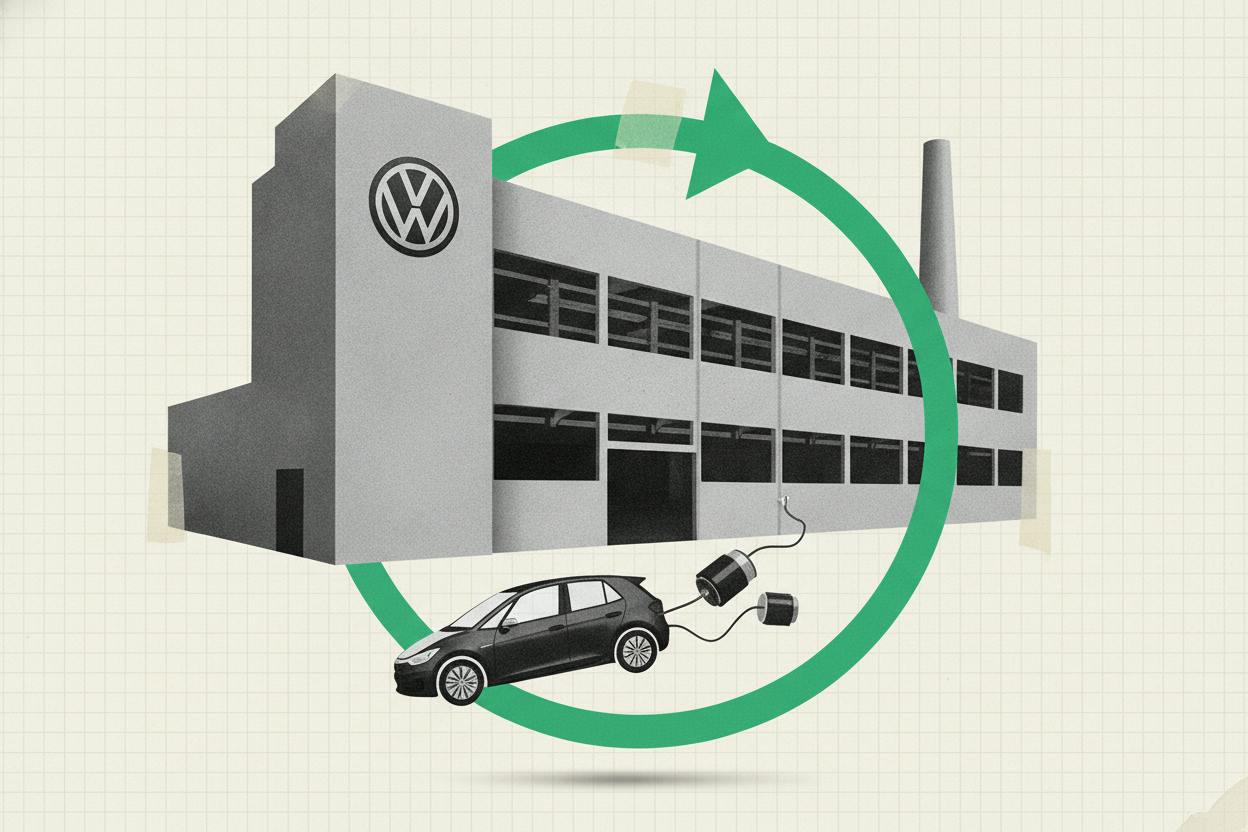
Volkswagen, Europe's largest automaker, is betting on recycling to soften the blow of an uncertain future at its electric vehicle plant in Zwickau, Germany. The company announced plans for a "Circular Economy Hub" that will dismantle old cars to recover parts and materials, a move it frames as a new business rather than a mere scrapyard.
The hub is set to begin operations in 2027, with capacity to process 4,100 vehicles a year. Volkswagen says it will invest up to €90 million in the project, with the German state of Saxony contributing an additional €10.7 million. The funding will also go toward retraining 100 workers for the new facility.
However, as Reuters reports, the initiative only partially addresses a much larger concern: the Zwickau plant currently employs roughly 8,000 people, and there is no vehicle production scheduled beyond 2031. That leaves a significant gap between the jobs the recycling hub can support and the workforce that could be affected.
Why recycling matters for automakers
Automakers are increasingly looking at the "circular economy" as a way to reduce waste, lower costs, and secure access to raw materials like lithium, cobalt, and nickel used in EV batteries. By dismantling end-of-life vehicles, companies can recover valuable components and metals, reducing their reliance on newly mined materials and potentially cutting production costs.
For Volkswagen, the Zwickau hub is a pilot project that could be scaled up if successful. The company is positioning it as a value-creating venture, not just an environmental gesture. But analysts note that the scale—4,100 cars a year—is modest compared to the plant's current output and workforce.
The move comes as Volkswagen navigates a broader restructuring. The company has been grappling with high costs, slowing EV demand, and increased competition, particularly from Chinese automakers. In fact, Volkswagen has recently announced plans to use China-built technology in global models, starting in South America, as part of its efforts to stay competitive. The company's 89-year run is at a crossroads, with management pushing for cost cuts and efficiency gains.
What it means for investors
For everyday investors, the Zwickau recycling hub is a small but telling sign of how Volkswagen is trying to adapt. The investment is relatively modest—€90 million is a drop in the bucket for a company of VW's size—but it signals a strategic shift toward sustainability and resource efficiency.
However, the bigger issue remains the plant's long-term future. With no vehicle production scheduled after 2031, the risk of significant job cuts is real. The recycling hub, while welcome, is unlikely to absorb all 8,000 workers. This uncertainty could weigh on VW's stock, as investors factor in potential restructuring costs and social tensions.
Investors should also consider the broader context. Volkswagen is not alone in facing these challenges; the entire auto industry is transitioning to EVs, which require fewer workers to assemble than traditional combustion-engine cars. This structural shift is forcing automakers to rethink their workforces and plant footprints.
The company's ability to manage this transition smoothly will be key. If VW can successfully repurpose plants like Zwickau for new businesses like recycling, it could mitigate some of the negative impact. But if the transition is messy, it could lead to higher costs and reputational damage.
Looking ahead
Volkswagen's next steps will be closely watched. The company is expected to provide more details on its post-2031 plans for Zwickau and other plants. Investors will also be monitoring EV demand, which has been softer than expected in some markets, and the company's cost-cutting measures.
For now, the Circular Economy Hub is a positive step, but it is not a silver bullet. As Reuters points out, it only partially offsets the risk of job cuts. The real test will be whether Volkswagen can create enough new value to sustain its workforce and remain competitive in a rapidly changing industry.
For those invested in VW or considering it, the key takeaway is to watch how the company balances its legacy business with its future ambitions. The Zwickau plant is a microcosm of that challenge.