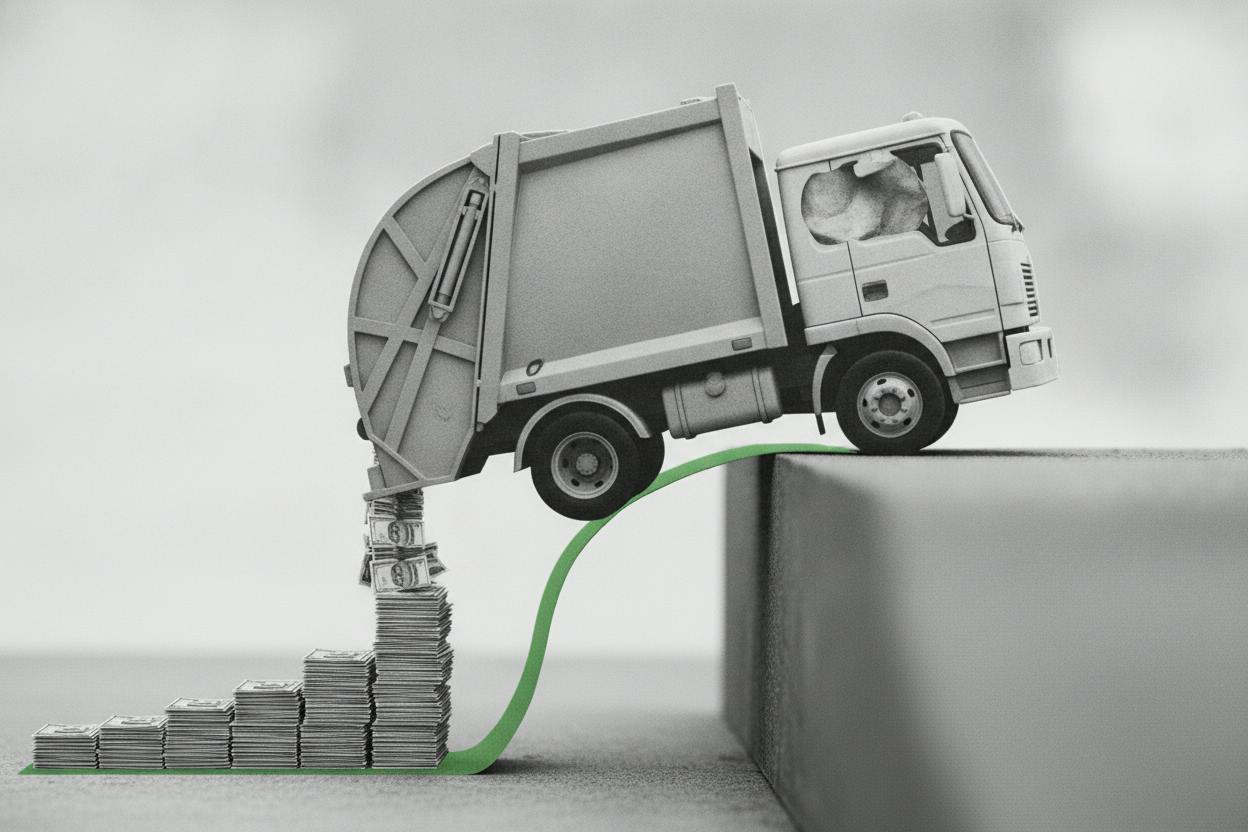
Waste Management, one of North America's largest garbage and recycling companies, reported a softer-than-expected third quarter as inflation pushed operating costs higher. But beneath the profit miss, the company's cash generation held up strongly, and management guided to the high end of its full-year range—a signal that the underlying business remains on solid footing.
Bank of America Securities, which follows the stock, flagged that inflation-related costs squeezed Waste Management's near-term profitability. The company's earnings before interest, taxes, depreciation, and amortization (EBITDA) came in at $2.12 billion, roughly 2% below what analysts had expected. For an asset-heavy operator that constantly spends on trucks, labor, fuel, and landfill operations, even a small miss on that measure can raise questions about margin durability.
Cash flow tells a brighter story
While the profit figure disappointed, the cash picture was more encouraging. Free cash flow—the money left after capital expenditures—rose 20% to $985 million in the quarter. That's a key metric for investors because it represents the cash available for dividends, debt repayment, or share buybacks.
Strong free cash flow is especially important for a company like Waste Management, which requires continuous investment in its fleet and infrastructure. It also gives management flexibility to return capital to shareholders, which is a big reason many investors own the stock in the first place.
Bank of America noted that management guided to the high end of its full-year free cash flow range, which suggests the company expects the cash momentum to continue despite the cost pressures. That guidance may help reassure investors that the profit dip is a temporary speed bump rather than a sign of deeper trouble.
Why costs are biting
Waste Management's cost pressures are not unique. Across the economy, companies are grappling with higher prices for fuel, labor, and equipment. For a business that runs thousands of trucks and employs tens of thousands of workers, those costs add up quickly.
Inflation has been a persistent theme for markets this year, with central banks like the Federal Reserve and the Bank of Canada keeping a close eye on price pressures. As Treasury yields edge up as the Fed holds rates, investors are watching whether inflation will ease enough to allow for rate cuts. For Waste Management, the key question is whether it can pass higher costs on to customers through price increases without losing business.
The company has historically had strong pricing power because waste collection is an essential service with few substitutes. But if inflation persists, even that pricing power may not fully protect margins. Similar dynamics have played out in other industries, as seen with Hero MotoCorp's profit miss when input costs outpaced sales growth.
What it means for investors
For everyday investors, the takeaway is nuanced. On one hand, a 2% EBITDA miss is not a catastrophe, especially when cash flow is growing strongly. On the other hand, it's a reminder that even defensive, essential-service companies are not immune to inflation.
Waste Management's stock is often considered a defensive holding—a steady, dividend-paying business that can weather economic downturns. The company's ability to generate cash even in a tough quarter supports that reputation. But investors should watch whether cost pressures persist and whether management can maintain its pricing power.
Bank of America's note suggests that the market may be overreacting to the profit miss, given the strength in cash flow and guidance. For long-term investors, the key metrics to monitor are free cash flow trends, pricing actions, and any signs that cost inflation is easing.
As the Bank of Canada resumes rate hikes and warns that energy costs could keep inflation high, the broader environment remains challenging for cost-sensitive businesses. But Waste Management's ability to guide to the high end of its range suggests management sees a path forward.
The bottom line
Waste Management's third quarter was a mixed bag: profit slightly below expectations, but cash flow up 20% and guidance intact. For investors, the cash flow strength is the more important signal, as it underpins dividends and buybacks. The profit miss, while worth noting, may be a temporary blip in an otherwise stable business.
As always, no single quarter tells the whole story. Investors should look at trends over time and consider how inflation and pricing power might affect the company's long-term profitability. For now, Waste Management appears to be managing the inflationary environment reasonably well, even if the road is bumpier than some hoped.