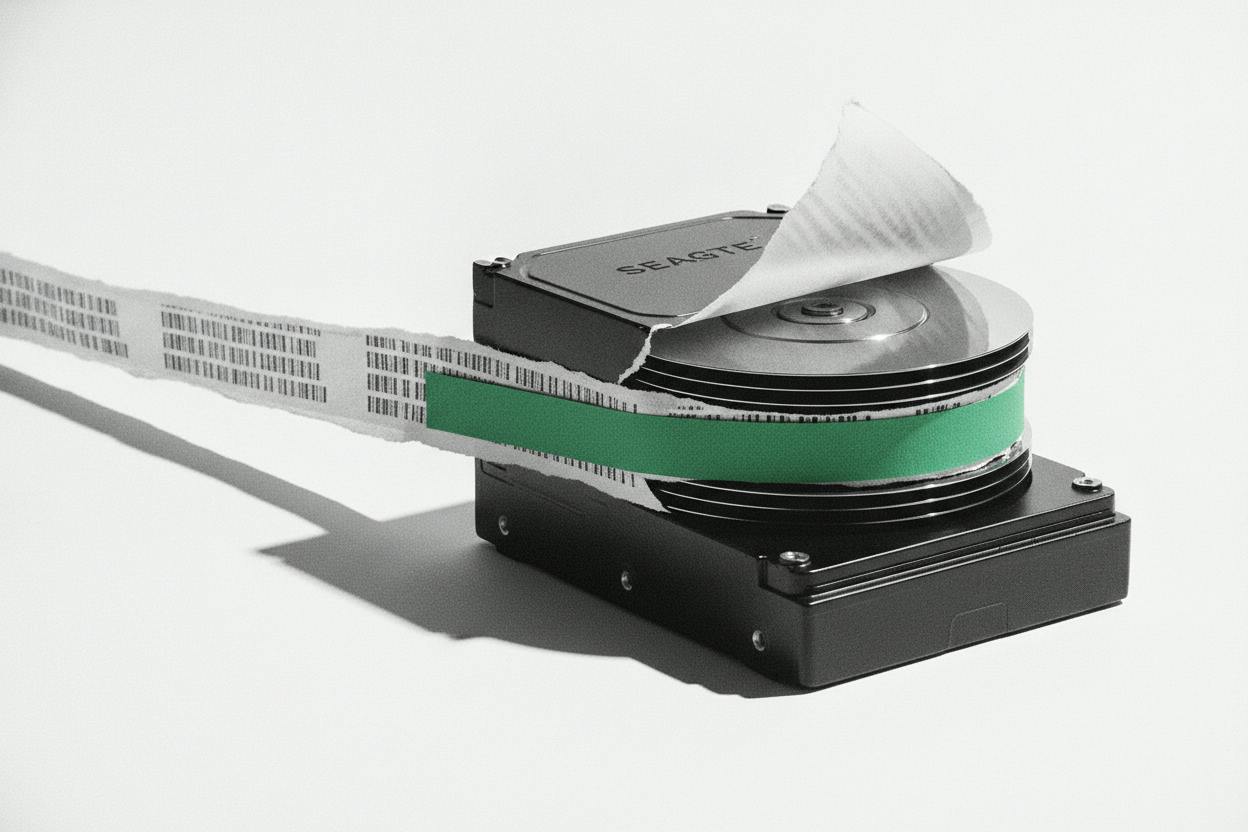
Investment firm Wedbush believes Seagate Technology can keep growing even after its latest quarterly outlook disappointed some investors. The firm's analysts argue that tight supply in the hard disk drive (HDD) market is pushing prices higher, and that Seagate's ability to pack more storage capacity into each drive will lift revenue and margins over the next few years.
Seagate's fiscal Q2 gross margin forecast came in softer than some hoped, and its fiscal Q1 exabyte shipments rose just 1% from the prior quarter. But Wedbush says those near-term numbers miss the bigger picture: the real opportunity lies in how cloud contracts reset as industry pricing moves up.
Why hard drives still matter
Hard disk drives may seem like old technology, but they remain a workhorse of the cloud. They are one of the cheapest ways to store the enormous amounts of data generated by streaming, artificial intelligence, and enterprise software. Even as solid-state drives (SSDs) gain ground in some areas, HDDs are still the go-to for bulk storage where cost per terabyte matters most.
Wedbush's thesis is that supply is constrained. With fewer manufacturers and limited capacity expansion, drive prices are trending upward. At the same time, Seagate is increasing the "bits per unit" — essentially, the storage capacity of each drive. That means the company can generate more revenue from each drive sold, without needing a big jump in the number of units shipped.
That combination — higher prices and more capacity per drive — is what Wedbush thinks will drive revenue and margins higher over the next few years.
The contract timing factor
One reason the near-term outlook looks soft is that Seagate's biggest customers — cloud service providers like Amazon, Microsoft, and Google — often buy under long-term agreements. These contracts lock in prices for months or even years. So when market prices rise, the increase doesn't show up immediately in Seagate's revenue from those contracted volumes.
Instead, price increases first appear in shorter-cycle channels, like sales to distributors or smaller customers. Then, when a long-term contract comes up for renewal, the new pricing can be applied to a large chunk of volume all at once. That can push a significant portion of the price increase straight into gross margin, potentially more than gradual unit growth would.
Wedbush says this timing effect is the key swing factor. Near-term guidance can look underwhelming while the multi-year path still improves, because the question is when those cloud contracts "catch up" and on what terms.
What it means for investors
For everyday investors, the takeaway is that Seagate's stock may be more about the future than the current quarter. If you're looking at Seagate as a potential holding, the near-term gross margin dip might be less important than the trajectory of contract renewals and industry pricing.
That said, this is a single analyst's view, not a guarantee. The HDD market is cyclical, and pricing can turn quickly if supply catches up with demand. Investors should also keep an eye on broader tech spending trends — if cloud providers pull back on data center investment, that could soften demand for drives.
Seagate's story is part of a larger theme in tech: companies are increasingly focused on protecting margins even as they invest in growth. Similar dynamics are playing out elsewhere, as seen in SAP swapping pricey AI models for cheaper ones to keep its margins healthy. And in the storage world, the shift toward higher-capacity drives is a key trend to watch.
For now, Wedbush's message is that Seagate's growth story is intact, but the timing of that growth may be delayed by contract cycles. Investors who understand that nuance may be better positioned to judge the company's quarterly reports.
As always, it's worth remembering that analyst opinions are just one input. Do your own research, consider the risks, and think about how a stock like Seagate fits into your broader portfolio.