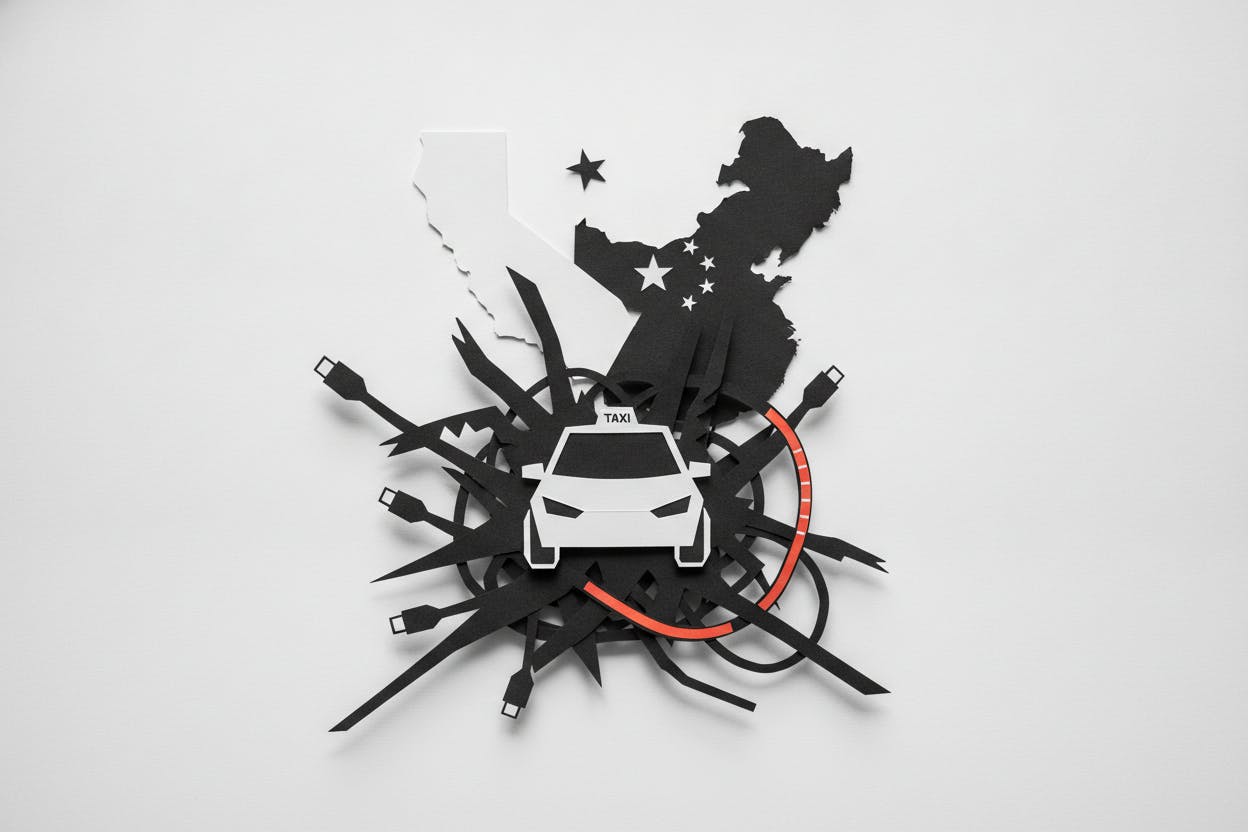
A new research note from Wedbush Securities argues that Alphabet's Waymo and China's Baidu are emerging as the early leaders in the robotaxi race. The key takeaway: the biggest constraint isn't what riders pay—it's how quickly companies can expand their fleets.
Wedbush estimates that Waymo can charge between $4.50 and $5.00 per mile in California and still remain fully booked, with wait times of around 15 minutes. That pricing gives Waymo a roughly 20% premium over ride-hailing services like Uber and Lyft, largely because supply is limited relative to demand.
Why scaling matters more than pricing
Robotaxis—self-driving taxis that operate without a human driver—are still in their early commercial stages. Companies like Waymo and Baidu have been testing and rolling out paid rides in select cities, but expanding to new areas requires solving a complex web of challenges.
According to Wedbush, the friction comes from coordinating multiple moving parts: road infrastructure, depot locations, charging networks, insurance policies, capital investment, and regulatory approvals. All of these must move in sync for a robotaxi fleet to grow efficiently.
Wedbush notes that Waymo's paid-ride volume is currently ahead of Baidu's, but the Chinese operator is scaling quickly. Investors may be underestimating how fast Chinese companies can ramp up, given the country's aggressive push for autonomous driving and supportive regulatory environment.
What this means for investors
For everyday investors, the Wedbush analysis highlights a few key points. First, the robotaxi market is still in its infancy, and the companies that solve the scaling puzzle first could capture significant market share. Second, pricing power exists—Waymo's ability to charge a premium suggests strong demand, but that advantage may shrink as more competitors enter the space.
Investors should watch for updates on fleet expansion, regulatory approvals, and partnerships. Companies like Hyundai, which recently took full ownership of Boston Dynamics, are also positioning themselves in the autonomous vehicle ecosystem.
Wedbush's note also touches on the broader competitive landscape. While Waymo and Baidu are leading now, other players—including Tesla, Cruise, and various Chinese startups—are racing to catch up. The winner may not be the one with the best technology alone, but the one that can deploy at scale most efficiently.
Regulatory and operational hurdles
Regulation remains a wild card. In the U.S., states like California and Arizona have been more welcoming to robotaxis, but federal guidelines are still evolving. In China, the government has been more proactive, granting permits for autonomous driving tests in multiple cities. That could give Baidu and other Chinese firms a scaling advantage.
Wedbush also points out that capital requirements are significant. Building and maintaining a fleet of self-driving vehicles, along with the necessary infrastructure, requires billions of dollars. Companies with deep pockets—like Alphabet and Baidu—have an edge, but even they face pressure to show a path to profitability.
For context, Apple recently cleared a regulatory hurdle in China by partnering with Alibaba and Baidu on AI models, underscoring the importance of local partnerships in the Chinese market.
What to watch next
Investors should keep an eye on quarterly updates from Waymo and Baidu, particularly around ride volumes, fleet size, and geographic expansion. Any news of new city launches or regulatory approvals could be a catalyst.
Wedbush's analysis suggests that the robotaxi story is still in its early chapters. The companies that can scale quickly while maintaining safety and reliability will likely be the ones that define the market. For now, Waymo and Baidu are setting the pace—but the race is far from over.