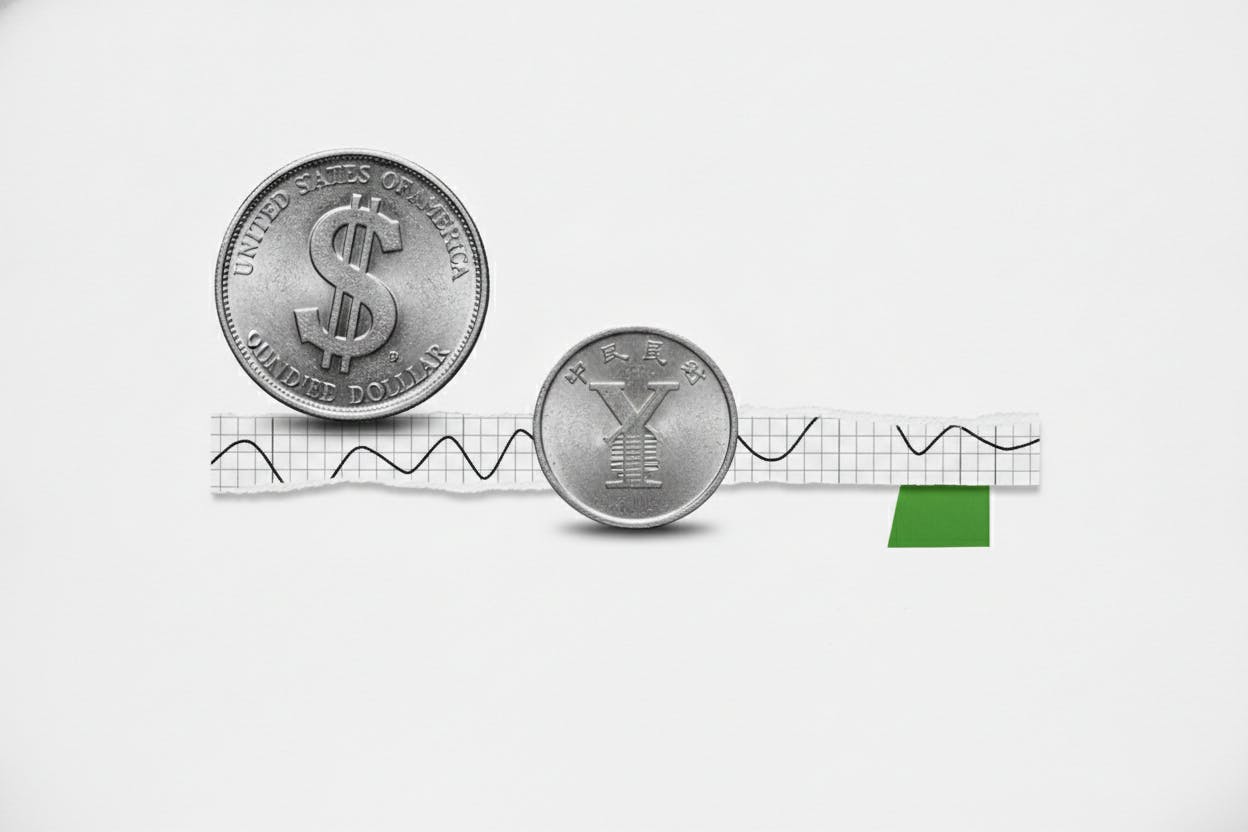
The Chinese yuan traded in a narrow range on Monday, holding its balance as the US dollar eased from a one-year high. The People's Bank of China (PBOC) stepped in with short-term liquidity operations, adding overnight reverse repos to smooth money-market conditions.
The dollar's retreat gave some breathing room to emerging-market currencies, but the yuan's stability was largely a product of Beijing's careful management. The PBOC set its daily reference rate, or "fix," at 6.8175 per dollar, a level that was weaker than analysts had expected. Under China's currency regime, the onshore yuan is allowed to trade within a 2% band around that fix.
Two Forces at Play
The yuan has been caught between two powerful forces. On one side, the Federal Reserve's commitment to keeping interest rates "higher for longer" has boosted the dollar, as investors expect US rates to stay elevated relative to other major economies. That dynamic has kept the greenback strong and put pressure on currencies like the yuan.
On the other side, Beijing has made clear its preference for a stable yuan. A sharp depreciation would risk capital outflows and import inflation, while a rapid appreciation could hurt Chinese exporters. The PBOC's daily fix is its primary tool for signaling its desired trading range.
Monday's fix was set slightly weaker than market expectations, suggesting the PBOC is comfortable with a modest softening of the yuan as long as it remains orderly. The central bank also conducted overnight reverse repos, a tool it uses to inject short-term cash into the banking system and keep money-market rates from spiking. This is part of a broader effort to manage liquidity without letting the yuan swing too wildly.
What It Means for Investors
For everyday investors, the yuan's stability is a double-edged sword. A stable yuan reduces uncertainty for companies that do business with China, which is good for global supply chains and trade. But it also means that the PBOC is actively managing the currency, which can create headwinds for investors looking for clear directional bets.
The broader backdrop is the dollar's strength. The greenback has been on a tear, driven by the Fed's hawkish stance and safe-haven demand amid global uncertainty. A strong dollar tends to weigh on commodities priced in dollars, like oil and copper, and can pressure emerging-market currencies. However, when the dollar pauses or retreats, as it did on Monday, it can provide a tailwind for riskier assets.
Investors should watch for further signals from the Fed. Any hints that the central bank might slow its rate hikes could weaken the dollar further, giving the yuan and other currencies more room to appreciate. Conversely, if US inflation remains sticky and the Fed stays aggressive, the dollar could resume its climb.
Broader Market Context
The dollar's pullback from a one-year high is part of a broader pattern. In recent weeks, the greenback has rallied as the Fed pushed back against market expectations of rate cuts. But Monday's pause suggests that some investors are taking profits or reassessing the pace of US rate increases.
Other currencies have also reacted to the dollar's moves. The Australian and New Zealand dollars, for example, have been under pressure as the dollar strengthened, while Latin American markets have rallied when the dollar retreats. The yuan's relative stability stands out, reflecting China's unique policy framework.
For investors with exposure to Chinese assets, the key takeaway is that the PBOC is likely to continue managing the yuan within a narrow range. That means currency risk is somewhat contained, but it also means that any sharp moves in the dollar could still ripple through Chinese markets.
Looking Ahead
Markets will be watching for the next batch of US economic data, which could influence the Fed's next move. If inflation continues to moderate, the case for higher-for-longer rates may weaken, potentially easing pressure on the yuan. But if the economy remains resilient, the dollar could stay strong.
In China, investors will also monitor the PBOC's next steps. The central bank has a range of tools to manage liquidity and currency stability, including reserve requirement ratios and medium-term lending facilities. Any shift in its stance could signal a change in the yuan's trajectory.
For now, the yuan is holding its balance, but the tug-of-war between the Fed and the PBOC is far from over.