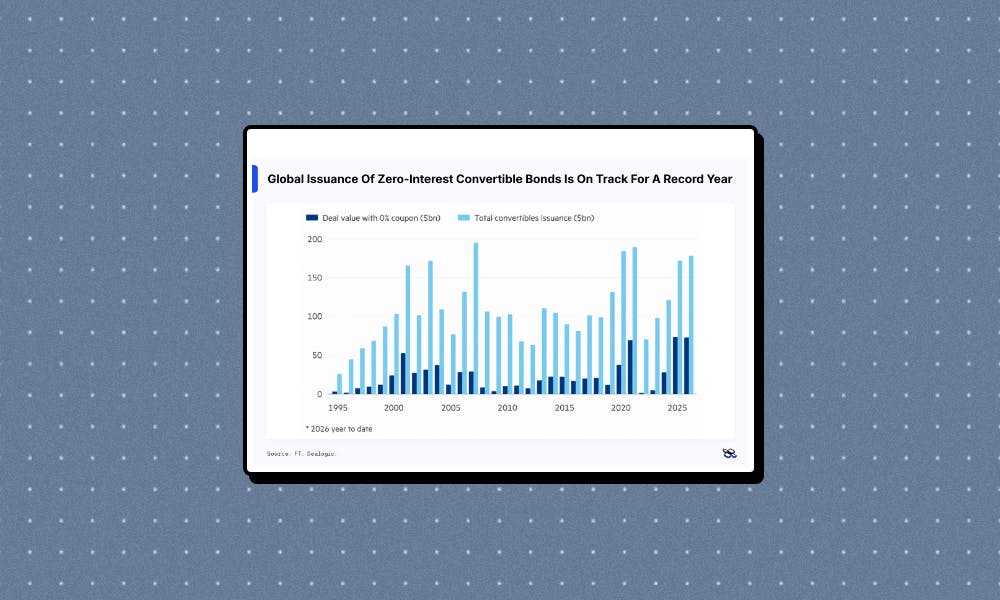
Artificial intelligence companies are finding a new way to fund their massive spending sprees: borrowing money without paying any interest. So far this year, firms have issued $72 billion in zero-coupon convertible bonds, putting 2026 on track to beat last year's record. This trend is reshaping how some of the biggest names in tech finance their AI ambitions.
What are zero-coupon convertibles?
To understand why this is happening, it helps to break down the jargon. A convertible bond is a type of corporate debt that can be exchanged for a fixed number of shares at a set price. A zero-coupon version simply means the bond pays no regular interest—hence the name. Instead, investors buy the bond at a discount and hope to profit either from the conversion into shares or from the bond's price rising.
For the issuing company, the appeal is obvious: they get billions in cash without the ongoing cost of interest payments. That's especially valuable for AI firms that are pouring hundreds of billions into data centers, chips, and other infrastructure. In an environment where borrowing costs are still elevated, avoiding interest can save a company enormous sums over the life of the debt.
Why investors accept zero interest
The trade-off for investors is the embedded option to convert the bond into stock. That option becomes more valuable when the underlying shares are volatile—and AI-linked stocks have certainly been that. When share prices swing widely, the chance that the stock will rise above the conversion price increases, making the potential upside more attractive.
In essence, investors are trading away steady interest income for a shot at capital gains. This is a classic strategy for growth-oriented investors who are willing to take on more risk in exchange for the possibility of higher returns. For AI companies, whose stock prices are often driven by hype and rapid technological developments, this volatility is a feature, not a bug.
The broader market backdrop also plays a role. With interest rates still relatively high, traditional bonds offer decent yields, but convertibles can offer even more if the stock performs well. That combination has made zero-coupon convertibles a popular choice for both issuers and buyers.
What it means for investors
For everyday investors, this trend has several implications. First, it signals that AI companies are confident enough in their future growth to take on debt—even if it's not traditional debt. But it also means these companies are betting heavily on their stock price rising. If the shares fall, the conversion option becomes worthless, and investors are left holding bonds that pay nothing.
Second, the rise of zero-coupon convertibles could be a sign of froth in the AI sector. When companies can raise money this easily, it may encourage overinvestment. History shows that easy financing often precedes market corrections. Investors should be aware that the same volatility that makes these bonds attractive can also lead to sharp losses.
Finally, for those who own shares in AI companies, this trend is a double-edged sword. On one hand, it provides cheap capital for growth. On the other, it can dilute existing shareholders if the bonds are converted into new shares. That dilution can weigh on earnings per share and stock price over time.
Looking ahead
With 2026 on pace to break records, the zero-coupon convertible market shows no signs of slowing. Investors will be watching whether AI companies can deliver the growth that justifies these bets. If they do, the strategy will look brilliant. If not, the fallout could be significant.
For now, the takeaway is that AI's funding machine has found a new gear. Whether that's sustainable remains to be seen, but it's a development worth understanding for anyone with exposure to tech stocks or the broader market.