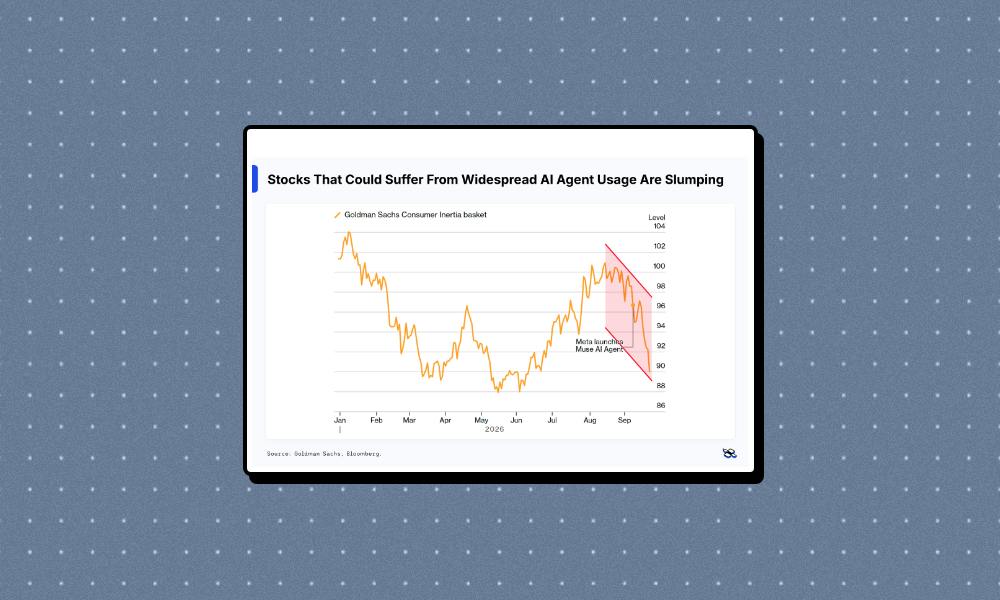
Meta's new AI agent, Muse, is topping US app-store rankings, and it's prompting a big question on Wall Street: what happens to businesses that make money from customers who simply can't be bothered to switch?
The idea behind "customer inertia" is simple. Many companies—think banks, insurers, telecom providers, streaming services, and travel platforms—earn steady profits because customers stick with them even when cheaper or better options exist. The hassle of switching, comparing plans, or waiting on hold is enough to keep most people loyal by default.
But AI agents like Muse could change that calculus. Muse can connect to services like Gmail and OpenTable and handle digital tasks for users—booking reservations, managing schedules, and potentially comparing prices or switching providers. As these agents get better, they could strip away the friction that keeps customers locked in.
Why investors are paying attention
Stocks that profit from making it hard to switch are already feeling the pressure, according to the source brief. That includes companies in sectors where customer retention is a key profit driver—telecoms, insurance, banking, and subscription services.
For years, these businesses have relied on a simple formula: acquire customers, then benefit from their reluctance to leave. Switching costs—whether financial, administrative, or just the time spent on hold—have been a moat. But AI agents could make that moat much less effective.
Imagine an AI agent that can, on your behalf, compare your current phone plan with competitors, handle the paperwork to switch, and even negotiate a better deal. Or one that scans your insurance policies and finds cheaper coverage, then manages the transfer. That's the kind of friction-reducing capability that could turn "loyal by default" into "loyal only if it's actually the best deal."
This isn't just a theoretical concern. Meta's Muse is already demonstrating the ability to interact with real-world services, and its rapid rise in app-store rankings suggests consumer interest is high. The recent partnership between PayPal and Meta to put AI shopping agents at checkout is another sign that tech giants are betting big on AI-driven commerce.
What it means for investors
For everyday investors, the key question is which companies are most exposed. Those with high customer churn rates and heavy reliance on inertia-driven revenue could see margins compress if AI agents make switching effortless.
On the flip side, companies that genuinely offer the best value or superior service may benefit, as AI agents could funnel customers toward them. The winners could be those that embrace AI to improve their own customer experience, rather than relying on lock-in.
It's also worth noting that this is still early days. AI agents are improving rapidly, but they're not yet perfect at handling complex tasks like switching a mortgage or changing a health insurance plan. Regulatory hurdles and security concerns could slow adoption. Still, the direction is clear, and investors are starting to price in the risk.
As US business activity hits a five-year high, the broader economy is showing resilience, but the competitive landscape could shift as AI tools become more mainstream. Companies that have long benefited from customer inertia may need to rethink their strategies.
Beyond the hype
It's important to separate the hype from the substance. Not every business with a loyal customer base is at risk. Some industries have high switching costs that go beyond mere inconvenience—think of banks where your direct deposits, bill payments, and credit history are tied up, or insurers where coverage terms are complex.
But even in those cases, AI agents could reduce the effort required to compare and switch. And as consumer spending shows signs of softening, price-sensitive shoppers may be more willing to use AI to find better deals.
For investors, the takeaway is to look at companies' customer retention strategies. Are they competing on price and service, or are they relying on inertia? The latter could be a growing risk.
As markets remain volatile, this is a theme that could play out over the coming years. AI agents are not going to disappear, and their ability to handle everyday tasks will only improve. The businesses that adapt—by offering genuine value and seamless experiences—are likely to thrive. Those that don't may find that their customers, once inert, are now just a click away from leaving.