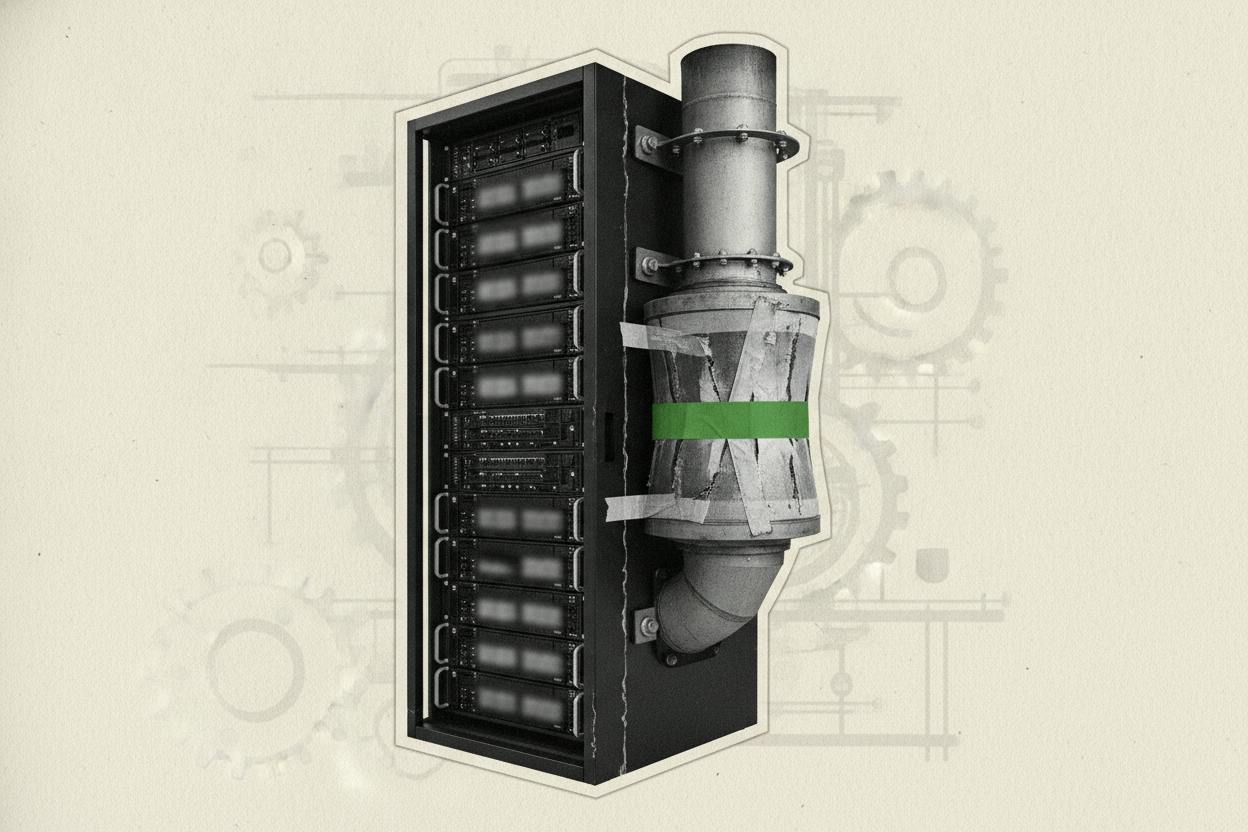
Johnson Matthey, the UK specialty chemicals company, says the artificial-intelligence boom is doing more than just powering data centers—it's also supercharging demand for its emissions-control equipment. The company reports that orders for its gas-turbine filters now outstrip what it can supply, a sign of how the race to build AI computing capacity is reshaping industrial markets far beyond the chipmakers.
Data center construction is ramping up, especially in the US, as Big Tech pours billions into AI computing. But many regions don't have enough grid capacity to handle the load, so operators are increasingly turning to on-site gas turbines to keep projects moving, according to Reuters. Those turbines still have to meet air-quality regulations, which is lifting demand for selective catalytic reduction (SCR) systems—equipment that reduces nitrogen oxides in exhaust.
Johnson Matthey is positioning itself as a key supplier in this niche. The company bought Cormetech, a US catalyst maker, in July, and CEO Liam Condon said demand now “far outstrips supply” even though the firm could expand production by adding machines and dryers. The company also lifted its annual sales outlook for Cormetech plus its Clean Air Solutions unit to more than £250 million, up from more than £200 million, and plans to report them together as a Clean Power segment from full year 2026/27.
Why gas turbines are suddenly everywhere
The surge in demand is tied to a simple problem: data centers need enormous amounts of electricity, and the grid isn't always ready. In many parts of the US, connecting to the grid can take years, so developers are installing gas turbines on-site to get power quickly. These turbines are essentially jet engines on a stand, and they burn natural gas to spin a generator. They're reliable and can be up and running faster than waiting for new transmission lines.
But gas turbines produce nitrogen oxides (NOx), which contribute to smog and respiratory problems. Environmental regulations in most developed countries require operators to install SCR systems to cut those emissions. An SCR system injects a reagent like ammonia or urea into the exhaust, and a catalyst converts the NOx into harmless nitrogen and water. Johnson Matthey makes those catalysts and the systems that house them.
The company's acquisition of Cormetech, a US-based maker of SCR catalysts, was a strategic move to capture more of this market. Cormetech's products are used in both power generation and industrial applications, and the deal gives Johnson Matthey a stronger foothold in the US, where much of the data center buildout is happening.
What it means for investors
For investors, the key takeaway is that Johnson Matthey's Clean Power business is growing faster than expected, and it comes with a pricing tailwind. If data centers rely on gas turbines while grids catch up, emissions controls aren't optional—they're part of the permission slip to operate. That makes this demand less sensitive to price than many industrial projects, because customers can't easily “wait it out” without delaying revenue-generating capacity. When suppliers are capacity-constrained, that dynamic often shows up first in firmer pricing and steadier margins, not just higher unit volumes.
That's also why the new Clean Power segment may be judged differently from Johnson Matthey's legacy auto-emissions business. The auto catalyst market is mature and cyclical, tied to vehicle production and tightening emissions rules. In contrast, the data center-driven demand for stationary emissions controls is tied to a structural shift in energy infrastructure. Investors are likely to focus on backlog durability and profitability—and on how quickly the company can add capacity—rather than treating it as a purely cyclical equipment line.
The company's ability to expand production by adding machines and dryers suggests it sees a long runway. But capacity additions take time, and in the meantime, turning customers away means leaving revenue on the table. That's a good problem to have, but it also means the company's growth is capped in the near term until new capacity comes online.
Johnson Matthey's outlook is part of a broader trend where AI data centers are creating ripple effects across the energy and industrial sectors. CATL's pitch for off-grid power for AI data centers is another example of how companies are scrambling to meet the power demands of the AI boom. Similarly, Soitec raised its outlook as AI data centers drive demand for optical chips, showing that the infrastructure buildout is touching everything from semiconductors to catalysts.
For everyday investors, this story underscores how AI's impact goes beyond tech stocks. Companies that provide the physical building blocks of the digital economy—power, cooling, emissions controls—are seeing demand surge. While Johnson Matthey is a UK-listed stock, its fortunes are tied to global data center investment, which shows no signs of slowing. The company's ability to convert this demand into profits will depend on how quickly it can scale up production and manage costs.
As always, it's worth remembering that demand can be cyclical, and regulatory changes could alter the picture. But for now, Johnson Matthey is riding a wave that shows no signs of cresting.



