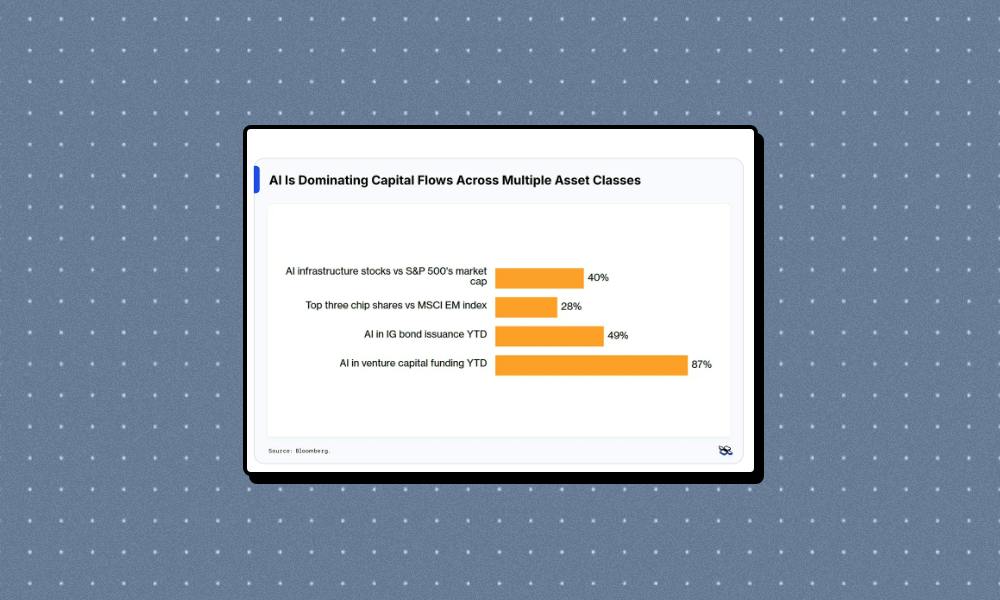
Artificial intelligence has become so pervasive that it's quietly reshaping the risk profile of portfolios that look diversified on the surface. Investors who spread their money across stocks, bonds, commodities, and private markets may still be making variations of the same big bet on AI, according to a new analysis.
The technology's influence is no longer confined to a handful of US mega-cap tech companies. It now stretches into developed-market equities, emerging-market benchmarks, credit markets, venture capital, infrastructure, and even commodities. That means the diversification investors think they have may be more illusion than reality.
How AI has seeped into every corner of the market
Take stocks. Developed-market indexes are heavily weighted in technology, with giants like Microsoft, Nvidia, and Alphabet dominating the S&P 500 and similar benchmarks. But the AI exposure doesn't stop there. Emerging-market indexes carry their own dose of AI through South Korea's chipmakers and Taiwan's TSMC, the world's largest contract chip manufacturer. So an investor who owns both a US index fund and an emerging-market fund may be doubling up on the same semiconductor supply chain.
The same dynamic shows up in credit markets. Hyperscalers—the giant cloud providers like Amazon Web Services, Microsoft Azure, and Google Cloud that are central to AI's infrastructure—borrow heavily in the bond market. When investors buy corporate bonds or bond funds, they're often lending to the very companies building AI data centers. That means credit portfolios, too, are quietly tied to AI's fortunes.
Private markets and venture capital are even more explicit. A large share of recent venture funding has flowed into AI startups, and infrastructure funds are pouring money into data centers and energy projects to power them. Even commodities are affected: copper, electricity, and natural gas demand are increasingly driven by AI's insatiable appetite for computing power.
Why this matters for everyday investors
For the average investor, the takeaway is that diversification—spreading money across different asset classes—may not provide the protection it once did. If AI stumbles, whether due to a regulatory crackdown, a slowdown in adoption, or a burst in the valuation bubble, the pain could be felt across a portfolio that looks balanced on paper.
This is especially relevant given how concentrated the market has become. As our October 2026 portfolio check noted, AI winners have driven much of the market's gains, while bonds have suffered from rising yields. A narrow market means that a few AI-related names can move the entire index, and that concentration risk is amplified when AI exposure is hidden in unexpected places.
Investors should also consider the broader backdrop. The US 10-year Treasury yield recently hit 5.34%, its highest level since 2002, which has pressured assets in emerging markets and elsewhere. As Latin American assets slid on that news, it's a reminder that global markets are interconnected in ways that aren't always obvious.
What to watch next
For investors, the key is to understand where their money is actually working. A fund labeled "diversified" may still be heavily tilted toward AI through its top holdings. Reading a fund's prospectus and looking at its sector and geographic breakdown can reveal hidden concentrations.
It's also worth watching how companies are responding to AI-related opportunities. For example, Metaplanet's move to add interest-bearing assets to fund more bitcoin purchases shows how even crypto-related strategies are adapting to a higher-rate environment. And in the corporate world, ConocoPhillips weighing asset sales highlights how traditional industries are repositioning in a world where capital is increasingly flowing toward AI infrastructure.
The bottom line: AI is no longer a niche tech story. It's a macro force that touches nearly every asset class. Investors who think they're diversified may need to look closer—because the same big bet might be hiding in plain sight.