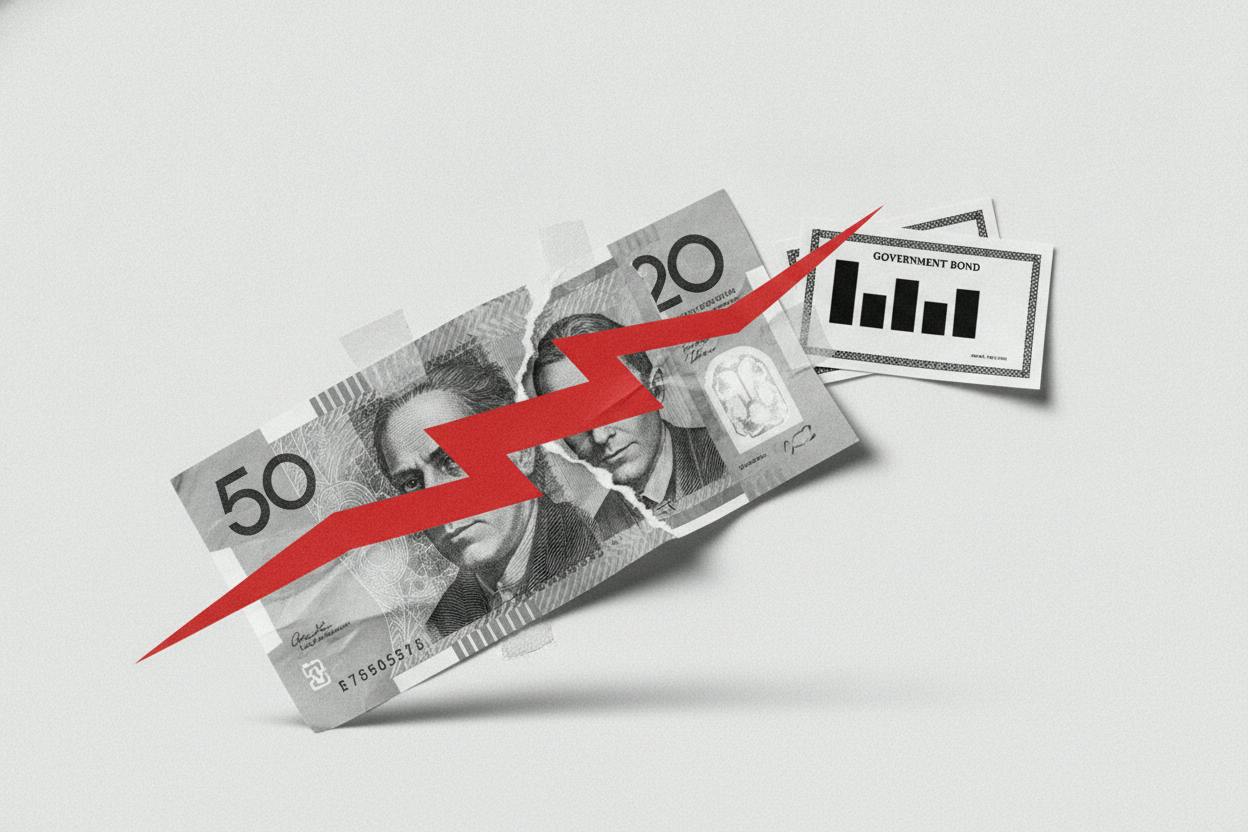
The Australian and New Zealand dollars slipped on Friday as a tech-led global stock sell-off pushed investors toward safer assets like government bonds, even as traders continued to price in a 95% chance that the Reserve Bank of New Zealand (RBNZ) will raise interest rates next week.
The move reflects a broader shift into “risk-off” mode across financial markets. Investors are questioning how much profit today’s artificial intelligence boom can actually deliver relative to the enormous spending required for data centers and chips. That uncertainty has hit tech stocks worldwide, with major indices like the Nikkei sliding 1.7% as the selloff reached Tokyo chip stocks.
Why the Aussie and kiwi are feeling the heat
The Australian dollar (AUD) and New Zealand dollar (NZD) are often called “high-beta” currencies, meaning they tend to move more sharply than others when global risk appetite changes. When investors feel confident, they typically buy these currencies, which are tied to commodity exports and economic growth in the Asia-Pacific region. But when fear takes over, money flows out of them and into traditional safe havens like the US dollar, Japanese yen, and Swiss franc.
That dynamic was on full display Friday. The AUD fell 0.9% against the yen and 0.6% against the Swiss franc, according to Reuters. These crosses often see the biggest moves during risk-off episodes because of the “carry trade.”
In a carry trade, investors borrow in a currency with low interest rates, like the yen or franc, and use those funds to buy higher-yielding assets elsewhere, including Australian and New Zealand dollar-denominated investments. When stock markets tumble, these leveraged positions are often unwound quickly. That means selling the Aussie and kiwi and buying back the yen and franc, amplifying the moves in those currency pairs.
RBNZ hike still on the table
Despite the global risk-off mood, New Zealand’s domestic economic picture still points to tighter monetary policy. Traders are pricing in roughly a 95% chance that the RBNZ will raise its official cash rate by 25 basis points to 3.0% at its meeting next week. That would be another step in the central bank’s fight against inflation, which remains above its target range.
However, as Friday’s price action shows, a widely expected rate hike does not guarantee a stronger currency. If global investors are cutting risk at the same time, the kiwi can weaken even as the central bank tightens. The same logic applies to the Australian dollar, which is also sensitive to global growth expectations and commodity prices.
What it means for investors
For everyday investors, the key takeaway is that currency moves are often driven by global sentiment as much as by domestic fundamentals. A central bank’s rate decision is important, but it is just one factor in a complex web of market forces.
The current selloff in tech stocks, partly fueled by concerns about Meta’s AI spending warning and similar signals from other companies, has broader implications. When investors worry that AI-related capital expenditures may not generate expected returns, they tend to reduce exposure to riskier assets. That can lead to a flight to quality, with money moving into government bonds, which pushes yields down.
For those holding Australian or New Zealand dollar assets, or planning to travel or invest in those countries, the recent weakness means their purchasing power in other currencies has declined. Conversely, if you are buying goods or services from those countries, a weaker currency could make them relatively cheaper.
It is also worth noting that the AI demand hitting a funding wall is not just a tech story. It affects everything from semiconductor stocks to currencies, as investors reassess the sustainability of the AI-driven growth narrative. The Tesla AI spending squeeze is another example of how heavy investment in AI is pressuring margins and raising questions about near-term profitability.
For now, markets are likely to remain sensitive to any news about AI spending, central bank policy, and global growth. The RBNZ decision next week will be closely watched, but as Friday showed, even a near-certain rate hike may not be enough to lift the kiwi if the global mood stays cautious.
Investors should keep an eye on how the tech selloff evolves and whether it spreads to other sectors. A sustained risk-off environment could keep pressure on the Aussie and kiwi, while a rebound in tech stocks might quickly reverse the trend.



