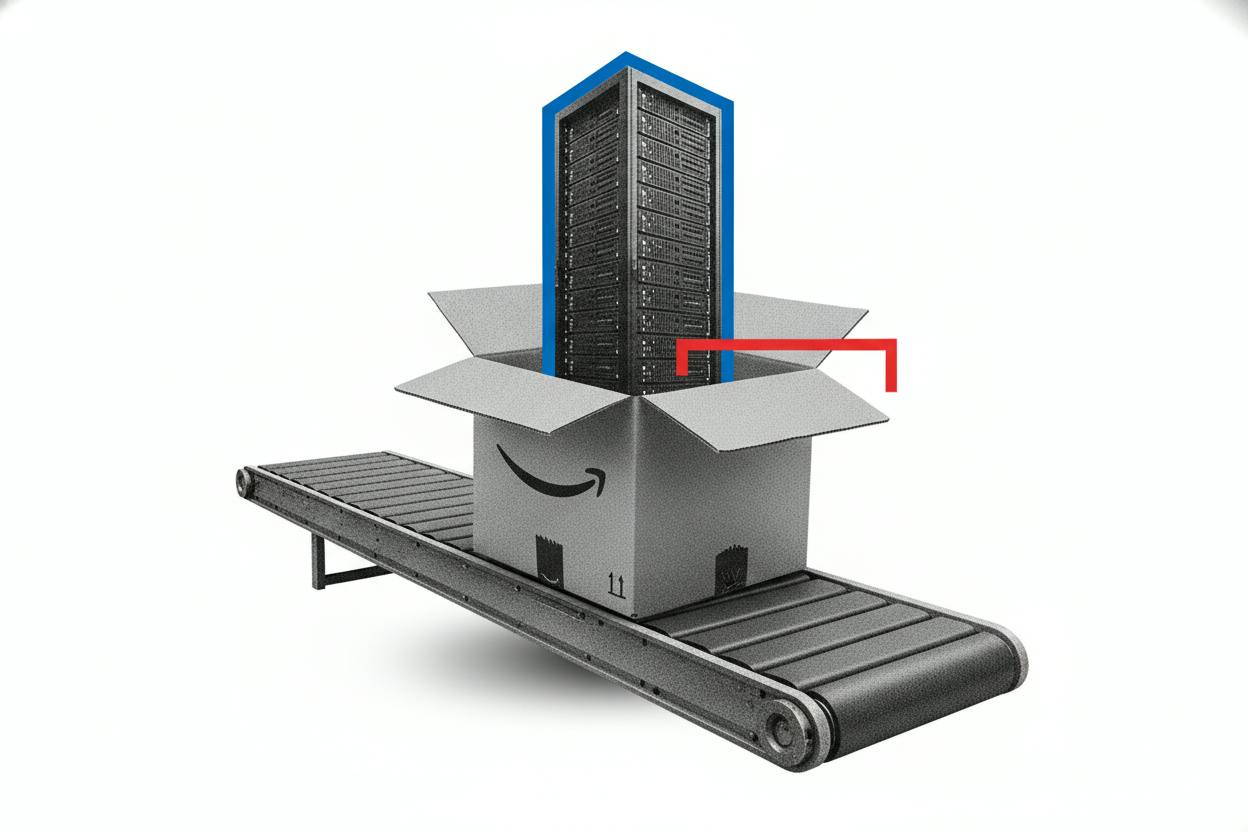
Amazon on Thursday gave investors a holiday-season forecast that landed a bit shy of what Wall Street had hoped for, even as its cloud-computing division continued to fire on all cylinders. The company said it expects fourth-quarter revenue to come in between $240 billion and $247 billion, a range that brackets the roughly $248 billion analysts had penciled in. The news sent shares down in after-hours trading, a reminder that even the world's largest online retailer isn't immune to the market's exacting standards.
A tale of two businesses
The earnings report laid bare the split personality of Amazon's sprawling empire. On one side, Amazon Web Services (AWS)—the company's cloud arm that rents computing power and storage to businesses—grew revenue 39% year over year to $46 billion in the third quarter. That's a blistering pace for a unit that already generates more than $90 billion in annual sales, and it underscores how deeply embedded AWS has become in the digital infrastructure of the modern economy.
On the other side, Amazon's core retail business faces a more uncertain holiday backdrop. Consumers, still feeling the pinch of elevated prices and higher borrowing costs, have been more selective with their spending. The company's guidance suggests that even with the crucial holiday quarter—which includes Prime Big Deal Days, Black Friday, and Cyber Monday—growth in its shopping business may be more muted than investors had hoped.
The contrast between AWS's strength and retail's caution is a familiar story for Amazon watchers. The company has long used profits from its cloud business to subsidize its lower-margin retail operations, and that dynamic appears to be continuing. But the market's reaction shows that investors are now scrutinizing every part of the business with equal intensity.
Why the guidance matters
For a company of Amazon's size, even a small miss on guidance can move the needle. The fourth quarter is by far the most important period for retailers, often accounting for a third or more of annual sales. When Amazon guides below expectations, it's not just a comment on its own business—it's a signal about the health of consumer spending more broadly.
That's why the market tends to react sharply to Amazon's holiday outlook. A soft forecast can drag down other retail stocks and even weigh on the broader market, as investors read it as a warning about the strength of the American shopper. Conversely, a strong guide can lift the entire sector.
In this case, the miss was modest—a few billion dollars at the top end of the range—but it was enough to spook traders who had hoped for a more upbeat tone. The company's management, in its earnings call, pointed to a consumer that is "cautious" and "price-conscious," language that has become a recurring theme across retail earnings this season.
What it means for investors
For everyday investors, the key takeaway is that Amazon's stock is now being judged on two very different metrics. The AWS business is a high-growth, high-margin operation that trades like a technology stock, while the retail side is a lower-margin, more cyclical business that behaves more like a traditional retailer.
That split creates a challenge for valuation. Investors who focus on AWS's growth might see Amazon as undervalued, while those who weigh the retail drag might see it as fairly priced or even expensive. The company's ability to manage both sides of the equation—keeping AWS growing while stabilizing retail margins—will be critical in the months ahead.
One bright spot for investors is that AWS's growth is not just about raw revenue. The unit's operating income has been expanding as well, helped by cost cuts and a shift toward higher-margin services like artificial intelligence. Amazon has been investing heavily in AI infrastructure, and those investments appear to be paying off, as businesses flock to AWS to build and run their own AI applications.
Still, the holiday forecast is a reminder that Amazon is not immune to the broader economic cycle. If consumer spending weakens further, the retail side could weigh on results even as AWS continues to shine. Investors should watch for signs of how the holiday season actually plays out—Amazon will report actual fourth-quarter results in late January or early February.
The bigger picture
Amazon's report comes at a time when investors are increasingly focused on how Big Tech is spending on artificial intelligence. As Wall Street now judges Big Tech's AI spending like a cash-flow business, companies are under pressure to show that their massive investments in data centers and chips are generating returns. AWS's 39% growth is a strong signal that Amazon's AI bet is working, but the company's overall guidance suggests that not every part of the business is benefiting equally.
For context, other companies have faced similar dynamics this earnings season. InterDigital beat Q3 estimates but warned on Q4 outlook, a pattern that echoes Amazon's own situation—strong current results, but a cautious view of the near future. And Hershey trimmed its growth outlook as shoppers tightened Halloween budgets, another sign that consumer spending is under pressure.
For Amazon, the holiday quarter will be a test of whether its retail business can hold up in a challenging environment. The company has been working to improve its logistics network, cutting costs, and expanding its same-day delivery options, all of which could help margins. But with consumers being more careful with their wallets, the outcome is far from certain.
Investors should also keep an eye on AWS's growth trajectory. If the cloud business continues to expand at a 39% clip, it could eventually offset any retail weakness and drive the stock higher. But if AWS growth slows—perhaps as businesses tighten their own IT budgets—Amazon could face a double whammy.
In the meantime, the market's reaction to Amazon's guidance is a useful reminder that even the most dominant companies are not immune to the whims of the consumer. For those with Amazon in their portfolios, the holiday season will be worth watching closely.